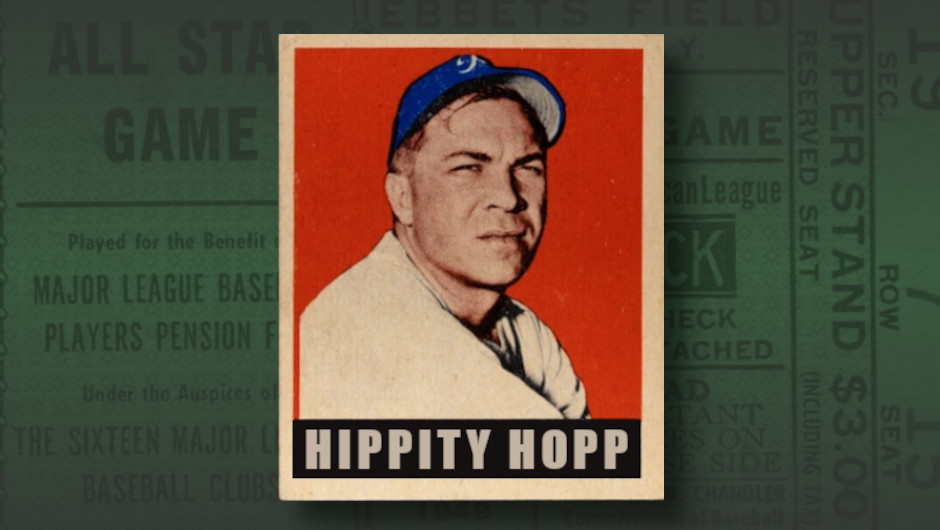
A quick glance at any baseball card produced by the Leaf Candy Company in 1949 reveals a focus on player names, a feature that was relegated to small print in almost every card brought to market before this time. These letters appear in large block letters against high contrast color block backgrounds, leaving no doubt in the viewer’s mind as to who the subject of this little bit of cardboard pop art was. The name was all you needed to know for the story to fill itself in.
Even then, spelling out a name could be an exercise in repeating oneself. You don’t have to fully write out “George Herman Ruth,” or even “Babe Ruth” for an audience to recognize the topic is the greatest baseball player of all time. A simple “Babe” would suffice, delivering the full payload of implied history and context in a single syllable. Nicknames are verbal shorthand for capturing a player’s essence, doing so with a poetic economy that echoes the clipped writing style of newspaper scribes and alliterative radio announcers covering the sport’s golden days.
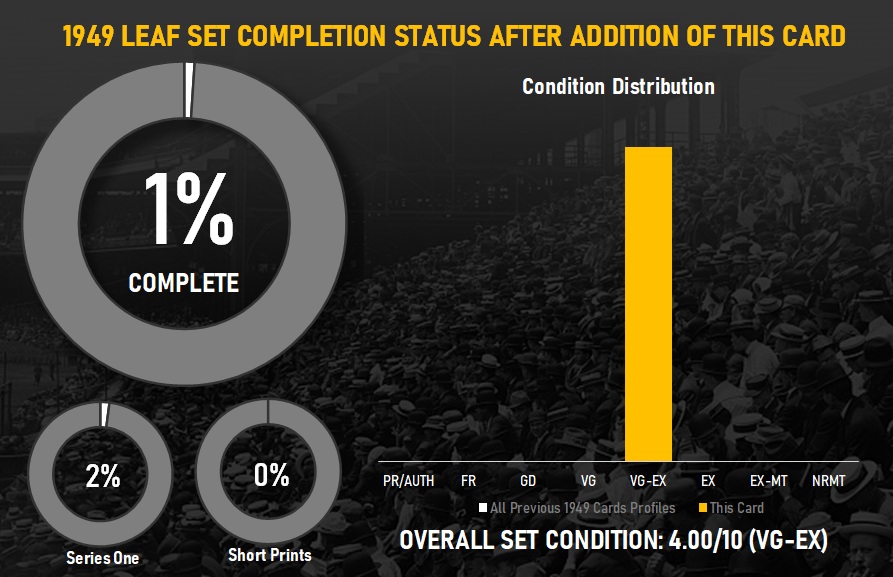
I am attempting to build a complete set of these brightly colored baseball cards. Like my other projects, this isn’t just one of acquiring bits of cardboard and stuffing them into a box. I want to know the stories behind the cards, and what better way is there to do that than to look at them through the lens of their subjects’ nicknames? The first of 98 nicknames I intend to explore belongs the Pittsburgh Pirates’ utility man Johnny Hopp.
Hippity Hopp
The one constant in descriptions of Johnny Hopp’s playing style is speed. He possessed a quickness that could only come from chasing rabbits across Nebraskan prairies. He starred on his high school track team before finding his way to into the labyrinthine St. Louis Cardinals’ farm system. He debuted in Class D ball in 1936, where he hit .361 and stole 36 bases. The next year featured a promotion to the AA-ball and another 33 swiped bags to his credit. His inability to remain still on the basepaths and an all out approach to taking the next base led locals to add the “Hippity” moniker to his name.
All this speed led Howell Stevens of The Sporting News to try and make a go of rebranding Hopp “The Human Motorcycle” in 1946. That’s the kind of impression left on a sportswriter after witnessing a speedy baserunner steal two bases in the same inning. However, with Hoppity having been entrenched in the public conciousness for a decade, Stevens abandoned the effort. As awesome as it is being known as a human motorcycle, one simply cannot beat a good alliteration. Certainly not one that had been in use for a century (first written use by M. J. McIntosh in 1845) and made its way into nursery rhymes styled after those of Mother Goose (1918 – Hippity Hop to Bed in The Peter Patter Book of Nursery Rhymes). The phrase “hippity hop” even made it into an odd musical number in the 1950 James Stewart comedy Harvey.
More than anything, what we have here is the personification of a rabbit turned loose upon the basepaths. Hopp would dart around the infield, seemingly unable to keep his twitchy, tightly coiled baserunning style still for any length of time. His legs turned singles into doubles. He routinely scored from first base on long singles and from second base could beat infield outs in a dash to home plate. In the rare event where a slide was necessary he would dive like a hare head first into the base. Johnny Hopp was in scoring position no matter what base he was on.
Tales of Peter Cottontail
Another term for rabbit is “cottontail,” given the short, white tail typically observed among North American species. The term is widely known and, due to the explosive popularity of the newly released (but unconnected) stories of Beatrix Potter’s Peter Rabbit and Thorton Burgess’ Peter Cottontail, would have been amplified around the time that Hopp and his siblings were first learning to read. If Peter Rabbit was to become known as Peter Cottontail, Hopp was destined to be known as a “Cottontop.”
Young Hopp had been given the anglicized form (John) of his father’s name (Johannes). In the same manner of countless others juniors, those around him soon adopted a nickname to distinguish who was being asked to pass the rolls at the kitchen table. Johnny’s extremely light blonde hair was a distinguishing feature, prompting others to refer to him as “Cottontop” and “Cottony” before regional dialects shortened it to a simple “Cotney.” Johnny formalized the informal after the birth of a son in 1944, naming him John Cotney Hopp.
Hippity Hopp on Cardboard
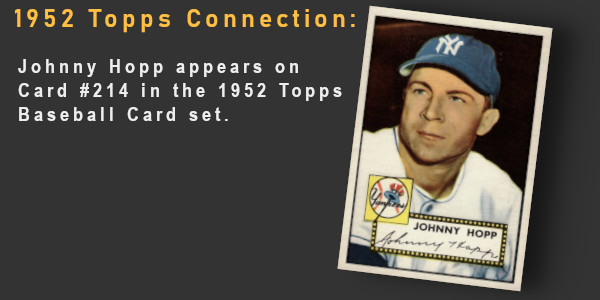
Leaf found its 1949 efforts to produce baseball cards to be in a losing battle with Bowman Gum Corporation. Both competitors produced cards that were a step above anything seen since the conclusion of the war, and while Bowman obtained an injunction to shutter Leaf’s printing press, it learned from its rival. Leaf’s prominent nameplates were so much of a selling point for consumers that Bowman’s adopted the practice immediately after banishing them from the market. Hopp appears in the late season sixth series as Card #207, and does so with “Hippity” prominently affixed in front of his last name.
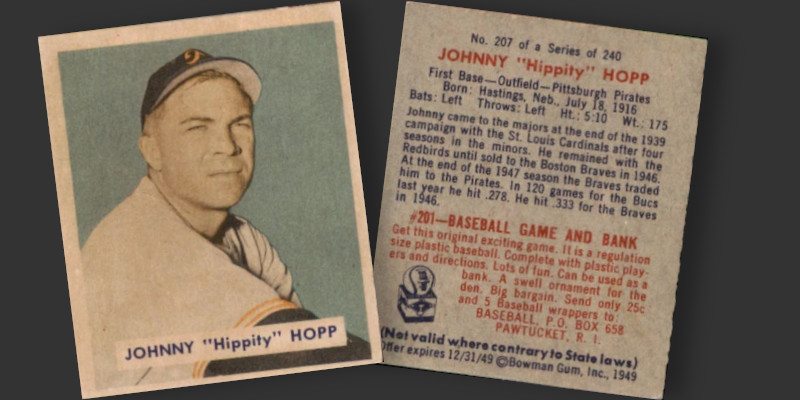
Bowman and Leaf were sharing more than just ideas about player identification. Both manufacturers utilized the same photograph to portray our rabbit-themed baserunner. The image appears to come from a pregame June 17, 1948 photo shoot at the Polo Grounds in New York. Hopp is seated at the top of the dugout steps, holding a bat at his knees and gazing up the left field foul line towards the photographer.
Leaf got to the photo first, electing to crop it as a tighter shot than Bowman and making use of greater contrast. Both cards mention his .333 batting average for 1946, with Leaf describing the mark as “nifty.” Neither card mentions his finishing second in triples in the 1948 season, with those dozen hits counting among the exactly MLB 1,000 hits to his credit at the time the card was released.
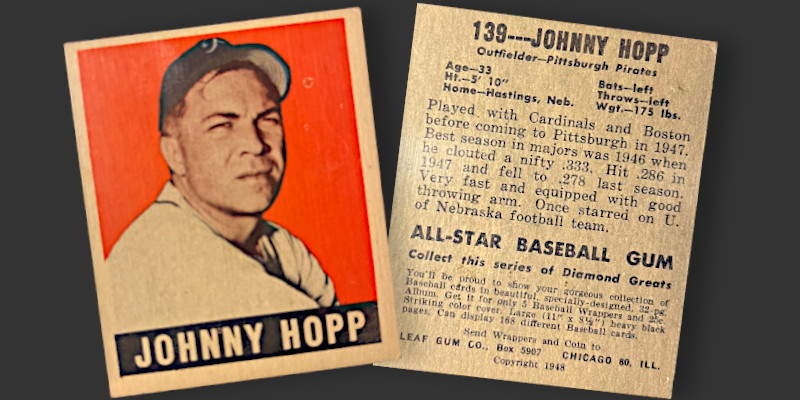
Pictured above is the very card that started me on this set building quest. This is the first ’49 Leaf I have ever owned, and initially purchased it as a “Type” card – one to have in my collection as an example of what a random card from this set looks like. Before long I was working on building a seemingly impossible set and learning that almost every card has multiple versions available. The one in my possession comes from the more plentiful variety, cards with a good deal of black ink used to indicate texture and shadow on ballplayer caps.
It’s amazing the speed at which this card made its way into my collection. I started out chasing cards from 1993 and 1952, only to expand my interest to 1949 three years later. I acquired my Hopp card on a whim and within two months had added another pair of ’49 cards to my stack. Soon I discovered the ever unfolding nuances of this set and the countless variations to be found within a deceptively compact checklist. Now these cards are multiplying like rabbits.