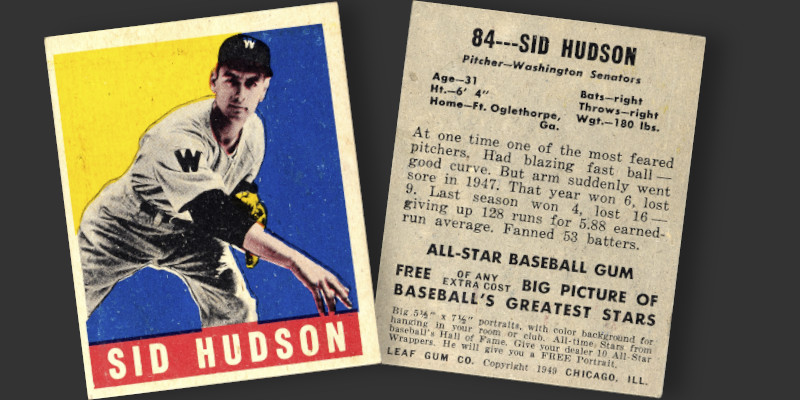
There’s a particular cruelty to baseball cards printed during a player’s decline. The 1949 leaf Sid Hudson card doesn’t dance around the subject. “At one time on the most feared pitchers,” it begins, and you can hear the grim author striking the typewriter keys as he continued to commit Hudson’s fall from grace to posterity in the past tense. “Had blazing fast ball — good curve. But arm suddenly went sore in 1947.”
The rest reads like a coroner’s report: “Won 4, lost 16, gave up 128 runs for a 5.88 earned run average. Fanned 53 batters.” The card was printed in 1949, a year that would see Hudson rack up 17 losses. If you squint hard enough at the statistics, you can almost see his career dying in real time. Time of death: 6th inning with runners on the corners.
Here’s the thing about Sid Hudson that the overly honest Leaf editorial staff didn’t capture on the back of that card, probably because there wasn’t enough room between the funereal stats and the player vitals: Sid’s career had previously been declared dead on arrival and had successfully been revived.
Enter Bucky Harris.
Harris himself was forged in conditions that would have broken others. When his father abandoned the family at age thirteen, Harris had to drop out of school and become a coal colliery slate picker at twelve cents per hour. Twelve cents. Disposable kids like Bucky populated such roles with hands deft and small enough to reach into fast moving chutes that grown men couldn’t reach, all for coins that wouldn’t buy them a sandwich by modern standards. It was dangerous work, even for adults. My paternal grandfather died in an industrial accident in one of those Appalachian mines. Harris earned a promotion within a year, giving you some sort of idea of how he handled himself amid unforgiving conditions.
His path from the coal mines to professional baseball sounds unbelievable. An undersized teenager, he was spotted playing in a local exhibition game against a group of barnstorming New York Yankees. He signed a minor league contract, was quickly released, and was then accidentally signed by the Reading Pretzels when the club mistook him for Merle Harris, his already established brother in Class D ball. The Pretzels had meant to sign one Harris and got the other.
A Washington Senators scout eventually signed Harris after witnessing him play through a game with a broken hand. The Senators ownership had decided their current roster was lacking in work ethic and was actively seeking grittier players. Harris, no stranger to coal dust and playing ball with a fractured hand, certainly fit the bill. He was soon getting regular playing time and gaining attention for intelligence and leadership far beyond that of his teammates. At age 27, owner Clark Griffith promoted him to the role of full-time manager, making him the youngest in the sport’s history to hold the role on a permanent basis. Harris led the Senators to their first ever World Series championship the same year, easily surpassing the losing record of the prior season. His decision making was aided by high emotional intelligence that would eventually bring a call to Cooperstown in 1975.
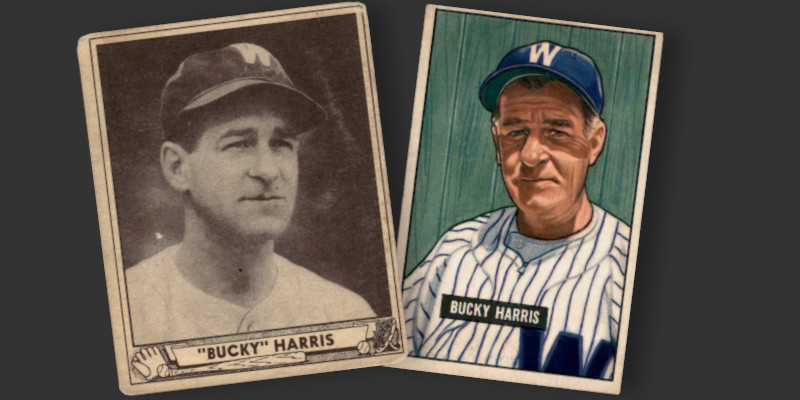
By the time Sid Hudson arrived in the major leagues, Harris had refined his managerial philosophy into something approaching an art form. He looked at 24-year-old Hudson, fresh from the minor leagues, and decided the best way to break him into his new role was to not break him in at all. Harris gave the rookie pitcher a starting role and kept him on the mound until Hudson learned to pitch at the major league level, which is either brilliant foresight or criminal negligence depending on how it turned out.
In Hudson’s case, it worked, but only a rocky transition period. Hudson’s hometown Chattanooga Daily Times noted that Harris had “always been Hudson’s Number One Rooter,” refusing to place him in a bullpen role despite an initially rough adjustment to the majors in 1941. He lasted. Hudson started 33 games that year and fully completed 19 of them. He pitched through the struggles, bad outings, and moments when conventional wisdom would have suggested giving the kid a break or moving him to lower leverage situations. Harris refused, backed by nods of approval from Griffith and coach Benny Bengough.
Harris almost achieved baseball immortality that year when he held Joe DiMaggio hitless in 2 at-bats during DiMaggio’s 56 game hitting streak. DiMaggio, who batted .408 over the entirety of the run, faced reliever Red Anderson and looped the final hit of the streak to left field after Hudson was pulled for a pinch hitter.
Harris may have seen something of himself in Hudson’s background. Sid’s father had died when he was seven years old, creating the same kind of family crisis that had defined Harris’ youth. Hudson eventually quit school to support the family as a bag boy in a local grocery store, trading education for the ability to keep food on the table and roof overhead. He played for amateur teams in his spare time, whatever spare time a working kid could scrape together, and was eventually signed to play first base for a Class D minor league team. He was a first baseman of middling ability in a league full of middling ability players when a new manager named Rodgers was hired. He brought his favorite first baseman along, and a dejected Hudson rode the bench until the new skipper decided to throw the surplus infielder into mop-up pitching duty during a blowout.
“Raw Meat” Rodgers possessed an incredible nickname that offered a disturbing window into both his dietary preferences and his willingness to reduce new recruits to their most basic elements. He threw Hudson into a game that was already lost, and Hudson responded by striking out the side for two consecutive innings. With six up and six down on strikes, Rodgers realized he had a potential pitching prospect on his hands rather than a subpar Class D first baseman. The next morning Rodgers was teaching Hudson the mechanics of pitching on a bullpen mound. Hudson’s career pivoted on a blowout loss that nobody remembers, witnessed by dozens of people who have all long since died.
By the time Hudson reached the majors and fell under Hudson’s protection, he had already experienced transformation and resurrection. Harris understood this instinctively as a journey he had made himself. The nickname “Bucky’s Boy” soon emerged in newsprint to describe the developmental grace allowed to Hudson and the manager’s stubborn refusal to demote a struggling rookie when giving up would have been the easier path. Five months into his MLB debut Hudson was sporting a losing record and an ERA north of 5.00.
Hudson called Harris “the greatest in the business,” which coming from a player about his manager carries weight that generic weight praise never could. This wasn’t corporate speak or some diplomatic nicety. He knew what Harris had done for him, understood that his career might have died in 1940 if a different manager had made different decisions.
The relationship between Harris and his players was widely known. Hudson’s former teammate Walt Masterson knew Harris’ style intimately, and years later when playing for the Red Sox, he learned that a trade was sending teammate Ken Wood to Washington. Masterson begged Wood to convince Harris to trade for him and to bring him back into the fold. Such tales of wanting to become one of “Bucky’s Boys” became a recurring theme among those who played for Harris. In a sport where players were routinely treated as interchangeable commodities, Harris had created something different.
Hudson twice earned All-Star selections, validation that his manager’s faith had not been misplaced, that the struggling rookie of 1940 had become a genuine frontline starter by the summer of ’41. It was in this sophomore period that he earned one more nickname after an abrupt mid-season transformation from losing pitcher to one who dominated. Reporters called him “Cinderella” following a contest in which he outdueled Lefty Grove in a 13-inning, 1-0 shutout victory. Grove was heading toward the Hall of Fame as one of the greatest southpaws of all time, and Hudson beat him in a pitchers’ duel that lasted through hours of scoreless tension before the Senators could push across a single run. The Cinderella nickname captured the fairy tale quality of Hudson’s rise, the magical transformation from grocery bag boy to Class D benchwarmer to major league All-Star. The problem with Cinderella stories, of course, is that magic eventually wears off and you’re left standing in the dark with one glass slipper and a rodent infestation.
World War II arrived and Hudson was drafted into the Army Air Force. He spent much of his service as a calisthenics instructor, leading repetitive exercises day after day, and by many accounts he wore out his arm through three years of constant use. It’s grimly ironic that his role, which spared him from combat but not from sacrifice, destroyed the very tool that set him apart. The war took four years from his career, removed from baseball during what should have been his prime, and returned a damaged version of what had been.
The postwar years were brutal. Hudson tried to pitch through an arm that no longer cooperated, that had lost the blazing fastball and sharp curve that made him one of the top hurlers in the American League. His ’49 Leaf card captured this decline with almost documentary precision, stating facts in past tense like they were writing an obituary for a player who was still technically alive and employed. There’s no soft-pedaling in those statistics, no attempt to make the situation seem better than it was. At one time one of the most feared pitchers.
Had a blazing fastball. Had. Past tense. Gone.
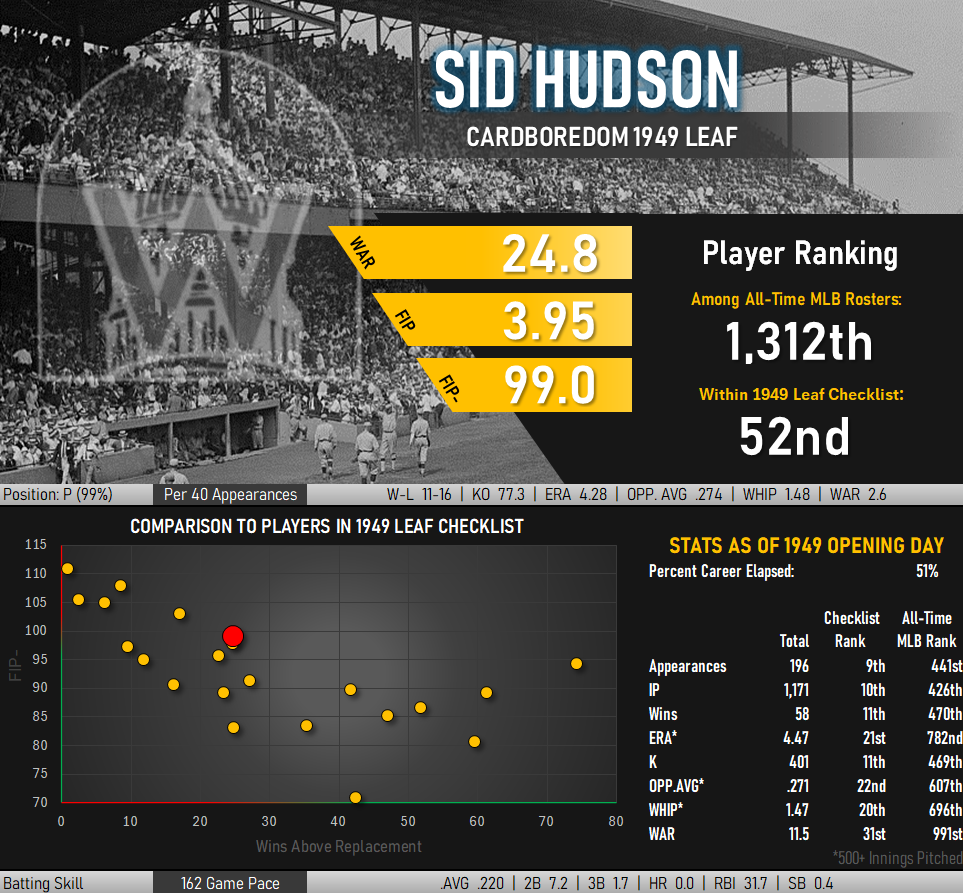
Yet, somehow, this was only halftime. He had one more resurrection in him. Hudson had only made 51% of his total career appearances when this card rolled off the printing presses as something that could have been a career sunset card. He stuck around through 1954 using the arsenal of assorted junk pitches learned by every aging veteran who no longer possesses their best stuff.
After his playing career finally, mercifully ended, Hudson went into coaching and continued for decades, eventually retiring at the age of 77. He spent that lengthy coaching career mentoring struggling pitchers in much the same way Bucky Harris had mentored him, paying forward the patience and faith that had saved his own career. Harris had learned leadership in coal mines and minor league dugouts, had refined it through managing teams to championships, and had passed it on to Hudson. Hudson had received that gift and spent the next several decades giving it to others, teaching young pitchers not just how to throw a curveball (he invented a machine for that), but how to survive when things went wrong and refuse to quit even when doing so made logical sense.
“Bucky’s Boy” might sound diminutive or even insulting on its surface, the implication that Hadson owed his success to favoritism rather than talent, but anyone who understood the relationship knew better. Hudson was Bucky’s boy the way all of us are shaped by the people who refuse to give up on us when we’re struggling and see potential when we don’t see it ourselves. Harris had been nobody’s boy, had clawed his way up from coal mines through broken hands and mistaken identities and sheer relentless determination. He could’ve managed with the same hard-edge ruthlessness that defined his own journey and could’ve treated players as disposable the way he had been labeled by his father. Instead, he chose patience, building people up rather than simply using them up.