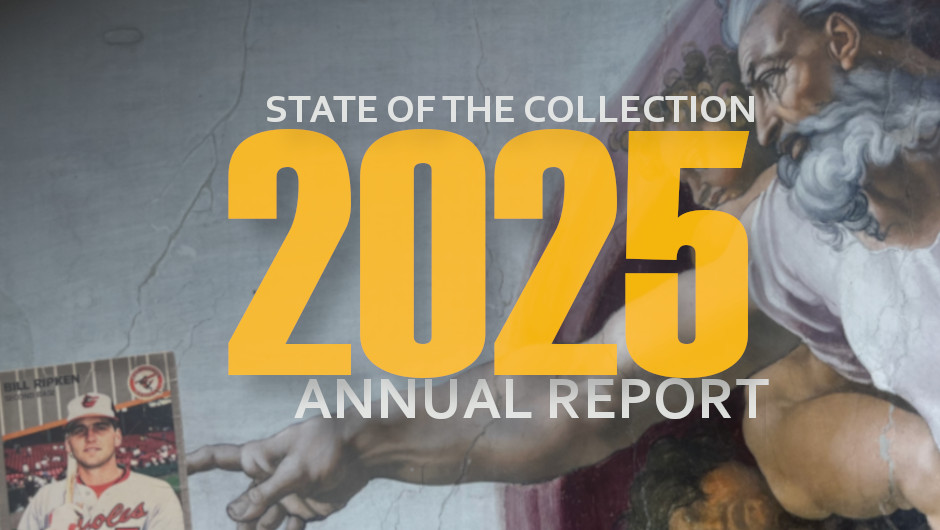
Welcome to the second installment of the Annual Report on the State of the CardBoredom Collection. The themes for this year turned out to be ones of measured progress towards set completion goals, continued elimination of non-core items, and the capture of my collecting white whale. As one of my ever-present wallet cards hint in the photo above, I also grew a “yeard” during this period, concluding the one-year mark on December 21 looking a lot more like Captain Ahab then when I started.
Collectors tend to throw around the term white whale quite a bit. In my mind a card earning this moniker must be so seldomly seen that one begins to wonder if one will ever become available or if they truly exist beyond singular examples. I have had two cards take up this mantle, the first being an obscure Donruss test issue that was secured in 2024. The second, which was sighted this year, is an ultra scarce regional food issue featuring Athletics pitcher Charlie Bishop, a distant relative of mine. I’ve seen a couple poor condition examples surface from time to time, but either wasn’t in a position to make a purchase or decided against paying almost four figures for a card that was previously submerged in hot dog juice. What is driving the scarcity, and more importantly, why is hot dog juice part of the story?
The card in question is from the 1955 Rodeo Meats set, an issue that released in the Kansas City area to celebrate the recent relocation of the Philadelphia Athletics. The cards saw limited geographic distribution and were only available inside packs of hot dogs. The cards that survived that greasy bath had to get past mothers dubious of handing these salmonella delivery vehicles to their children and the innate urge to throw any inedible part of hot dog packaging into a campfire.
Not only that, Rodeo had tried to keep up with the changing roster of the A’s. Multiple print runs were employed with some names eliminated when they were cut from the roster, including Bishop. What we have here is an already rare set with limited distribution and systemic condition flaws affecting almost the entire print run, combined with the added bonus of the one card I sought having been pulled from production well before the others (T-206 Honus Wagner vibes). The card was so obscure that a popular 1976 reprint of the set completely overlooked the Bishop card.
And. It’s. Now. Mine.
Here it is:
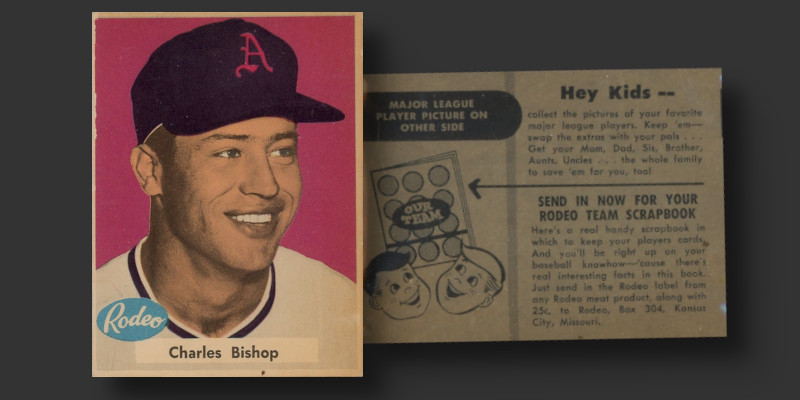
This spring I saw the finest known full set consigned to one of the big auction houses. I watched the bidding sail way beyond my league and moved on. A month or so later I learned that a card shop in the midwest had been the buyer and was breaking up the set. Minutes after finding this out I secured the card and had a tracking number showing it enroute to my mailbox. Not only did I finally land an example of one of the toughest cards I have ever chased, I ended up with the copy in the best known condition (VG-EX). PSA has seen three other copies of this card, with the others topping out at Good condition.
Card of the Year Runners Up: 1955 Topps Double Headers Hal Newhouser/Some Other Guy
Taking its spot as a runner up for Card of the Year is an item from the quirky 1955 Double Headers issue, a novelty item issued by Topps featuring two players on each card. These oversize cards were modeled after the T-201 Mecca Tobacco issue from 1911. Like their turn of the century counterpart, the front features a large, brightly colored drawing of a player in an action pose. The back features statistical tables and a pair of biographical sketches alongside a smaller image of another player. These secondary images could be folded along a perforated line so that they partially overlapped the image on the other side. Both images are aligned so that the bottom half of one image matches seamlessly with whichever image is overlaid across it.
The card inhabiting my collection features a pair of pitchers in their final year of service. Hall of Famer pitcher Hal Newhouser is shown warming up for the Cleveland Indians as the cards primary subject, but it is the presence of his Kansas City Athletics counterpart on the back that brings this card to me. Portrayed on the back is the now familiar face of Charlie Bishop.
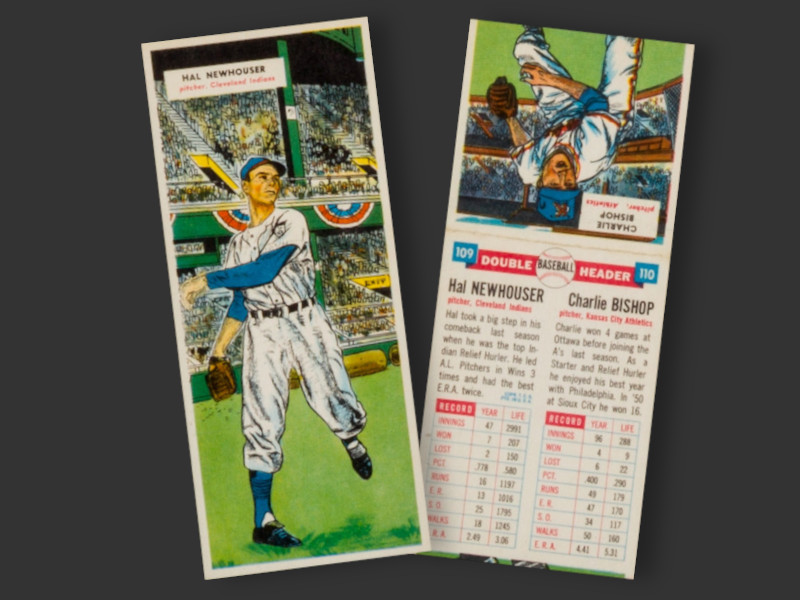
The family connection gives this piece of cardboard a bit of pedigree, but in true Double Header fashion, this specific example carries a second pedigree. This card previously resided in the personal collection of Herky Rupp, son of Hall of Fame University of Kentucky basketball coach Adolph Rupp. Herky had been an avid sports card collector throughout his life with a focus on completing sets in high grade. He passed away in 2016 and a large portion of his collection was sold by Heritage Auctions earlier this year. This included a complete set of 1955 Double Headers, which was subsequently broken up and sold by the buyer.
I acquired the Newhouser/Bishop card during this distribution, replacing the existing GD-VG example already in my collection with a spectacular SGC 7.5 NM+ example. The card carries the second highest grade seen by the major grading services, trailing a handful of NM-MT 8’s by just half a point and perfectly slotting into my goal of assembling the finest collection of Charlie Bishop cards.
Runner Up Number Two: 1952 Topps Pee Wee Reese
My mail carrier encountered a lot of packages heading in opposite directions in 2025. The crosscurrents of downsizing and new additions were both present, as well as a few purchases of larger lots that were parceled out into stacks of “needs” and “duplicates.” This card of the Brooklyn Dodgers captain Pee Wee Reese was one of four 1952 Topps high numbers that joined my collection in just such a manner.
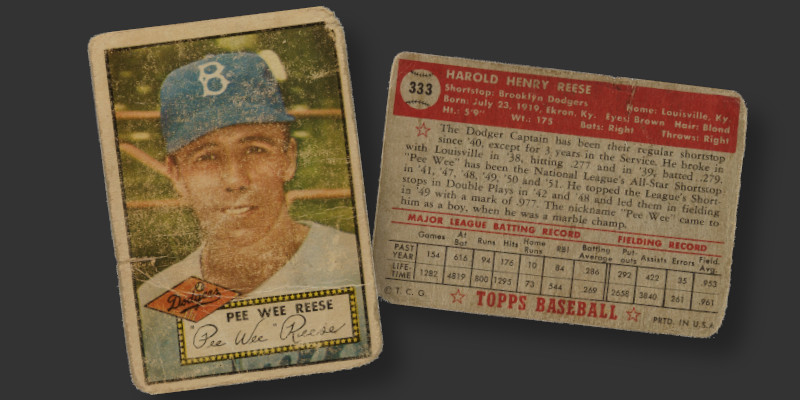
This fall I encountered a lot of more than a dozen tough but absolutely thrashed high numbers being sold. Reese and three commons were on my want list, with the rest already having been checked off my list. Doing some quick math, I found the breakup value of the lot to likely be high enough to effectively gain the Reese card for less than I have been paying for some commons. The lot was purchased and by the end of the month the duplicates had been sold and sent onward to new owners. [Fun Fact: Five of the duplicates were sold to a well-known card dealer in Los Angeles who turns out to be using Seinfeld character aliases to mask the identity of accounts through which he makes acquisitions].
Of course, it’s not the bargain that makes an acquisition worth talking about. The importance of this card to my collection as a Hall of Famer in the high number series would guarantee its placement in my top three regardless of price. I mention the transactional aspect because without it, this card would still be a far away object on my collecting wish list.
Wallet Cards
Ohhhh…this has been a fun one in 2025. I started out the year by selecting a pair of themed cards to slowly destroy by carrying them around in my back pocket. The cards both feature guys whose last names end in “-ipken,” and given a rather over-the-top itinerary of excess I think I nailed the selection of the two most relevant cards to this theme. Read the introduction of these cards if you haven’t already done so.
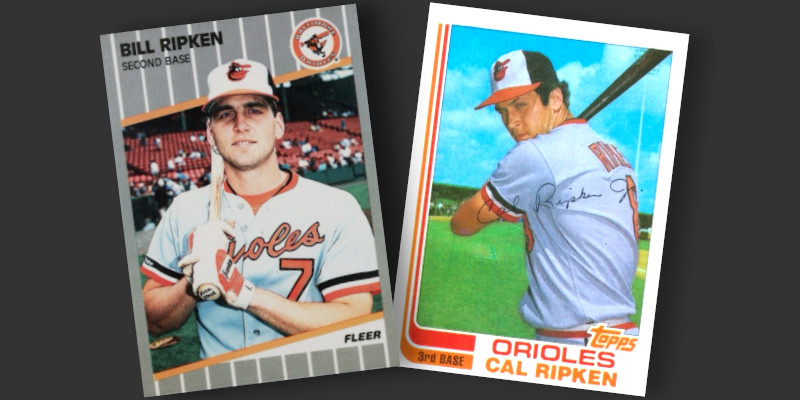
Billy was the star of the show, getting photographed in all kinds of adventures (summiting a volcano, a near air disaster, getting creased by a nun, and an epic birthday surprise) before becoming a biohazard when one of my favorite bands got their claws on it. His brother Cal, sensibly left in the car for Billy’s final adventure, lived up to his Iron Man reputation by finishing out the year in his brother’s place.
The full story (and pictures!) will be posted when new wallet cards are unveiled in February. The new cards have been selected, and though they remain shrouded in secrecy, I will tease a few details to keep you guessing. Like 2025’s cards, I plan on sticking with two pieces of cardboard. Billy Ripken’s handwriting on a baseball bat proved to be a bit chaotic, so 2026 will be toned down in favor of…a critique of someone else’s handwriting? The 2026 wallet card nominees were issued decades apart and gained their fame not from on-field exploits, but rather from penning an influential book. Unlike the -Ipken cards, neither of these unassuming wallet cards should draw curious onlookers despite the fact that one is autographed. And why would I wreck a perfectly good autographed card? Let’s just say I have some disdain for half-hearted penmanship. Billy was at least legible.
The stack of cards that will eventually be subjected to the Wallet Card treatment grew quite a bit this year, filling out a full roster for this annual project through my 50th birthday. There are a couple of monster cards in this stack, each with technical flaws or evidence of micro-trimming that ruin the fun for high grade collectors but making these imperfect cards ideal for my purposes. A vintage O-Pee-Chee card is also in the mix, so hopefully I can figure out how to involve it in travel to Canada at some future date. Topps, Bowman, Donruss, and Upper Deck all made appearances in this latest round of additions.
Collection By The Numbers
In 2025 I reduced the size of the collection from 866 cards to 740. The elimination of a sizeable stack of trimmed early 1950s commons increased the estimated overall condition of the collection from 3.8/10 (Very Good) to 4.8/10 (VG-EX+). The ratio of slabbed cards within the collection was little changed, edging up to 45% as a function of thinning out selected items. Importantly, this pruning improved the overall percentage of cards meeting my stated collecting goals from 79% of the collection to 92%.
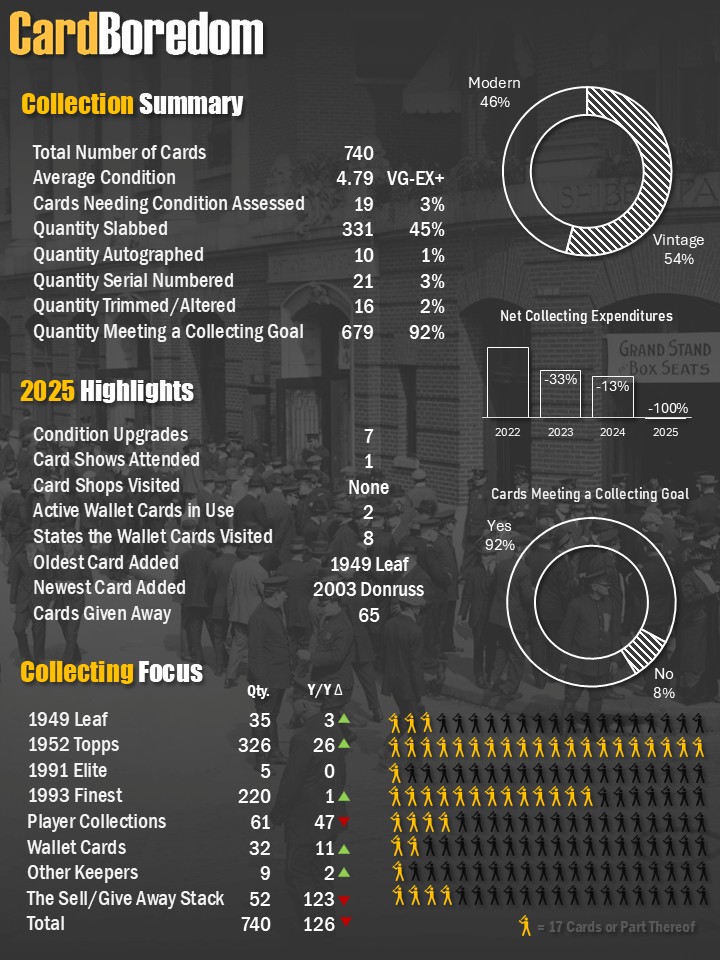
One of the outliers visible in this summary is the complete collapse of net expenditures on baseball cards. I still spent my allotted budget on building out the collection, but saw an even larger amount return in the form of proceeds from recycling duplicates out of a purchase of 1952 Topps high numbers and liquidating the high grade portion of my Jose Canseco player collection. The net result was a modestly positive cash flow contribution to the household budget rather than the usual dedicated outflow. The excess was redirected towards family activities and I will be starting the collection’s fiscal new year from scratch.
The goal for 2026 will be to fill in a few easy wins with commons in the ’52 Topps checklist and to make a run at one of the remaining big cards from my want list in the back half of the year. As you’re about to read, I found my collecting white whale in 2025 and no longer see structural scarcity as an impediment to any of the remaining cards I am seeking. Slow and steady now supplants serendipity in card sourcing strategy from here on out.
Progress Towards Specific Areas of Interest
How did these three cards and the others that came in during 2025 help my collecting goals?
1993 Finest Refractors
You would think that a completing a full set of these in 2024 would keep me from adding any more shiny cards to my collection. Nope! Not a chance.
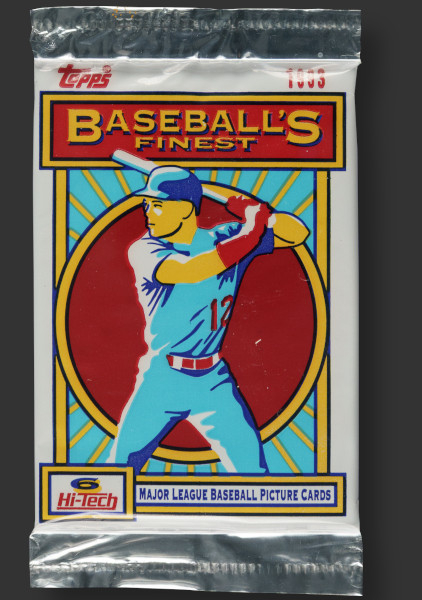
I picked up an unopened pack this summer and plan on keeping it sealed alongside the set. This one came sealed inside a PSA slab. I’m at a bit of a loss as to how they grade packs, but at least the slab keeps it from getting bent up in my storage box.
This particular pack does not have a refractor in it, a fact belied by an element in the design of the foil wrapper. I plan on walking you through how to identify which packs contain these shiny parallels in the coming months, as well as all sorts of details about the collation process and other aspects of unopened ’93 Finest material.
1952 Topps Set Building Project
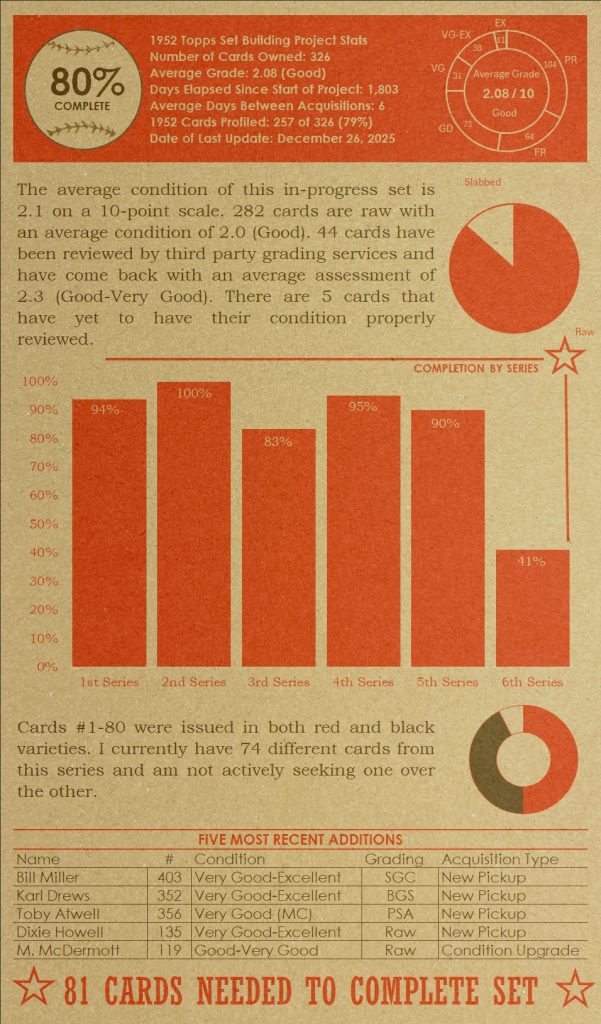
This project is where the bulk of my set building progress took place in 2025. I crossed 26 names off the checklist since my last report, bringing overall set completion up to 80% (and 93% completion excluding the difficult high numbers). The new additions included 9 high numbers, significantly boosting the completion status of those final 97 names in the checklist. New acquisitions joined the collection with an average grade of 2.45/10 (Good-Very Good), once again incrementally raising the overall grade of my in-progress set by a few hundredths of a point.
In addition to these cards, I changed out 7 lower grade cards for ones with better visual appeal. I even added a “downgrade” in the form of a duplicate Monte Irvin that I want to hold onto. The card had an odd series of type-written numbers affixed to the back. At first I thought this to be some sort of ascension number, the numerical identification of an item belonging to some sort of museum or library inventory control system. After searching for reports of missing cards from public institutions, I belatedly realized that the numbers on my card can be spliced in such a way as to match Irvin’s 1952 statistical performance. A collector in the 1950s had apparently used a typewriter to append the stats on the back of the card and left off the visual cues that make for easy reading of tabular data. Operator error on my part – nothing to see here – move along.
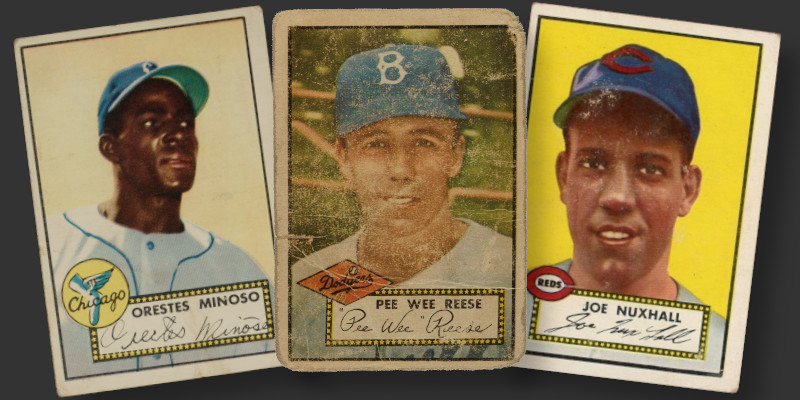
The highlights among these new arrivals are concentrated three cards. The biggest card of note is the high number Pee Wee Reese described earlier, a card combining Cooperstown notoriety with Brooklyn Dodgers nostalgia and the scarcity of a sixth series release.
Joining it from the high series is a fair condition Joe Nuxhall, which as the next to last card in the checklist exhibits the kinds of condition scarcity issues that plague the set’s better known Eddie Mathews rookie. It’s a card that has proven challenging to find at a reasonable price and I was glad to finally track one down that didn’t look like something given to the dog in The Sandlot.
Wrapping up the big three pickups is the final star player needed for my lower series set; Minnie Minoso. Not only is this a card of “The Cuban Comet,” it is his Topps rookie card. I had a poor condition example of this card when I was a teenager and have been looking for a suitable replacement for quite a while. This happened to be auctioned off at the same time as multiple higher grade examples, leading higher end collectors to fight over the others while I picked off the one matching the overall grade of my set.
1949 Leaf Set Building Project
Picking the top three additions to my 1949 Leaf project proved fairly easy: That is the exact number of new cards I picked up.

Two of the cards even carried a theme. Cincinnati’s Kent Peterson and Brooklyn’s Gene Hermanski are known to fans of the set as having two of the three most recognizable variations in the checklist. Peterson’s card is available with either a black hat (like mine) or a much scarcer red hat. Hermanski’s card can be found with or without the letter “i” at the end of his name. Once again, the example in my collection reflects the easier to find correctly spelled version.
The big highlight for the year is a very well centered, excellent condition card of Luke Appling. Appling fell a few hits shy of batting .400 in 1936 and, though he never clubbed more than a half dozen home runs in any one season, managed to take Warren Spahn deep at age 75 in a 1982 Old Timers Game.
Finding ’49 Leaf cards in the wild is always fun. Every now and then I am fortunate to come across a stray example in a common bin. I added three additional low grade duplicates this year and put them into the rotation of cards getting mailed out to other collectors. Let me know if you need a Larry Jansen card or a Sam Vico rookie.
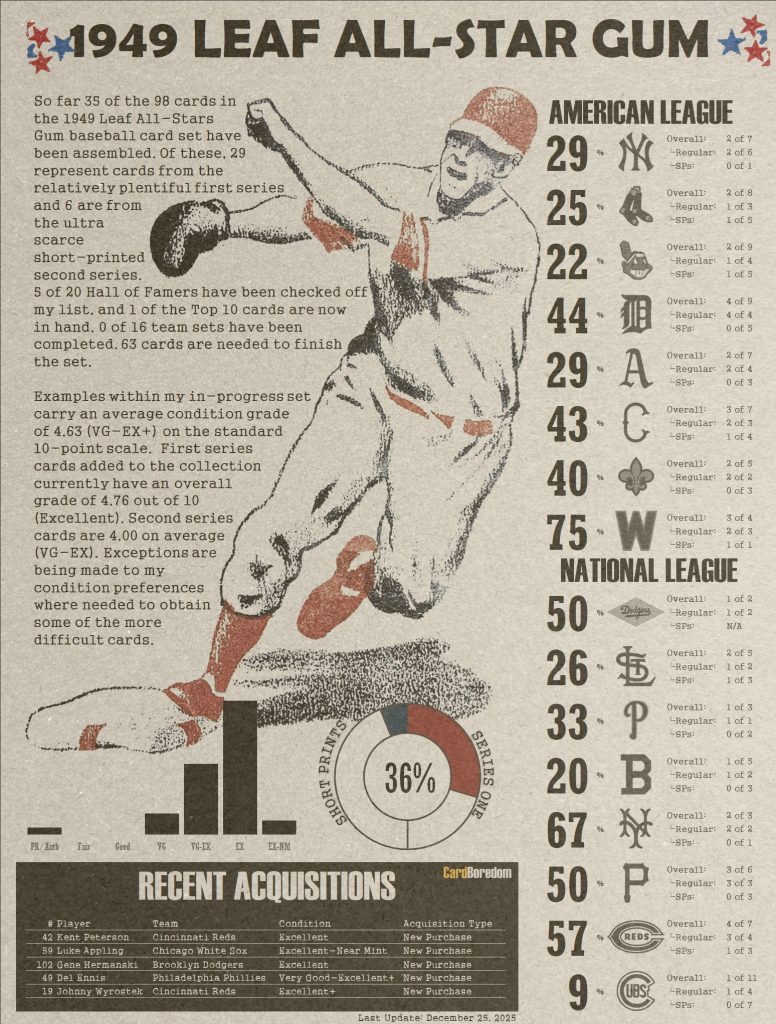
It wasn’t so much the addition of new cards that moved my progress metrics forward with this set as it was finally getting started on writing about them on CardBoredom. An infographic like the one below is now routinely updated on a page dedicated exclusively to this set building project, along with links that will fill in as more information is published over the coming months.
Player Collections
With two of the top three overall 2025 additions hailing from the player-focused region of my collection, you just know this section has to be good. I’ve already introduced the Rodeo Meats and Double Headers Charlie Bishop cards. In addition to these cornerstone pieces of my Bishop collection, I added 15 additional examples of his 1953 Topps rookie card. While most of these are of the quality one would expect from the heavily discounted common bins from which they are typically found, I did manage to land one with a PSA 7 Near Mint designation. With this I have more or less completed my run of Charlie Bishop cards (though there still remain some oddball stickers and ephemera to chase).
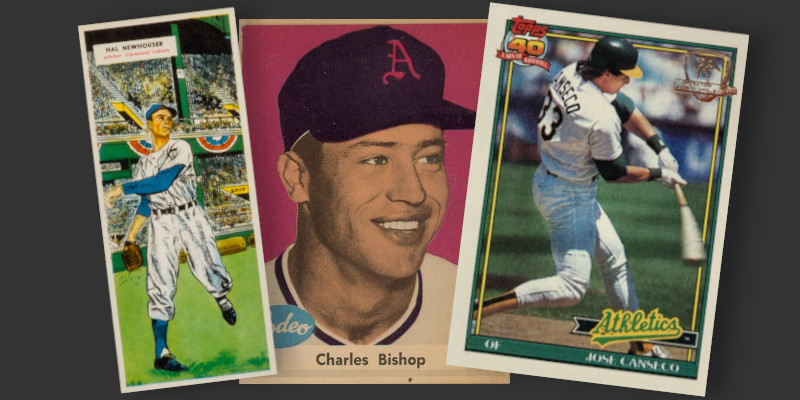
Rounding out the top player collection cards of 2025 is the other subject of my player-focused collecting: Jose Canseco. Jose was the first recognizable player I ever pulled from a pack of cards and I still seek out his cardboard. The key addition to the Bash Brothers portion of my PC is the 1991 Topps Desert Shield card shown above, combining my favorite Junk Wax Era player with what I will cheerfully argue is perhaps the greatest Junk Wax Era set. The card has a fantastic story (issued as wax packs to soldiers stationed overseas in an active conflict), some of Topps’ best photography, the manufacturer’s best flagship design in a generation in both directions, a set building challenge (no factory sets), and true scarcity that was structural rather than artificial.
The card is emblematic of just the sort of Canseco-themed cardboard I enjoy adding to my collection, a practice that was moving along quite nicely at the start of the year. This collecting contentment hit turbulence in the summer after I got a bit aggressive in pursuing a pair of Canseco cards. Both had been graded Gem Mint 10 and I got too competitive in the pursuit, ultimately paying fairly stiff prices. The nominal price tags didn’t damage my collecting psyche on their own. Rather, every time I looked at them (and the rest of my similarly slabbed Canseco cards) all I could see was the total estimated value and unfavorable comparisons to the nicer cards I could have had instead. Each had been “worth it” to add individually to my collection, but I realized their collective financial heft was tying up the funds that could have knocked out any piece of cardboard that I could want short of a ’52 Mantle or ’49 Satchel Paige.
Once this conclusion had been verified as being more than a passing thought, I identified my 10 favorite slabbed Cansecos, set them aside, and proceeded to liquidate the rest of the ones locked up with PSA 10 labels. Four financially aggressive Canseco superfans picked apart the 64 cards I turned loose on the market, ultimately providing enough proceeds to flip my net 2025 card spending into a negative figure, generating cash for current and future pursuits. I am optimistic something much better will replace these cards in 2026.
Other Priorities
Once again, no progress was made towards completing the 1991 Donruss Elite set. For the second year in a row I am unmoved at the 50% completion mark. I am seeing more come up for sale than in the past, but the really nice condition ones I seek are still commanding prices above my target range. I plan on picking up a wax box of ’91 Donruss if I come across one at a card show but am otherwise focusing elsewhere until interest cools to more manageable levels.
Upgrading the Infrastructure of CardBoredom
As I alluded to in last year’s retrospective, documenting cards and building CardBoredom is as much a hobby as collecting cards itself. In 2025 I wrote my 500th post, discussing the Willie Mays card in my 1952 Topps set building project. Some basic analytics were installed on the back end, providing the surprising insight that a brief post from 2021 about the production run of 1991 Donruss cards is somehow the site’s most visited page. I don’t consider it groundbreaking, entertaining, or even relatively good compared to other parts of the site, but the bots sure love it. I must have accidentally hit on some sort of search optimization technique on that one.
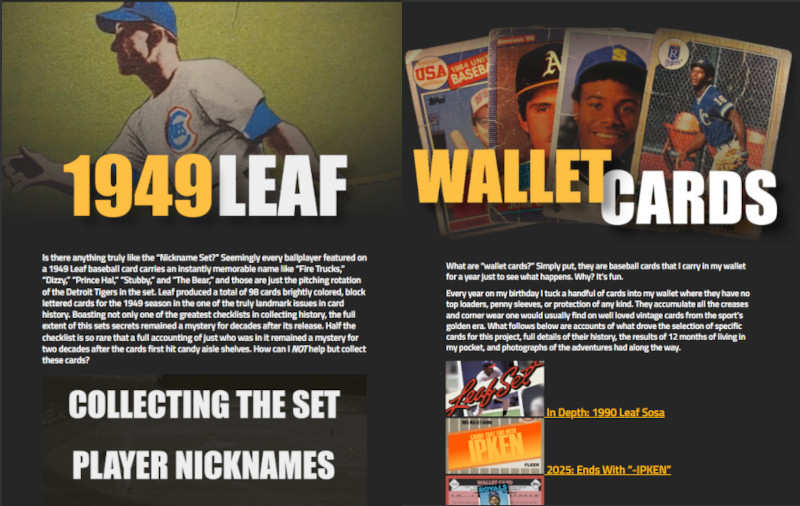
This year saw the introduction of a few minor upgrades across the site. I tightened up the visual look of the logo and made some adjustments to the site’s primary fonts. Navigation was simplified with the addition of top-level landing pages for Wallet Cards and the 1949 Leaf set. There’s a lot I want to improve visually on these. I will continue to tinker with both in 2026 but wanted to get some of this functionality rolled out before it gets buried by whatever else pops into my head.
Some time ago I introduced the player infographics that inhabit so many of the pages on this site. I’m happy with their look, but saw these images contained a distracting, single pixel-wide line along two borders of each file. This year I went back and wrote a script to edit each image so that the lines were removed. I’ve gone back and replaced the existing images with the new ones on most pages, but still need to go back and root out the stragglers. Low priority but slowly getting there.

There are some more changes in store that require a more robust test environment. I’ve set up a test domain and will play around with some things there rather than break something on the live version of CardBoredom. I don’t know at what point these features will be seen by readers here, but am confident that some additional improvements will be forthcoming.
2025 CardBoredom Posts by Subject:
| 1952 Topps | 36 |
| 1993 Finest | 23 |
| Wallet Cards | 5 |
| 1949 Leaf | 2 |
| Player Collections | 1 |
| Updates/General Info | 1 |
2025 GOALS
In 2024 I listed 8 collecting goals for the new year and completed 5 of them. In 2025 I again completed 5 goals, but fortunately for my ego I had only publicly committed to chasing 6 goals during the year.
Goal 1: Spend less than $120 on building my collection in the first six months of 2025
RELATIVE SUCCESS. Did I spend less than $120 in the first 6 months? No. Finding your collecting white whale has that kind of effect. However, there was indeed a 6 month (actually 8 month) stretch where card collecting outlays were not only below $120, they were in negative territory. I thinned out items at the periphery of the collection and jettisoned a stack of completely unnecessary PSA 10 Canseco cards. While I didn’t hit my goal in the strictest terms, the underlying spirit of spending less while making the collection more concentrated was more than met.
Goal 2: Find new cards to give away, mailing out packages to at least six collectors who consistently write about their collection over the course of the year
GOAL EXCEEDED. This worked out well. My own collecting interests are rather narrowly focused. Reading about others’ interest allows me to continue enjoying searching for cards even when it is evident nothing is available to fill spaces among my own boxes. Sometimes these packages were a single card. Sometimes they were many cards. Vintage cards are the usual staple of these envelopes, though a mix of different eras pop up now and again. There were forays into sending unopened material and hockey cards. And, for those new to this, you’re supposed to send any Tim Wallach cards you come across here.
There were a few other cards sent to collectors no longer actively writing, including a handful sent anonymously in plain white envelopes postmarked from distant locations that I had a chance to visit. Amazingly, within days of sending one of these my inbox pinged with an email from a recipient saying he got the cards!
Goal 3: Add three more cards to either my Charlie Bishop or Jose Canseco player collections. Any Canseco items should be limited to a print run of 10,000 or less.
GOAL EXCEEDED. Three fantastic, high grade Charlie Bishop cards fully met this goal. I was perhaps a bit too successful in finding somewhat limited production Canseco cards. In my enthusiasm I overpaid for two slabbed Canseco cards. Doing so mentally broke my interest in this area of my collection, leading to the sale and elimination of a good deal of cards from this area of interest. I still have my 10 favorite Canseco slabs, as well as all my ungraded material.
Goal 4: Bring the percentage of cards meeting at least one of my stated collecting goals up from the current 79% to at least 90%
GOAL EXCEEDED. I reached this goal primarily through attrition with the collection shrinking by a net 125 cards during the year. Many non-core cards were removed and a stack of cards slated for mailing out were distributed to other collectors. I removed several dozen Canseco cards from the collecting goal tally but the overall boost in collecting focus still brought the overall metric of cards meeting core goals up to 92%.
Goal 5: Overhaul the “Other Cards” section of CardBoredom, separating out my Bishop and Canseco sub-collections into usable form.
GOAL NOT YET MET. I have a draft version of the new player collection landing page up and running, but its automated feed of player-specific posts is not quite behaving in the way I want. It will remain hidden from public view until I get around to working on it again.
Goal 6: Post at least 60 card profiles to CardBoredom
GOAL EXCEEDED. By my count I posted 62 card-specific profiles in 2025.
Goals For 2026
I’m back with another set of collecting goals for the new year. Taking a cue from the trend of the prior two years, I am putting forward a smaller number of goals.
For 2026 my collecting goals are as follows:
- Get deep into the weeds with set based research. This includes posting at least 9 deeper looks at various aspects of the 1993 Finest, 1952 Topps, and 1949 Leaf issues. I have a assembled a trove of notes on these fascinating sets and it is time to get that information into a more public format.
- Obtain a REALLY big card from one of my active set building projects. What makes something “really” big? It has to be a card that would instantly join my collection’s Mt. Rushmore of 4 best cards. I have a few specific names in mind, which is a feature (or a curse) of chasing these specific sets. My collecting budget will likely be in prep mode for this purchase into the second half of the year.
- Complete at least 2 of the remaining series in 1952 Topps. I completed the second series in 2024 and am at least 90% done with the checklist in 4 of the remaining 5 series. Completing this goal should be achievable if I purposely target a handful of cards.
- Make a plan to attend the National Card Collectors Convention. The key word is “plan,” as I still do not see myself traveling to Chicago for the 2026 edition of this annual gathering. However, I will never attend if I do not take steps towards one day getting there. In that frame of mind, my goal is to fully lay out what it would take in terms of logistics, funding, and time away from work and family to make this a reality. My goal is to act as if I were going – how many days would I attend? What kind of admission ticket would be needed? Where would I stay? Would I drive, take a train, or fly? What would I eat? How likely would it be to actually find something that lines up with my collecting interests and budget? Are there any non-baseball entertainment options I would seek out? Instead of having a nebulous figure for expenses in my head, the goal is to come up with concrete estimates for making this happen.
We’ll see how I fare against these goals next December. Here’s to a happy 2026 and keeping cardboard from ever being boring.