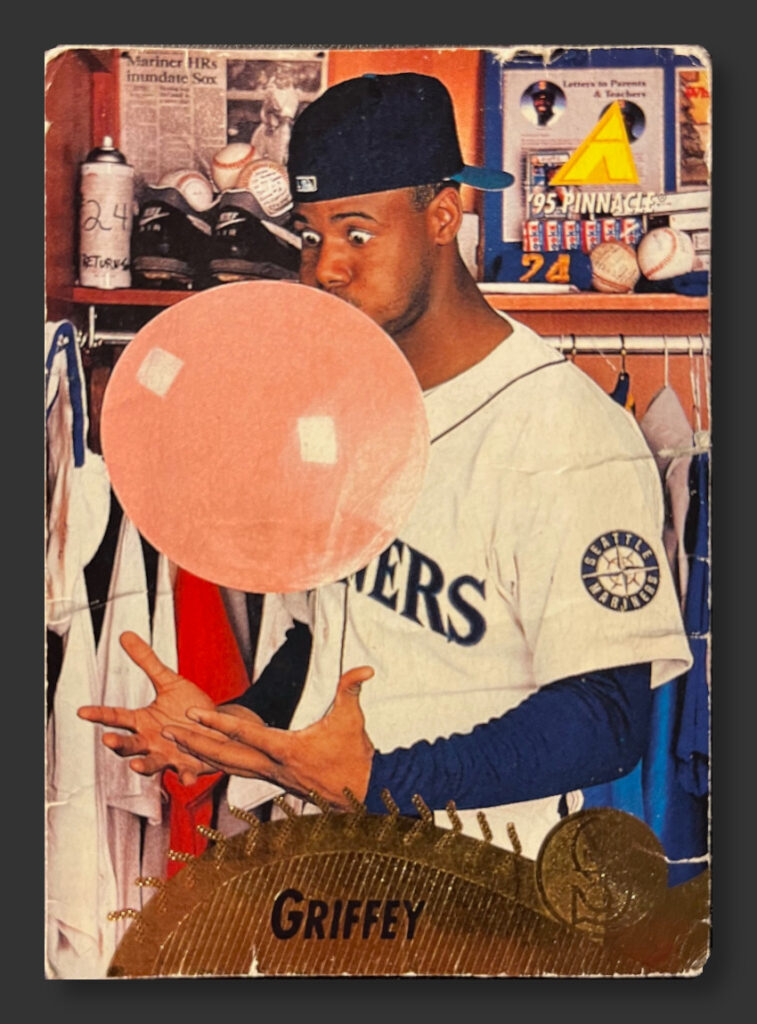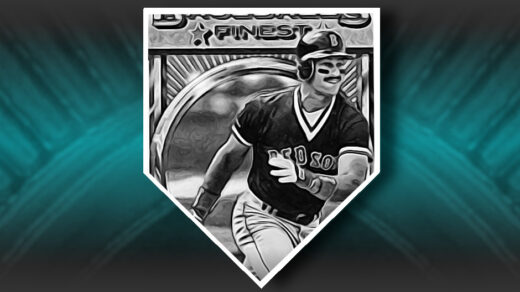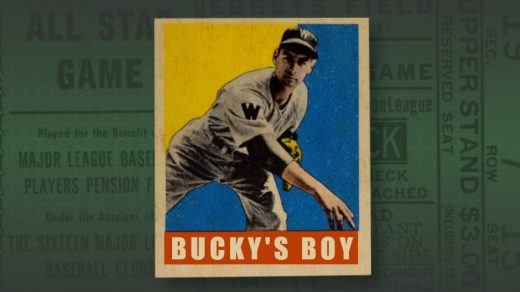
[Author’s note: Every year on my birthday I select a handful of instantly recognizable baseball cards to become “Wallet Cards.” The cards are always chosen with a theme in mind and are subsequently deposited for the next 12 months into my wallet. The cards are not encased in any sort of protective sleeve and quickly accumulate significant damage and wear. I document the before and after states of these cards and will sometimes keep a photographic journal of the adventures on which they have accompanied me. Each of these cards has its own story behind it, and at a later date I take them out and find out all I can about their history. This exploration of the 1995 Pinnacle Ken Griffey, Jr. baseball card that accompanied me in 2023 is the latest in this series.]
Iconic Shots
Do you know John and Tock Costacos? If those names don’t immediately bring to mind a very specific aesthetic, ask yourself if you recognize any of these images:
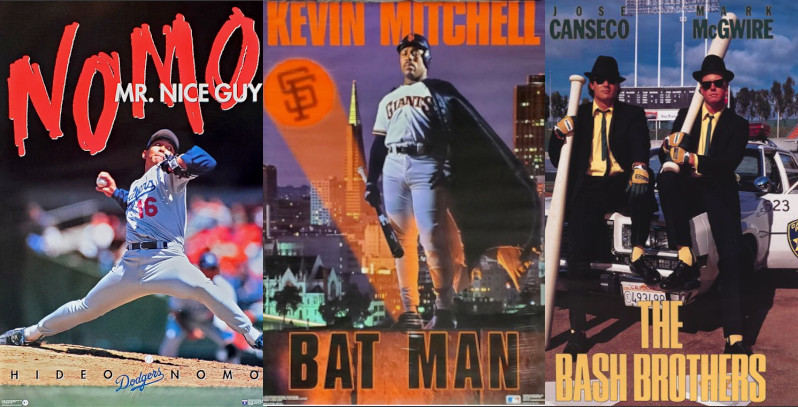
These once ubiquitous posters were the work of the Costacos brothers, siblings who made names for themselves by setting athletes into their own action movie posters. Working out of the Seattle area, they were looking for approachable local players and were able to become one of the first commercial entities to capture Ken Griffey, Jr. when he made the club out of Spring Training in 1989.
The initial story around Griffey, of course, was the fact that he looked ready to pick up where his All-Star outfielder father Ken Griffey, Sr. was leaving off. Utilizing the font of Star Trek: The Next Generation and some serious logistical hustle, the duo was able to secure both Griffeys for a photo session in the Mariners’ clubhouse. The elder Griffey had just renewed his contract with the Cincinnati Reds and, given the fact that the nearest National League ballpark was 800 miles away, had a tight schedule to keep. An early April west coast road trip for the Reds provided the opening for a baseball family portrait, coinciding a homestand for Seattle.
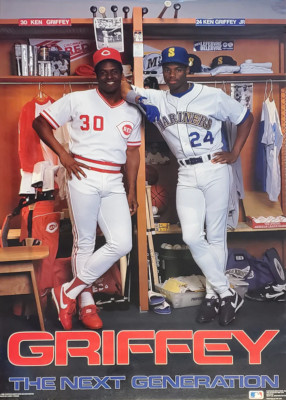
The resulting shot captured the pair at side by side lockers. Traveling apart from his team and missing the San Diego leg of the road trip, Griffey, Sr.’s gameday look is betrayed by a lack of necessary equipment and the presence of his personal golf clubs. The locker appropriated on his side has been decked out with various bits of Reds merchandise, Senior’s travel locker name plaque, and a well placed can of “Dad’s” root beer. The dividing wall between the lockers has two baseball cards affixed, a 1975 Topps card showing Griffey, Sr. on his first individual card and an ’89 Fleer Griffey, Jr. rookie.
Junior’s side is much more interesting. The messy bits of being a professional athlete are present: Towels, shower shoes, medical tape, etc. A giant carton of fan mail is seen piling up, literally only weeks after being promoted from AA-Billingham. A “Lefebvre Believer” bumper sticker is glued to the back wall, which I suppose is a better place than the bumpers of his budding Ferrari collection. Most interestingly is the yellow box of Ken Griffey, Jr. candy bars sitting on the lower shelf. These were novelty chocolate bars introduced by Pacific Trading Cards that very month, and have the added quirk of Junior being unable to eat them due to a food allergy.
The poster proved so popular that the Costacos would go on to create baseball card-sized portfolio pieces to pass out to potential photography subjects. Athletes might not recognize the name, but they would recognize the photo.
Composing a Classic
Card makers take note: This is how you make a baseball card. Setting aside the mandatory nature of responding with his ’89 Upper Deck rookie, this is the best base card of Ken Griffey, Jr. ever produced. And guess where it is set? We’re back at that same Seattle locker.

The nameplate refers to him simply as “Griffey.” Not “Ken Griffey, Jr.” or some other variation. Just a simple pair of syllables that instantly alert the reader about who is on the card. He is shown with his eyes bulging, hands protectively outstretched, and cheeks fully extended in the act of blowing a massive bubble. He is wearing the Mariners’ crisp new home uniform for 1993, the year this image was captured (more on that timing in a bit). That same locker from his rookie season photo shoot is there in the background, packed with even more items of interest.
What is in that locker? There is a newspaper clipping showing Griffey connecting for a home run with the headline “Mariner HRs Inundate Sox.” The article references an August 31, 1992 shellacking of the Red Sox in which Griffey’s home run helped defeat the visitors by a score of 15-2. Five autographed baseballs, at least two of which appear to be team signed balls, are seen amid a sea of Griffey’s items. A pair of cleats (with Nike swooshes clearly visible) are otherwise inexplicably stored at eye level. His wristbands bearing the number “24” are propped up to also catch the eye. Four VHS tapes can be seen, though their handwritten labels are too faint to be clearly read. A contemporary interview revealed Griffey did not study game tapes of opposing teams, so these may be family videos (or episodes of In Living Color that he hoped to catch up on).
There is a folder or book cover spread out against the back wall that includes “A Message to Parents & Teachers” from the Mariners. I believe this may have been produced in connection with Sports Illustrated and distributed in school book fairs but have not yet matched it with a photo outside of this shoot. Propped against this curiosity is a baseball card. Specifically, his Sports Illustrated for Kids card from the 1990 series.
The most obvious part of this card is the giant bubble trying to block our view of Griffey. To anyone familiar with baseball cards of his father’s generation, there is an equally obvious callback to the only other piece of cardboard that can be called “the bubble gum card.”
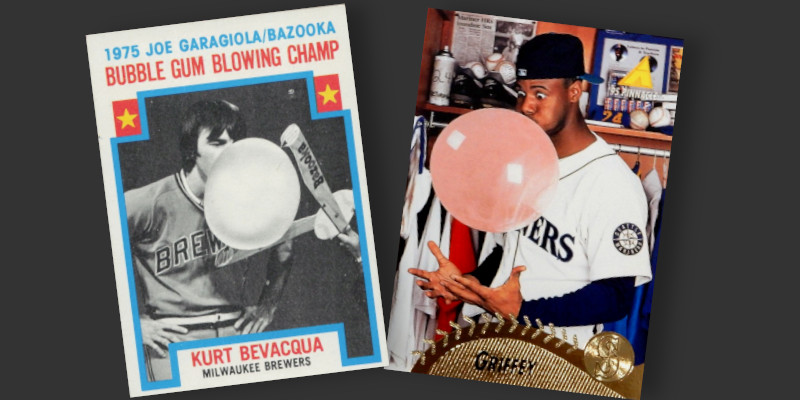
Kurt Bevacqua was the winner of a bracket style bubble gum blowing tournament for baseball players sponsored by Bazooka in 1975. The tournament had scientific measurement, as evidenced by the baseball themed calipers seen in use on Bevacqua’s 1976 Topps baseball card showing his winning bubble. Starting conditions were kept identical for all participants, with each allowed to use six pieces of Bazooka gum to construct their bubble.
And what is seen on the shelf just behind the bill of Griffey’s backwards hat? Exactly six pieces of Bazooka gum with their labels turned towards the camera. Those six wrappers are still intact, and Griffey’s bubble isn’t really made of gum. A true bubble is largely opaque, rarely perfectly round, and produces a dull, flat finish. Griffey’s is a perfect circle, is evenly transparent, and has the reflection of two soft box lights captured in its reflective surface. Griffey is blowing up a balloon.
Griffey is well known for blowing bubbles on the field, but he is better known for wearing a backwards ballcap. He started the practice when he is 6 years old. As a child he insisted on playing catch while using his father’s much larger team-issued hat, which posed problems when the bill slid over his eyes. He solved the problem by turning around the cap and had been doing it ever since. One of the things that makes this such a quintessential Griffey card is the fact that his cap is once again turned around to be out of his way.
Turn it Backwards
Flipping the card over, we get to answer the question of what is better than a backwards hat? TWO backwards hats! The first baseball cards featuring Griffey in a backwards cap were released in 1992. 1993 Studio gave us the first bit of cardboard dual-wielding backwards hats, and Pinnacle followed suit with in 1994 and 1995. This was made possible by a well laid out design for the reverse of the card. The back is colorful, has multiple large images, and conveys the most important information about the player depicted.
As a fairly new brand only 3 years removed from its debut, Pinnacle needed to include everything collectors expected but still manage to differentiate their offering. Full bleed photography and metallic foil were only par for the course, something that should be expected from any manufacturer trying to stake a claim in the market. Other innovations, like Topps’ four decade use of statistical tables and Upper Deck’s anti-counterfeiting holograms, were table stakes. How could Pinnacle incorporate these items into their design without being seen as an also-ran who could only copy innovation? They would reinvent stale elements of baseball card architecture.
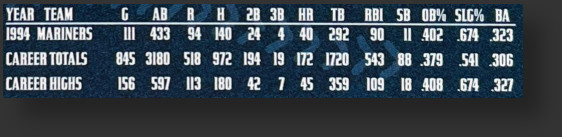
For starters, Pinnacle went after Topps’ original claim to fame: Player stats. The incumbent card manufacturer had introduced the now familiar stat tables on the backs of their 1952 cards and had continued the practice every year since then. This had started as an abbreviated table giving readers the totals of the most recent season as well as a player’s lifetime numbers, and then ballooned into massive, all-encompassing tables that completely filled the backs of the cards of veteran players. Pinnacle went back to that original last season and career totals ethos, but modified it in a way no one else had. They introduced a third stat line giving the player’s career bests in each category. You no longer needed to wade through a decade of small font text to see if a guy had the potential to put up a 30/30 season. It was already there in the statistical highlight reel while freeing up a predictable amount of space for the rest of that image heavy design.
Apparently worried about the potential for counterfeits, Pinnacle included a small box on the back of each card containing a series of microprinted gridlines. These lines would lose their definition and appear muddy if reproduced on most photo reproduction equipment of the era.
Familiar Photography
Pinnacle made heavy use of interesting image composition wherever they could. Bo Jackson was portrayed in the set not shagging flies with his fellow California Angels, but flying with the Blue Angels. The image was taken in February 1994 after he pulled 6-Gs with the Navy demonstration team.
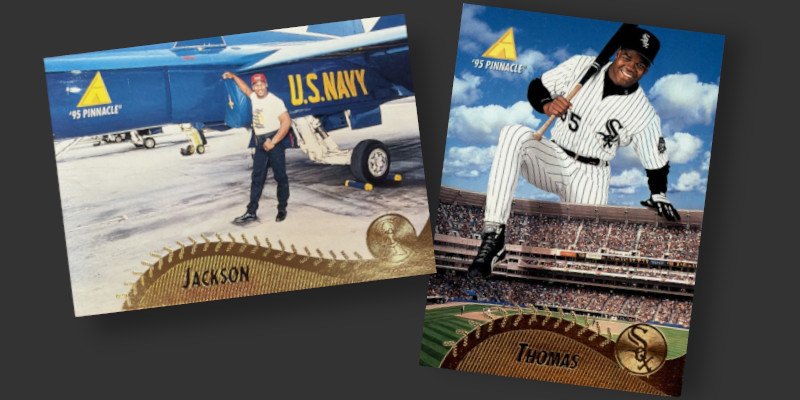
The Big Hurt climbing into New Comiskey Park is another classic image in the Pinnacle checklist, one that can be traced back to George B. Fry III. That’s a rather specific attribution and is possible because Fry’s work was used as the July 1993 cover of Sports Illustrated for Kids.
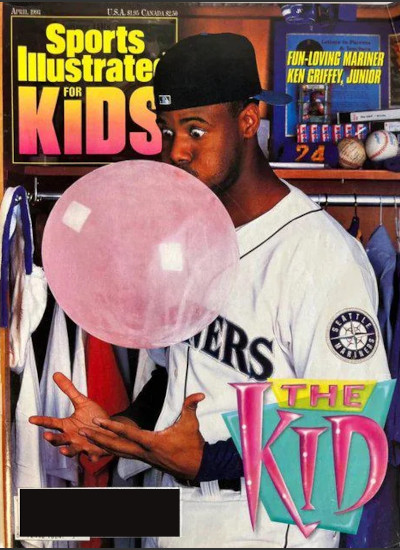
This wasn’t the only SI for Kids cover to come off the press at Pinnacle. It wasn’t a current picture, but rather one that had been the cover shot for the April 1993 edition. This makes sense given the magazine’s long history of producing sports posters. Their vaunted photographers would be experts in crafting a visual narrative like this. It even explains why his SI-issued baseball card is placed in the field of view. I am getting all kinds of hallucinatory answers as to who actually set up and captured this photo. VJ Lovero is my top guess. I would appreciate it if anyone with access to this back issue can pass along the photo credit from the issue’s masthead/contents page.
A Lot of Griffeys in Those Pinnacle Packs
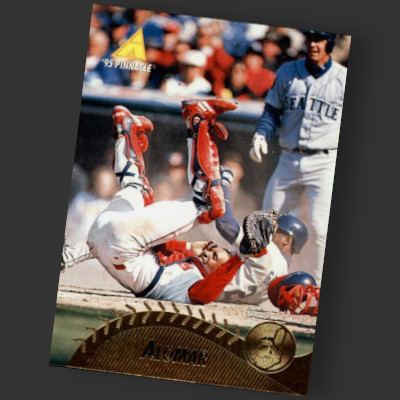
So how would you go about getting one of these cards? With just 225 cards in the first series, collectors opening packs of 1995 Pinnacle have a fairly decent shot at getting a Griffey card. The odds get even more favorable if you’re willing to accept Griffey making a cameo on another card. He can be seen on the ground in the aftermath of a collision at home plate on Sandy Alomar’s card.
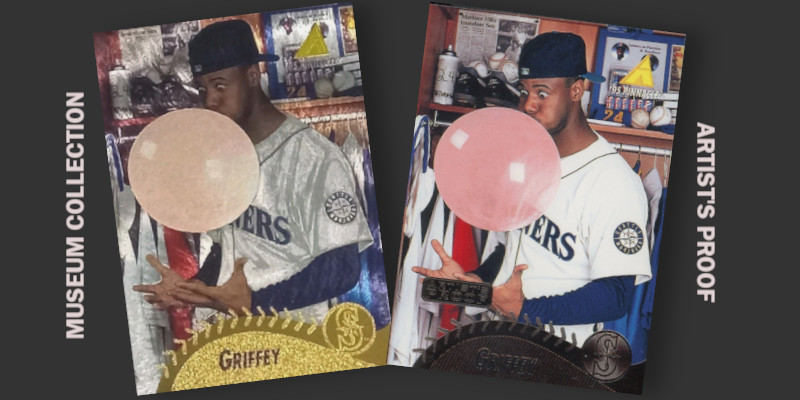
And guess what? Each and every card in the ’95 Pinnacle checklist is available in two parallel formats: Artist’s Proof and Museum Collection. The latter is by far the best looking of the two, but Artist’s Proofs were limited to a production run of 1,000 copies.
Given the odds of posted on boxes of Series 1 packs (not the erroneous info on odds reporting websites), production numbers for Museum Collection and base Griffeys can be extrapolated. Making the totally arbitrary assumption that 10% of production was allocated to jumbo boxes and the remaining 90% allocated evenly between retail and hobby boxes, I come up with the following estimates:
| Odds of Finding Griffey | Base Griffey | Museum Griffey | AP Griffey |
|---|---|---|---|
| Est. Production Run | ~440,000 | ~9,300 | 1,000 |
| Retail | 1:19.4 Packs | 1:900 Packs | 1:5,850 Packs |
| Hobby | 1:19.5 Packs | 1:900 Packs | 1:4,985 Packs |
| Jumbo | 1:15.3 Packs | 1:900 Packs | Zero |
Plausibly bringing the percentage of jumbo boxes a bit higher potentially brings overall production of base and Museum Griffey cards to the nice round figures of 500,000 and 10,000 each. This is good enough for establishing relative scarcity between parallels and ’95 Pinnacle’s place against overall card production of the era. Think of the base Griffey as being about as common as the typical 1986 Topps Traded card.
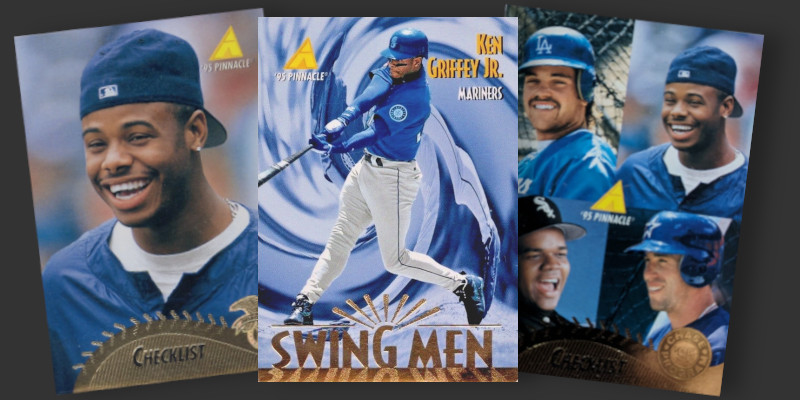
Although the Griffey (and Alomar) card was only in packs of Series One, there was actually a higher chance of getting a Griffey card in Series Two where he is featured on three different base cards. For fans of parallels, that represents 9 possible Griffey cards in the series that doesn’t even include a regular Griffey card.
Trade Bait
“I’ve got a new Griffey card. Wanna trade?”
Instant BMX-Stopping Attention.
Trading baseball cards was serious business when I was growing up. We all had our favorite players and sets that we wanted to complete. We also had a regulatory framework governing those trades that was hammered out with far more effort than anything ever put together for the Model United Nations club at school. It basically boiled down to one rule: Any cards changing hands must be exchanged for equal value as determined by the most recent price guide.
I like to look back at what kinds of cards were considered fair trades over time. For most years, the prices referenced reflect the average high and low column values reported in Beckett. This usually tells a story, one in which a card rises to hit some sort of Junk Wax Era peak before falling into obscurity with the possibility of a mild post-pandemic pickup from nostalgic collectors wishing they didn’t look like dorks when they turned their hats backwards today. Griffey gets to turn his hat around. You don’t.
This card doesn’t fit the normal pattern.
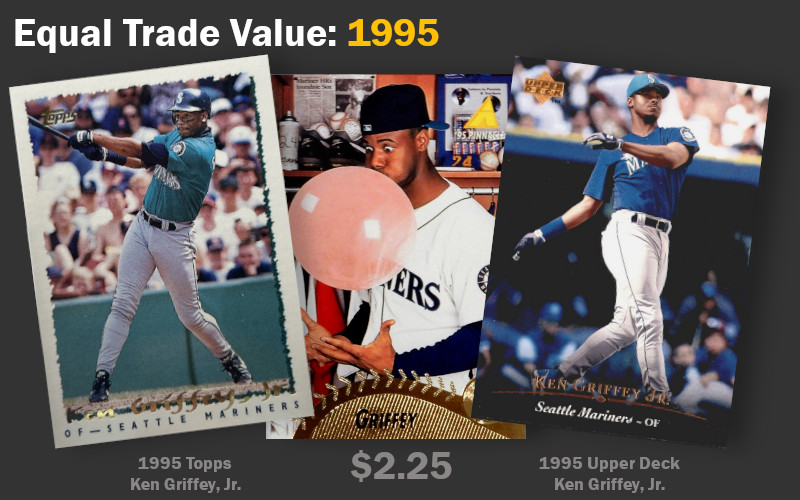
So what could you have parted with to land the best Griffey card of call time in the year it came out? If you had been opening packs you may have had duplicate Topps or Upper Deck cards to part with. Pinnacle had fantastic cards, but they were seen as being on par with any of the other major releases of post-strike baseball. At that time you could open a box of Upper Deck (I did for my 13th birthday) and pretty much trade your Griffey for any other base Griffey card outside of a few key sets of the last 5 years.
This was also a point in the hobby where the idea of player collecting was really beginning to take off. It was around this time that I noticed more and more collectors chasing all the cards of their favorite players rather than specific sets.
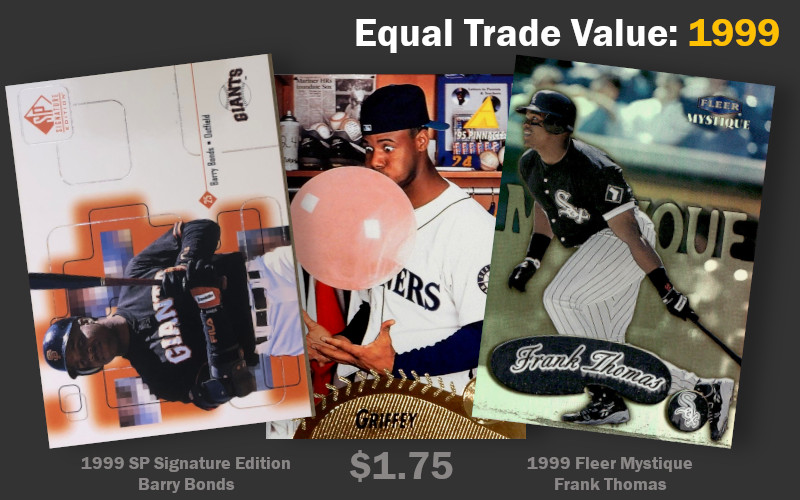
A Griffey is still a Griffey, regardless of what set it is from. A base card like the ’95 Pinnacle could still be exchanged for a top tier player like Barry Bonds or Frank Thomas in the current year offerings.
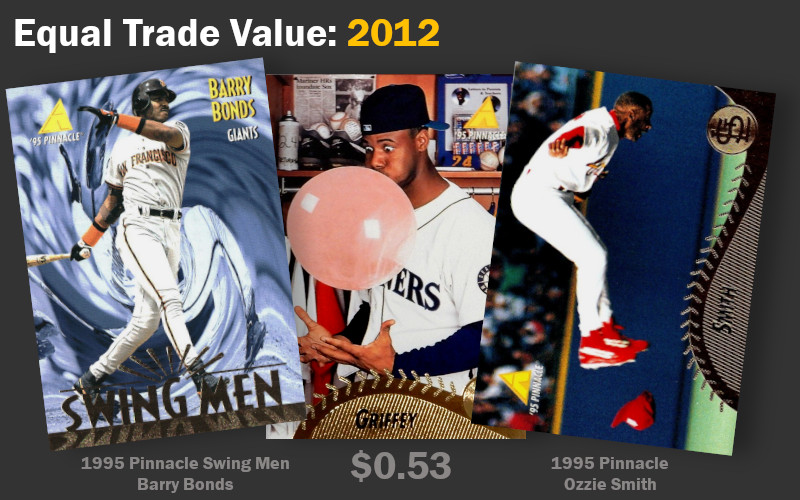
The ’95 Griffey bubble card was deep into discount bin territory a couple years after his retirement, but then again so was just about everything else. Card shows were almost non-existent at this point, but quarter and dime boxes abounded whenever a hotel manager rolled their eyes and agreed to host a gathering of collectors in an unused ballroom. There was no end to the variety of cards that could be picked up with pocket change, a haul documented on an equal variety of the then-popular blogging phenomenon.
Everything from the mid-late ’90s sort of blended together, and if Night Owl’s reporting is correct, made up the bulk of the contents of those discount boxes. ’95 Pinnacle was a fantastic set, but seemingly every one of the star cards in its checklist were interchangeable. My trusty 2012 price guide lists these Ozzie Smith and Barry Bonds subset cards as being perfectly fine candidates for a straight up trade for Junior. While I feel collectors would readily agree on a hierarchy among this trio, the equal treatment in the guide did at least hint at a willingness of collectors to trade “a card of your guy for a card of my guy.” The hobby was back to making playground trades.
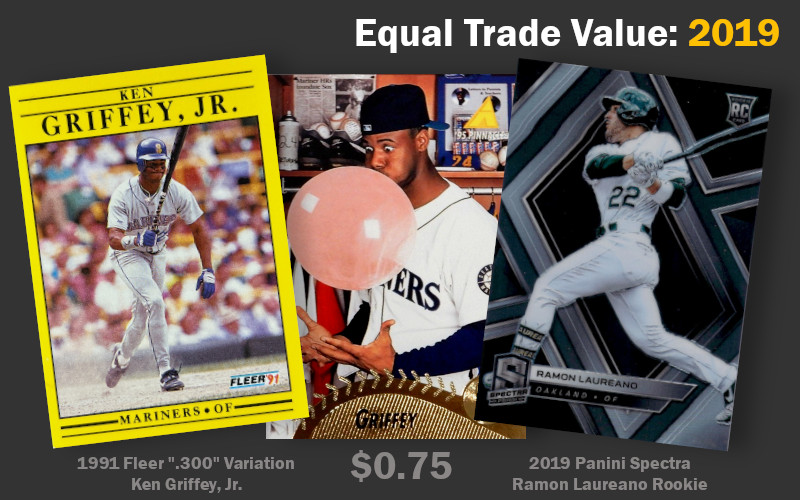
The way to get to the playground when I was opening packs of Pinnacle was to take a yellow school bus, and nothing says yellow school bus like 1991 Fleer. I have to confess to not being fully on board with the universal disdain of this set. Invert the yellow and black colors and cut the print run by 90% and you would have an instant classic. Despite this, I struggle to see someone actually being able to pull off a 1:1 trade of a ’91 Fleer Griffey for the Pinnacle card. Yes, the ’91 Fleer in this example is actually a slightly difficult to find variation of the set’s Griffey card (his batting average gets reported as two different figures in the print run), but I cannot see more than a few Griffey collectors interested enough to give up their bubble gum card in exchange.
Unlike the previous numbers in this writeup, this isn’t a theoretical price. The 42nd Edition of the annual Beckett Price Guide claims to report yearend 2019 values for 2.2 million cards. The Fleer Griffey and numerous cards like the Panini Ramon Laureano card shown above appear valued at $0.50-$1.00. The Pinnacle Griffey, and every other Pinnacle card produced, are completely omitted from the pages of this book. The $0.75 trade value I placed on my card is based on the actual price I paid for my copy in 2020.
Give me the bubble gum card every time.
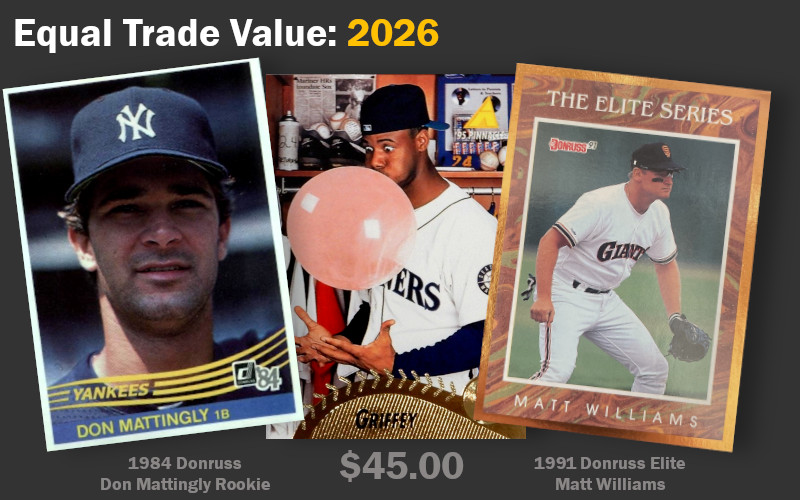
THIS IS NOT A MISPRINT! I averaged the last 100 ungraded examples that sold on eBay, a sample size that covers three weeks worth of sales. The mean price was $44.64 and does not include shipping. This is not a fluke number generated by one or two outlier comps.
Everyone sort of knew this was a classic Griffey card, but with a half million printed always assumed it would be widely available. After all, weren’t we theoretically trading it for ’91 Fleer variations just a few years ago? I think you have to think back to the time prior to Junk Wax print runs to get a feel for this card. 500,000 copies is a print run similar to that of the cards of the mid-1970s and the early 1980s. None are really rare, they have just reached some sort of psychological and fiscal escape velocity. If these kinds of prices hold, with collectors seemingly adding it to the ’89 Upper Deck Griffey as requirements for a Griffey collection, the card could find itself as part of any number of one for one trades for similarly iconic cards.
Right now, I see some ’84 Donruss Mattingly rookies and ’91 Donruss Elite commons available in the same price neighborhood as this former star of the dollar bin. Think a deal for either of those won’t work? There are plenty of very nice Dave Winfield and Robin Yount rookies to be had at the same levels as those last hundred Griffey bubbles. Perhaps collectors want to experience the fun of “The Kid,” rather than high priced cards of the other guys, guys pictured just doing their job at work.
After a Year of Carrying the Card Around in My Pocket
I carried this ’95 Pinnacle Griffey in my back pocket for an entire year in 2023. The card went through a car accident, raced a nuclear submarine, helped build a deck, and was present for the ignition of my son’s love of aviation. Despite the fact that my copy is now likely the lowest grade example in existence, these memories make it priceless.