It all started when Del Webb, owner of the New York Yankees, decided he wanted to show off his ballclub to his friends out west. He was a fixture in Phoenix, where he had built his fortune as a construction contractor and was rapidly expanding into other interests. He purchased the New York Yankees with Larry MacPhail in 1945 and would go on to develop iconic western institutions such as Sun City and the Sahara Casino in Las Vegas. He pulled off an unusual real estate swap in 1951.
Since the war ended, a few ballclubs had been setting up for Spring Training in Arizona. The Yankees had a long established presence in St. Petersburg, going as far as building a new stadium in 1947 and building an entire economy around their Florida outpost that they shared with the St. Louis Cardinals. Webb wanted to bring the Yankees out to Phoenix for a one-time experience in which his social circle could experience his ballclub that had carried three of the last four World Series titles. He convinced New York Giants owner Horace Stoneham to swap Spring Training facilities for the upcoming ’51 season. Joe DiMaggio and the Yankees would go to Arizona, and the Giants’ Durochermen would set up camp overlooking Tampa Bay.
That is how Leo Durocher came to find himself on the opposite side of the Florida Peninsula from his previous haunt managing the Brooklyn Dodgers in Vero Beach. Having decisively put down an internal rebellion over Jackie Robinson, he was now tasked with integrating Hank Thompson, Monte Irvin, and Willie Mays into the roster. Durocher wasn’t worried about the Giants’ offense. Bobby Thomson could be counted on for a couple dozen home runs. The team had picked up Al Dark and Eddie Stanky, players Durocher approved of, from the Braves the prior season. Combined with the skills of Thompson, Irvin, and Mays the lineup had been remade into a scoring machine.
What was concerning him was pitching. His plan for 1951 was to carry fewer offensive players than most teams with the extra roster space used to bulk up pitching options. Here he had two capable aces with Sal Maglie and Larry Jansen already taking two rotation spots. The rest was, in the parlance of Durocher’s hobby, a crapshoot.
That was the true reason for Spring Training. He was here to gather together the top rungs of the Giants’ farm system and pit them against major league bats. Trains had brought pitchers by the literal carload from the organization’s AAA teams in Minneapolis and Jersey City. Frank Shellenback, the pitching coach, may as well have been the most in demand person in the entire camp.
Durocher leaned his back against the railing and surveyed the scene before him. A pair of pitchers were throwing from bullpen mounds in the Florida heat, Shellenback standing beside them with arms crossed. They were both minor leaguers, the last of a half dozen hopefuls vying for the last open spot in the club’s 1951 rotation.
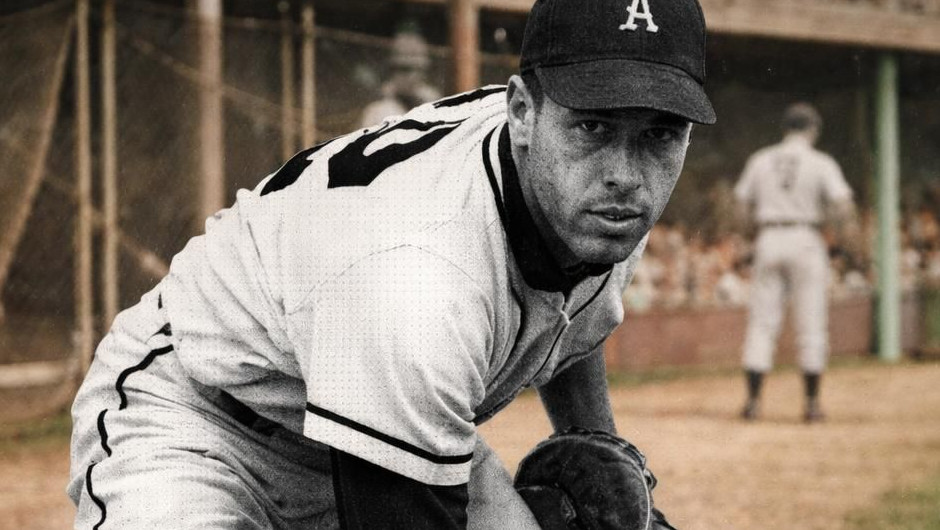
One of those arms belonged to Charlie Bishop, a tall Georgian who had been discovered by “Tubby,” a scout who newspaper accounts claimed hadn’t seen his feet since the onset of The Depression. Tubby arranged for the wide eyed teenager to suit up and sit in the dugout for a week with the champion ’42 St. Louis Cardinals. Bishop had eagerly signed and was promptly fed into Class D assignments in the Cardinals’ labyrinthine farm system. Service in the Navy intervened and he had spent the ensuing years working his way up the ladder, culminating with an invitation to the Cardinals’ spring training camp in ’49.
Commissioner Happy Chandler had smashed open the farm system just over a year ago, allowing stockpiled players who would otherwise never throw a Major League pitch to be claimed by teams that wanted to use them. The newly instituted Minor League Draft had seen the Giants pick up Bishop’s contract in December 1949, sending him to play for their Class A club in Sioux City. Having put up a 16-9 record, he was the sole Class A representative auditioning for Durocher and was doing so from the same mound from which he had tried to make the Cardinals’ roster.
Durocher was watching Bishop alternate throws with George Bamberger, whose 17-13 record made him the sole pitching invitee from the Pacific Coast League. At Durocher’s side was Hall of Fame pitcher Carl Hubbell, now employed as the director of the Giants’ farm system, giving him the backstory and development notes on the pitchers before them.
Bishop stole glances at the two as he waited for the return throw from his catcher. He couldn’t join the conversation happening to his left, or the non-verbal one happening between the looks exchanged by Shellenback and Durocher. All he could do to have a say is throw the ball hard enough to make an audible pop in the catcher’s mitt. He gripped the seams harder and fired. *POP!* He proved his velocity while the catcher proved his acrobatic skill.
Had Durocher seen that? He couldn’t tell. The manager’s head was turned, greeting some men who had ambled to the railing behind him. Who were these guys? Reporters? Celebrities? Bishop had seen Durocher’s wife, LaRaine Day, wearing a polka dot dress in the stands a few moments ago. She always had an entourage of photographers following her. Were these Durocher’s personal friends, underworld figures, or perhaps some combination of the two? Everyone in his orbit seemed to share some sort of inside joke that Bishop couldn’t read. Durocher was an enigma and Bishop was finding himself constantly 60 feet-6 inches away.
Bishop threw another fastball, sending the catcher out of his crouch to make the grab. One of the mystery figures quipped something about “practicing his brushback” to some chuckles. Durocher didn’t laugh. Bishop threw another one closer to the plate. He just needed to rear back and throw, and he was blowing it. He had a no-hitter in ’47, and lost another on the final out. Had Hubbell told him that? Or had he read from more than one minor league reporter about how he was just as likely to throw a ball over the backstop as strikeout a batter. Durocher stepped away from the wall and began dismissing his onlookers with a series of handshakes and “see ya laters.” Shellenback held up his hands for the catchers to keep their baseballs and dismissed the two pitchers. “Alright guys. That’s enough for now.”
Bishop was intercepted by a group of reporters on his way back to the clubhouse. As a newcomer, they wanted his impressions of the colorful manager. He hadn’t know what to expect given the news coverage of the last five years and confessed to the press that he had very different expectations for the man he encountered. “I had read a lot and figured he might be more dynamic and probably impatient, but I found Leo a grand fellow.” He went on to describe Durocher as very patient, helpful, and more than anything else, “businesslike” and very nice to deal with.
Seeing a rookie speaking with the press, Hubbell made his way over as Bishop made his exit from the reporters recording his words. He added a postscript about Bishop for their stories. “There’s a boy who should do you some good. He’s a little wild, but he’s not essentially wild. It comes and patches and bothers him. But he has a good chance yet and should get over it.”
Bishop’s next chance came in an intrasquad game between Giants players. He pitched the final three innings and secured the statistical credit for a 10-8 victory. This was a mixed result, as he came into the game with a 7-6 lead and promptly gave up home runs to Bobby Hofman and Monte Irvin. In some spectacular foreshadowing of the season that was to come, Bobby Thomson saved the game for Bishop with a 3-run homer.
Just over a week later the Grapefruit League was in full swing. Rookie arms were thrown into the live fire exercises of pitching to established major leaguers from other teams. The Philadelphia Phillies visited for a game and Bishop was once again given the ball for three frames with the Giants up by a score of 6-2. Eddie Waitkus and Richie Ashburn both sent misplaced pitches over the outfield wall, hitting him for 5 runs and the loss in a 7-6 decision. The decision was made that evening to give him a minor league assignment for the upcoming season.
Bishop wasn’t just being shipped out of Florida, he was being sent to another country. Expanding television ownership was curtailing attendance within the range of broadcast towers in New York. The Giants found their Jersey City attendance falling in lockstep with this development and took the decision to relocate their AAA club to Ottawa, outside the reach of the signals emanating from New York.
Bishop’s assignment to the newly reconstituted Ottawa club wasn’t widely known until the teams broke camp. As late as March 31 Durocher was telling reporters, “From among George Bamberger, Charlie Bishop, Roger Bowman, Frank Fanovich, Norman Fox, and George Spencer I out to get two more pretty good hurlers. If I don’t come up with at least one good starter I’m going to be badly fooled.” It may have been a prepared line, if the alphabetical ordering of player names is any indication. Hubbell assured Bishop this was a promotion, with the Giants wanting to keep an eye on him while moving him several rungs ahead of his prior year role in Single A.
If Bishop’s job interview on the mound had the hiccups, his 1951 season had the plague. Before the end of his first inning with Ottawa he threw a wild pitch, committed a fielding error, and gave up 5 runs. Three games later he was sporting an 0-3 record and driving to Oakland. He was farmed out to the Acorns of Pacific Coast League in exchange for Raoul Lopez, an equally wild fastballer from Havana who had played Cuban ball with Ray Noble for Cienfuegas and in the Negro Leagues for the New York Cubans. Lopez had begun the year on a missing persons list and wouldn’t arrive for a month. Bishop had been traded for a ghost.
A change of time zones did little to help the faltering pitcher. Now 27 years old, he went 2-8 while watching his ERA spiral to 5.88. Hubbell sent him down to A-ball with the Jacksonville Tars in the South Atlantic League. Bishop, as one reporter diplomatically put it, was “very unhappy” about the move.
Bishop’s ’51 season had been nothing short of a disaster from start to finish, but it was the intersection of multiple other disasters that would create his next opening. Horace Stoneham was one of small number of owners with no material sources of income beyond their sports teams. One year of gate receipts had shown Ottawa to be uneconomical for the Giants. Specifically, the weekend homestands that Stoneham had counted on were unable to be played due to entrenched local ordinances preventing Sunday baseball. The Giants consolidated their AAA affiliates down to the Minneapolis Millers and sought out a buyer for the Ottawa club, eventually reaching a deal with the perpetually cash-strapped Philadelphia Athletics.
Prior to this the organization had no minor league affiliate above Single-A. The A’s had spent the past two decades borrowing money to paper over internal ownership disputes instead of building out a farm system. Connie Mack’s Athletics paid $75,000 for the Ottawa franchise, which was swiftly renamed the Ottawa Athletics. The terms of sale allowed the A’s to seed the empty roster with five Ottawa players of their choosing, and it was one of those selections that saved Bishop from the subtle nods and headshakes of Durocher and Shellenback.
While Bishop toiled away in obscurity at Jacksonville in August 1951, the Ottawa Giants were busy calling the police. Starting pitcher Walter Cox was missing.
He didn’t show up for a road game in Syracuse and a search of his hotel room revealed packed luggage but no sign of the pitcher. Calls to Cox’s wife and his mother revealed no knowledge of his whereabouts, and local police were called in to search. Cox, who reportedly did not drink or show any other prior signs of potential danger, surfaced four days later at a ballpark for an Ottawa away game in Springfield and refused to give an account of where he had been. Between the recent disappearance of Cox and that of Lopez earlier in the year, it was just par for the course in Giants’ minor league baseball.
News of the disbanding of the Ottawa Giants and their subsequent sale to the A’s for parts was announced in early February 1952. Bishop was once again crossing the country, this time heading to Phoenix for the Giants’ training camp at Hubbell’s invitation. Walter Cox, the disappearing pitcher and a former Sioux City pitcher alongside Bishop, was also slated to appear but was told instead to change plans and report to the A’s camp in Melbourne, Florida.
Newspaper reports began to surface on March 11 that Cox had not reported to the Athletics and that his whereabouts were unknown. Two more weeks elapsed with no sign of the Athletics’ newest arm. While Connie Mack was perfectly fine with not having to pay a player’s salary during Spring Training, he needed his player to be ready for the fast approaching opening day in Ottawa. A frantic search revealed that Cox had been institutionalized for his safety in a mental hospital for the past several months with no indication of when he would be released.
Elmer Burkart, the Philadelphia representative tasked with building out the A’s minor league roster, contacted Hubbell to inquire about a remedy for their damaged player. Hubbell agreed to take back Cox, but to do so Burkhart would need to select a name from a list he provided right then and there. “How about Charlie Bishop?”
Burkhart had been involved in minor league scouting for several years. He remembered Bishop’s name as the strikeout leader of the Western League in 1947 and, with the assurance that Bishop was indeed physically in the Giants camp and with absolutely zero additional information to go on, he agreed to the swap. With that phone call, Charlie Bishop had been traded for a guy locked away in a mental asylum.
The season started out surprisingly well for the newest member of the Athletics. He had some victories under his belt. His ERA was respectable, and while his pitching was at times wild, a new grip learned after a blistered finger had it under control on most days. He even managed a few extra base hits at the plate, including a 5 RBI performance in early May.
A decent, if unremarkable, season coalesced into something special on May 24. The Athletics were scheduled to play against the Syracuse Chiefs in a double header. Facing off in the first game would be Bishop and the league leader in wins, Bobo Holloman. Capitalizing on the promotional potential of the day was the Syracuse Chamber of Commerce, whose members had loaded up a truck with prizes to be awarded to the best overall player of the night and anyone who performs a “first.” The hitter of the first single would receive a prize, as would the first player to score, steal a base, strikeout an opposing batter, and the like.
The stage set, Bishop proceeded to mow down the starting nine of Syracuse in order. He recalled becoming aware of having a potential no-hitter when the leadoff man came up for the second time, this time thriving on the pressure. At the conclusion of the game he had struck out one, walked three, and importantly, not allowed a single hit in a 1-0 victory. The game was the first no-hitter of 1952 at any level of professional baseball, one that generated the headline “STAR HURLER TWIRLS NO-HITTER” from an Oakland newspaper that just months earlier had noted his ineffectiveness for the Acorns.
The Syracuse business contingent had no choice but to name Bishop the night’s MVP. Since he had negated the ability of so many firsts, he was awarded the spoils of every unclaimed prize on hand. He had single handedly sacked Syracuse. In the clubhouse that evening he looked like royalty in an elaborate smoking jacket that had been presented. Standing astride a newly acquired Persian rug, he doled out loot to teammates who quickly adopted the nickname “Prince Charlie” for their conquering hero. He had boxes of cigars and coupons for steak dinners. There was a bushel basket containing a breakfast service for four, as well as a silver tray. He had leisure shirts and sports jackets at his disposal. An elaborate clock was kept for himself. There was even what was described as a set of ladies’ travel luggage designated for “a wife.”
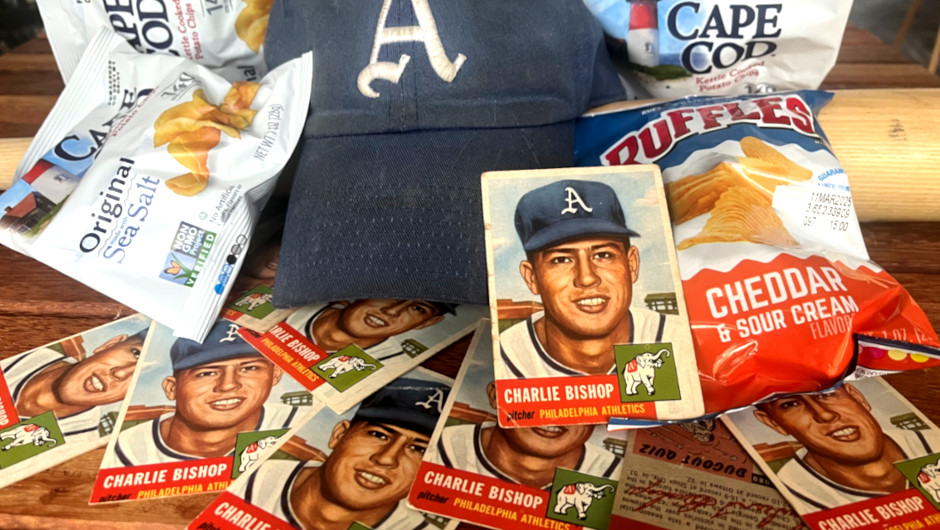
Bishop wasn’t celebrated only on the mound in Lansdowne Park. He was sought after in the candy aisle. The newfound popularity of the International League led to the creation of baseball cards for the Canadian Market. Parkhurst introduced the first postwar hockey cards in 1951 and followed up that effort in 1952 with a set focused on the three Canadian outposts of the International League. Bishop and his Ottawa Athletics comprised two dozen slots in the checklist, giving the newly revived pitcher his first baseball card after a decade of professional action.
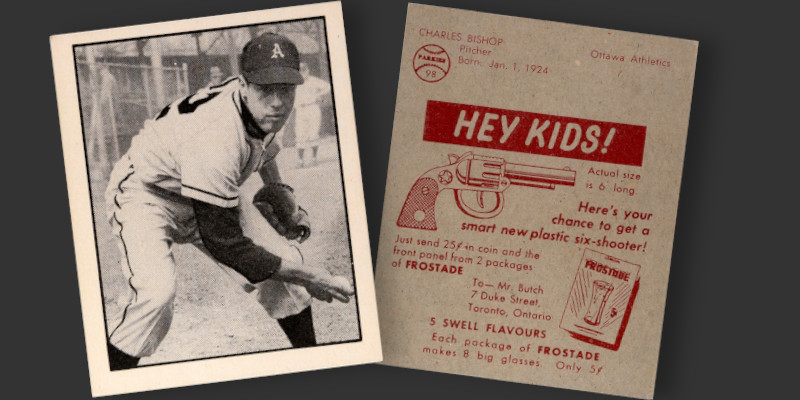
Decades later, collectors would recognize a similarity between these cards and the chaotic revival of Bishop’s career. New to manufacturing trading cards, Parkhurst looked for a readily available method of mechanically randomizing inventory for insertion into their five card packs. The solution was the wholesale dumping of cards into a rotary cement mixer, which did wonders for creating condition scarcities. Even in cardboard effigy he could not escape the turbulent absurdity of his career.
By late August Bishop was sporting a respectable 3.64 ERA. His 12-10 record reflected the fact that Ottawa would not be competing for the International League title that season. This opened up the intriguing possibility of an expanded roster push for the Big A’s, who were just six games out of first place in Philadelphia. Bishop was called up to Shibe Park, where his first two appearances saw him earn two wins across 15⅔ innings while striking out 12 batters.
The call to the Big A’s had required immediate travel. Upon arrival in Philadelphia, the abdicating prince wrote farewell letters to the editors of Ottawa newspapers expressing his gratitude to his supporters.
I didn’t get a chance to see or call any of the people in Ottawa who were so nice to us so, if you should have the opportunity, I would appreciate it if you would mention that we enjoyed Ottawa, the understanding fans, and friends and neighbors. I wish I could have seen them all before we left, but just didn’t have the time.