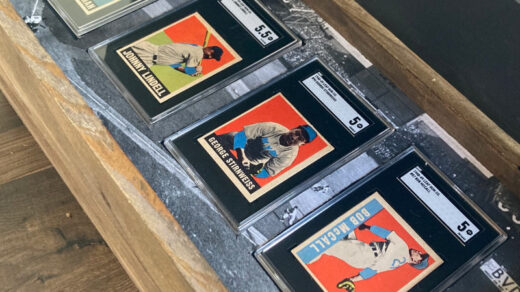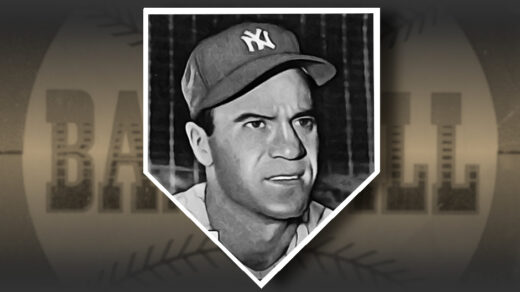
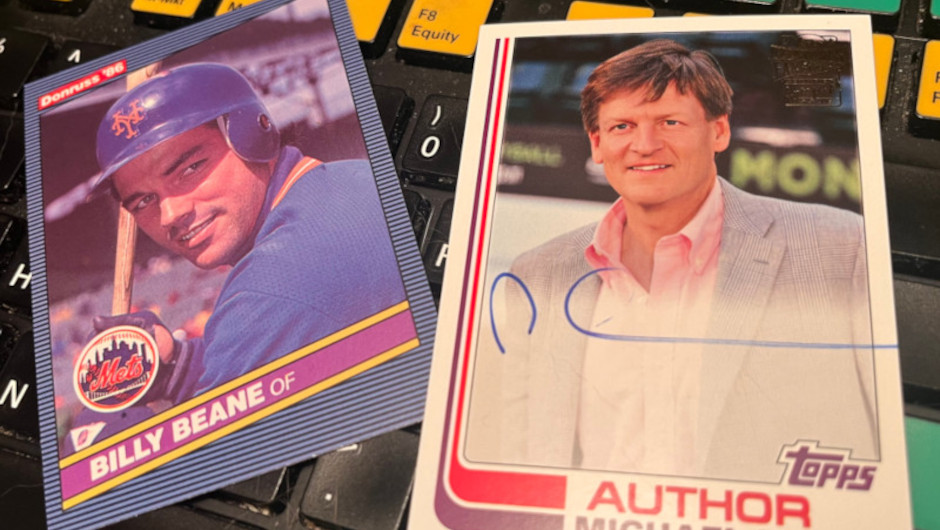
[A quick note on The Wallet Card Project: Every year I select a small number of themed baseball cards to carry in my wallet. These cards are not protected by anything and are left exposed to the wear and tear of being sat on for a full year. These rapidly depreciating assets, usually from an era in which cards were transferred directly from wax packs to top loaders, accrue a patina of damage more typically associated with fascinating vintage cards of Mays or Mantle. More modern cards that would otherwise be quickly glanced at become visually fascinating and generate recurring dividends of memories as they go on their journey.]

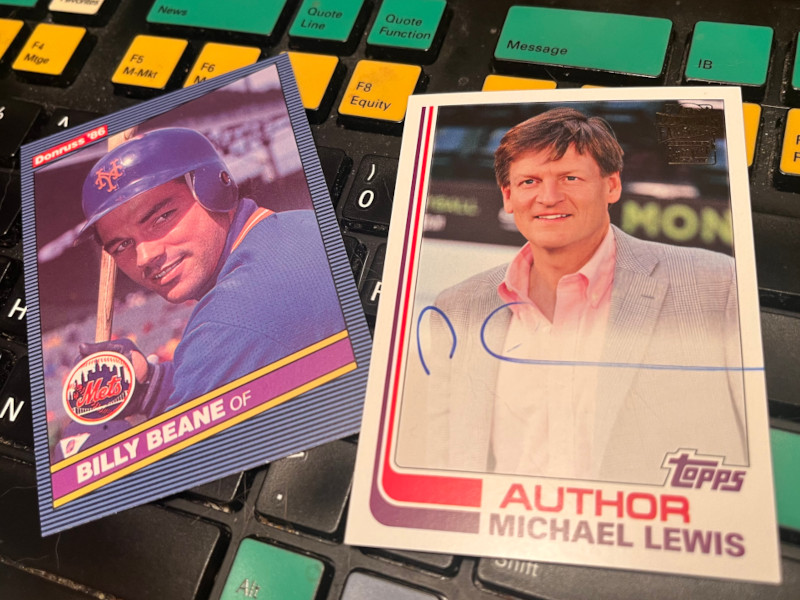
Do you see this scribble? Do you know what it is? It is the signature of Michael Lewis, author of Moneyball, and, though the signature is poorly written, is going to tell a story. I’m going to use it in 2026 to write a story of my own, one that involves taking baseball cards to be sandblasted at the beach, slammed through thrash metal mosh pits, and if they behave themselves, used as bookmarks at the library.
This tale begins with the arrival of a book. My parents gave me a stack of baseball themed reading material one Christmas, and included in that pile under the tree was Bill James’ The Politics of Glory (eventually republished under the title Whatever Happened to the Hall of Fame?). The case he laid out against the arbitrary borders of Cooperstown stuck with me. James’ work helped move this elementary school baseball player away from just the “baseball card stats” towards something that helped him rank the players in his baseball card collection. It also drove me to keep my own logs for one or two seasons of middle school, extracting the data from box scores and learning how the game fit together. Sure, the statistical side of fandom had been doing that for a century and a half, but it wasn’t until I read that book that I had any interest in it myself.
If only Bill James had his own baseball cards…what a fun wallet card selections they would be. It turns out James does indeed have some cardboard, but a review of the options left me wanting something that could be better woven into a story. James provided the vocabulary and underpinning for this search, but it was the tale of the general manager who built a team around his ideas that brought it to life for me.
I do not have a contemporary memory of Moneyball as an Oakland A’s phenomenon. I was busy working and taking as many courses as I could to graduate as soon as possible. I wasn’t watching television any more and would ditch the device completely by the 2003 publication date of Michael Lewis’ book Moneyball. I wouldn’t read the book until 2011 and do not recall real-time discussions of the underlying strategies. I was experiencing baseball largely through box scores, standings, and league leader tables, along with participation in rotisserie fantasy baseball.
Baseball obviously changed in that decade. I could see it in the leader tables and box scores. On the recommendation of a coworker, I picked up the book and learned for the first time exactly what had been happening.
This leads to the first card of the CardBoredom Moneyball Era: A rookie card of the future general manager of the Oakland A’s, Billy Beane. He is pictured with the New York Mets as a failing first round draft pick, but a smile of recognition is beginning to cross his face. Despite the protestations of the photographer, he isn’t looking at the camera. Instead, his gaze is drifting off to the side, probably to an empty chair in the front office. He’s looking at his future.
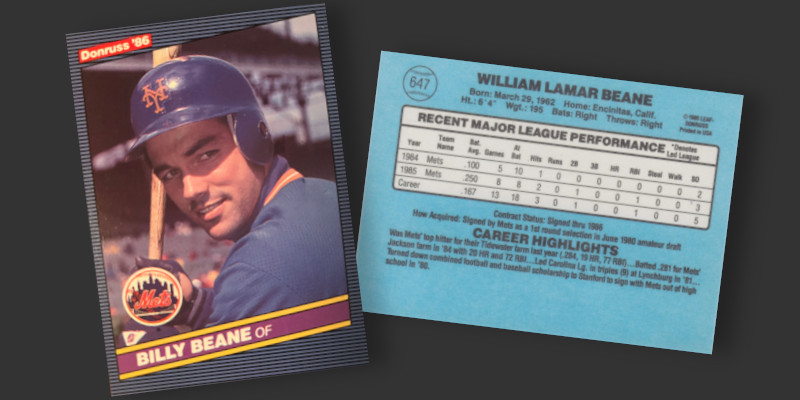
Despite being massively dilutive to collectors, 1986 Donruss was a premium asset class to me. It was issued before I got into the hobby, so I did not get a crack at picking up packs from retail shelves. By the time I was collecting the baseball card bubble was setting itself up as a precursor to Alan Greenspan’s “irrational exuberance” and the possibility of Cecil Fielder, Fred McGriff, and Jose Canseco rookies lurking in packs had pushed prices beyond what my friends and I could stomach paying. As a result, cards from this mass produced, visually distinctive set were rarities in the collections I was familiar with. This card has a connection to me, even if it is the fact that this connection is the simple awareness of not having it.
Having previously broken down the Canseco rookie from the same set (during a global pandemic), I am certain this Billy Beane card will get its fair share of wear. Those dark borders are going to look fantastic with creases encroaching from all sides. That picture above is probably the last time you will see a right angle on any of those corners.
So why pick Beane, other than the fact I didn’t have this card? Because even though Moneyball was already firmly entrenched in the Oakland organization upon his ascension to the GM role, it is through him the story gets told. The A’s had their first success with the plan on his watch, and a storyteller saw his backstory as the scaffold upon which to weave the tale that has become the defining history of the moment.
Destroying a Michael Lewis Autograph
Moneyball, the program in which Beane’s front office sought to systematically identify undervalued talent, wasn’t supposed to be how the team made it to the playoffs. They only embarked on this course because of an ownership change and decline in fiscal headroom. Moneyball, the book, only emerged from the keyboard of Michael Lewis after he became distracted from writing a magazine article on what baseball players thought of teammates who were paid materially different salaries despite having performance metrics that could easily be compared to their own. I was already very familiar with Lewis’ writing, having devoured Liar’s Poker as a teenager after learning of it when the very public collapse of Long Term Capital Management blew a budding interest in investment wide open.
Lewis appears in the 2018 Topps Archives Fan Favorites set, an issue that also marked the cardboard debut of Bill James. These insert cards featured autographed versions, and given the level of forgery rampant in the book market, I sought out one of these certified signatures for my own collection.
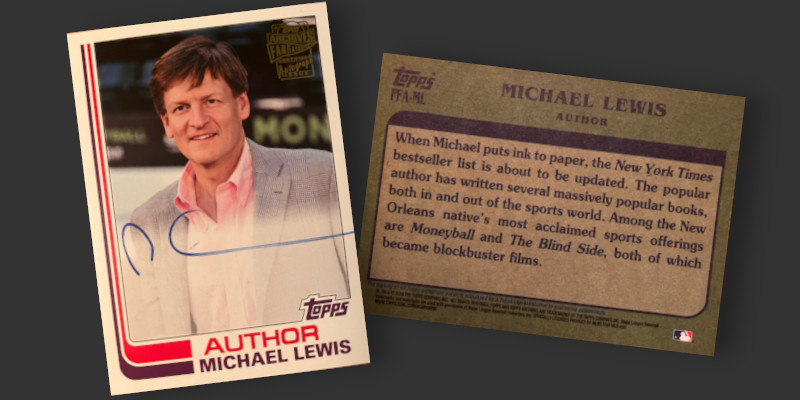
Lewis, it would seem, didn’t care too much about signing his card. The signature isn’t quite lined up with the area prepped for the autograph and there doesn’t seem to be much of an attempt to even make the scribbles he made look anything like his name. Visually, it looks as if he was applying a graffiti tag to a train car as it picked up speed and rolled away. I briefly considered the possibility that he passed off signing duties to an assistant, but I find it likely someone earning a paycheck from impersonating his signature would have done more to make it resemble what he writes on a bookplate. No, what I have in my hand is physical evidence of a good writer badly writing.
However, the more I look at this excuse of an autograph, the more it makes sense. Lewis is trying to efficiently sign his name with maximum output while avoiding risk (chances that someone getting an autograph will pitch him their unsolicited life story). The result bears little resemblance to the letters forming his name, but then again the Athletics didn’t resemble a normal baseball team. Those misshapen letters on my card resemble the physical oddities drafted by Oakland. The card is messy, and the A’s were messy. Lewis signs like a storyteller, and he’s playing Moneyball with his pen.
Billy Beane built a team and Michael Lewis signed the card. Both are broken ends of this story, the Beane rookie being an overproduced Junk Wax rookie of a guy with a .219 career batting average and Lewis giving up the dignity of a legible signature for efficiency. For these reasons both cards will be given the Wallet Card treatment. Will creases and bent corners make the cards look better? Does the messy signature need a messy card to match? Is a creased card like a well-read book with a creased spine?
These thoughts are too heavy to carry in my mind, so I plan to carry them in my pocket. I figure the fellow finance guy turned author doesn’t care much for his card, but as a writer he would appreciate all the stories that will accumulate with it while it travels in my pocket. I already have tickets secured for a Megadeth and Anthrax performances, so these cards should be damaged in the most efficient way possible.