Nicknames come in two forms: Those that are descriptive and those that are brief. Ralph “Wig” Weigel falls into the latter camp. Sporting a full head of homegrown hair, the shorthand name for this American League catcher came solely from the shortening of his two-syllable surname. It’s a brief nickname that was already well established prior to Wig’s arrival in the big leagues, but one that ended up proving painfully descriptive in its brevity by the time he left.
Weigel began his pro career in Class D ball with a Cleveland Indians affiliate in 1940. A promising catcher with a good arm, he batted over .300 in two of three seasons before military service called him away from the the low minors. While he put up an impressive batting average playing games stateside for the Coast Guard, the Baseball in Wartime blog points out that once he was deployed to the Pacific Weigel may have used his ship’s deck cannon to shoot down an incoming kamikaze plane during the Battle of Leyte Gulf.
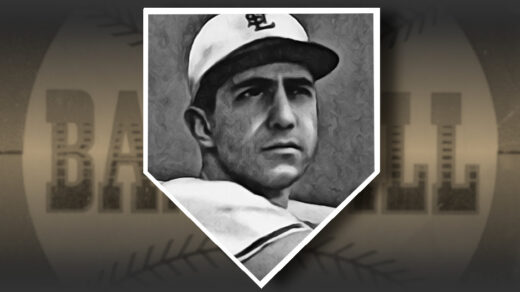
After his discharge, Weigel returned to baseball. Although he got a six game cup of coffee with the 1946 Indians, he largely spent the next two years in the club’s farm system. He again showed promise, generating an .818 OPS in over 100 games for the AAA-level International League’s Baltimore Orioles. The 1948 Indians, however, were a team on the verge of winning the World Series. This was not a lineup in which a prospect could grow, especially with 1947 All-Star catcher Jim Hegan calling the shots from behind the plate. With a half dozen games of Major League experience under his catcher’s mask, Weigel was traded to the Chicago White Sox for former All-Star centerfielder Thurman Tucker.
If Rome had its Year of the Four Emperors, Chicago had its year of the four backstops. Weigel came into the Sox camp as one of a small army of potential catchers vying for a spot. The Sox were embarking on their newfound “Youth Movement,” a focus on phasing out veteran players in favor of new faces. Weigel, who became a father during this battle for a starting position, emerged as the primary catcher out of a three man platoon. Weigel wrecked his knee, possibly tearing his ACL, while dodging a brushback pitch from Virgil Trucks in a 1948 Independence Day game. Less than four weeks later he was being eased back into the lineup. Rub some dirt on it and get back in the game Wig!
Helmed by Frank “Trader” Lane, Chicago dumped the other members of the catching platoon in the off season and acquired another former Cleveland Indians rookie catcher in the form Joe Tipton. Weigel appeared ready to start the season as the Sox’ starting catcher, a position that looked all the more certain with Tipton being called to his home state of Georgia to testify in a murder trial. Tipton concluded his testimony and returned to the team the night before Opening Day, and in an ending befitting for the chaos of the Year of the Four Emperors, prompted the team to immediately sell the now expendable Weigel to the Washington Senators. He would appear in just 34 games for the Senators in 1949 before being optioned to the minor leagues for the rest of his career.
Wig had a short nickname, but then again he had a very abbreviated MLB career. In addition to the perpetually balky knee, his 106-game, three-team career saw him taken out of the lineup for bruised heels and a torn muscle in his once celebrated arm.
A Brief Baseball Card Career
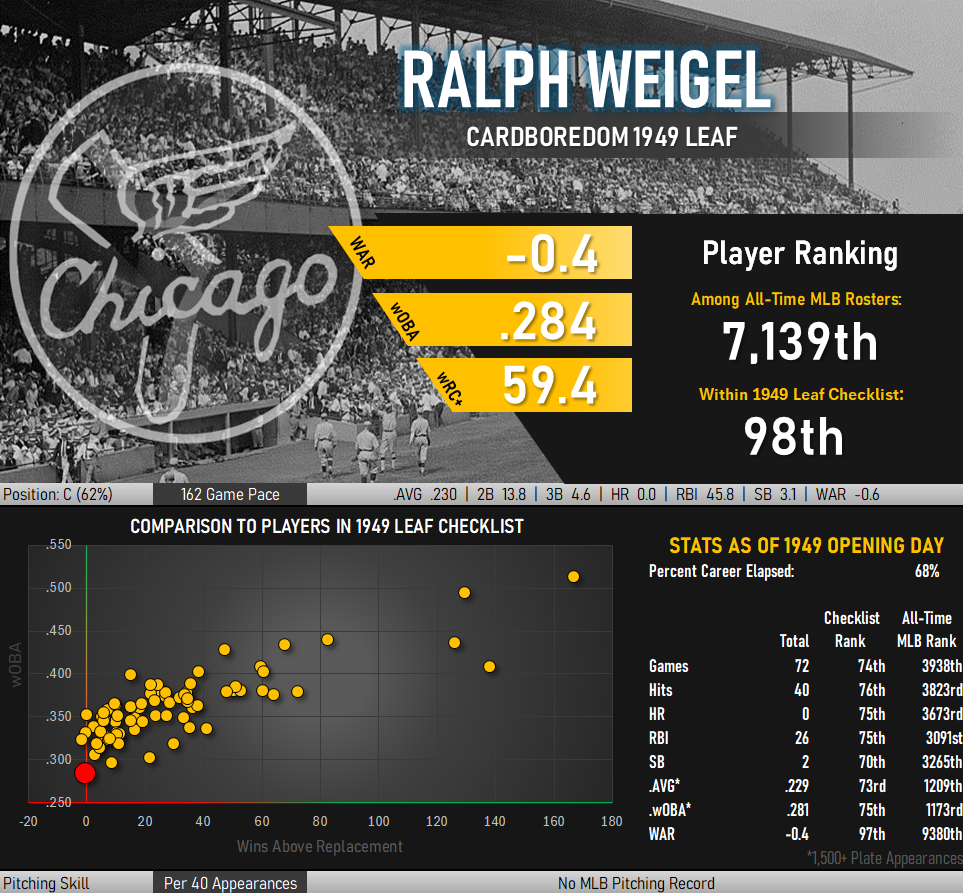
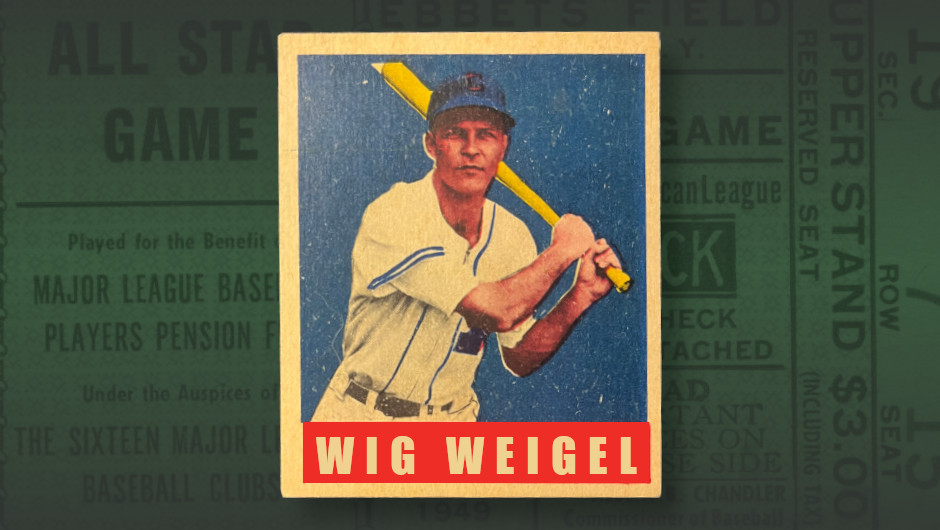
The Leaf Candy Company was a Chicago staple, a status reflected by the 20% allocation of local ballplayers to the manufacturer’s debut baseball card release in 1949. Weigel, the White Sox’s default starting catcher heading into ’49 Spring Training, was one of three members of the team to be included in first series packs issued in March. With just 106 games to his credit, Wig ended up with the shortest tenure of any player appearing in the 1949 Leaf checklist. This ended up being the only baseball card of Weigel issued during his career, and absent a later reprint of the set, remains the only baseball card commemorating his brief time in the majors.
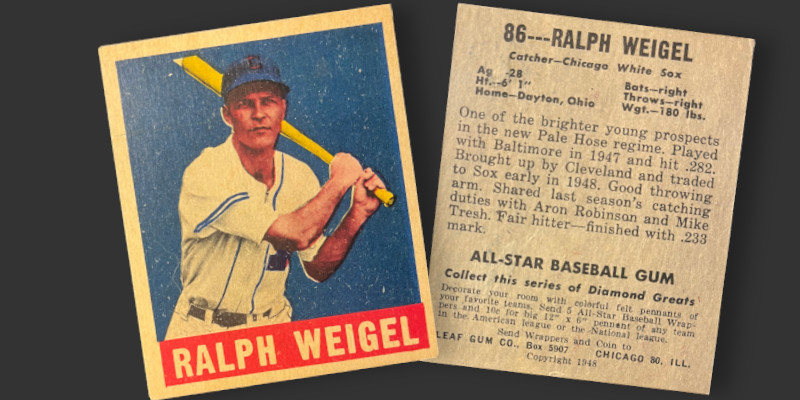
The back of Weigel’s lone baseball card has a few items of interest. For starters, it begins with a nod to Chicago’s new focus on younger players with its mention of “…the new Pale Hose regime.” The card identifies his prior season rivals for the Sox’s starting catching duties, Aaron Robinson and Mike Tresh. Robinson’s name is misspelled “Aron,” perhaps an inadvertent nod to how far he ranked below Weigel on the depth chart.
The card describes Weigel as a “fair” hitter and immediately backs up the assertion by mentioning his .233 batting average. While the term “fair” sounds okay in most contexts, in the world of baseball cards it refers to a low-grade card barely clinging to any sort of collectability above the most beat up examples. In this context fair is not a compliment. Given the evidence of Weigel’s injury-influenced stats and quick replacement, he ranks 98th out of 98 players appearing in the ’49 Leaf checklist, I am inclined to think the card’s term isn’t entirely a compliment either.