I’m tired.
Work. A barrage of medical appointment reminder texts that never quite state which family member they are for. Teenage relationship drama. I nuked my lawn, tilled the soil, and started over with new seed. I need to figure out when I can take my car in for some needed maintenance. My inventory of previously written posts has run dry and I am back to making it up as I go along. The genealogy tangent I wrote about a month ago has exploded into something larger than I anticipated and I cannot turn off that section of my brain. My sleep has been constrained by assorted claims on my time for several months at this point. Even my wallet cards are looking tired and creased.
I am simply tired. The word appears italicized, a condition indicating that even the letters themselves are so exhausted that they too are falling over.
I’m almost too tired to look at baseball cards. Almost.
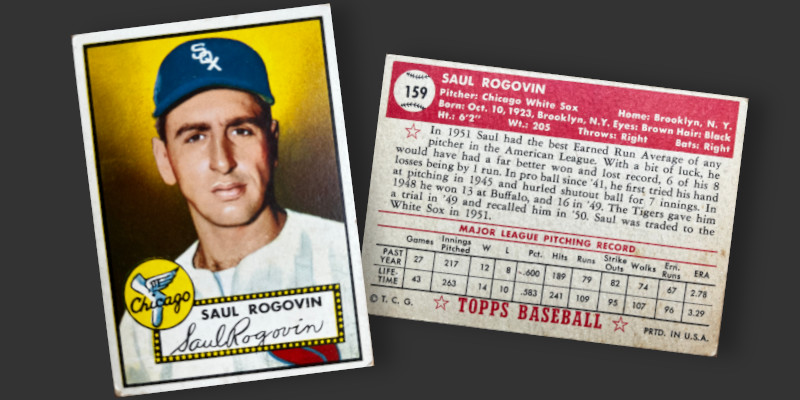
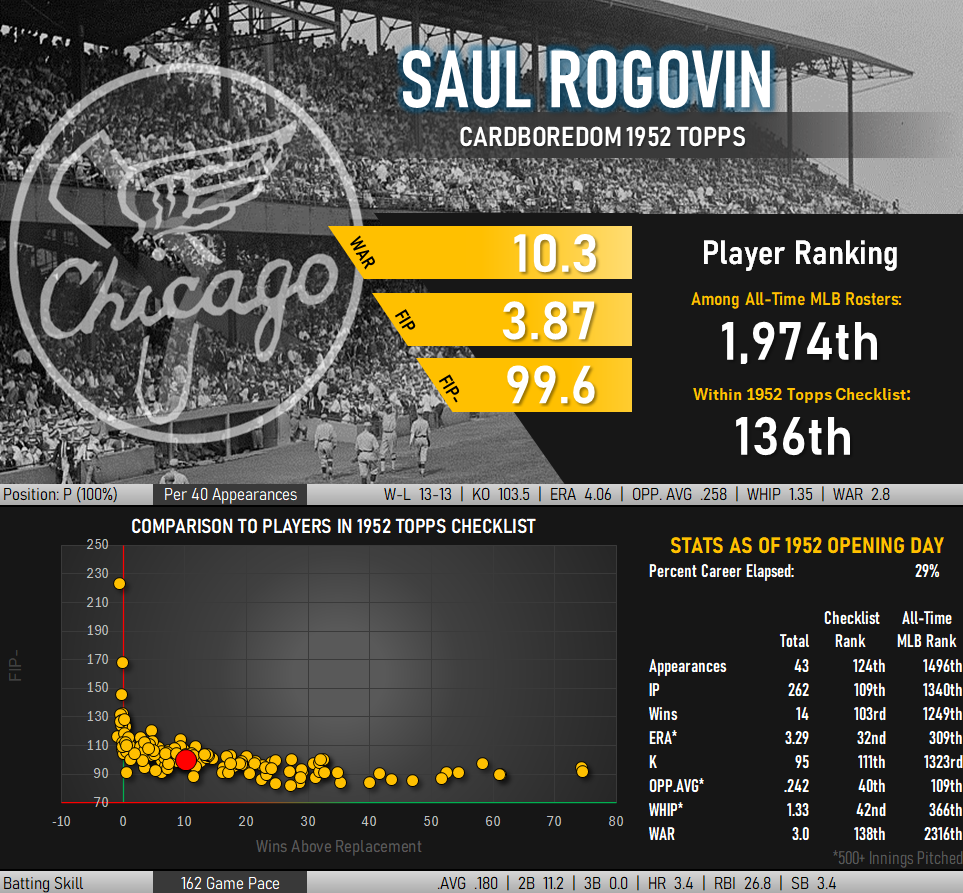
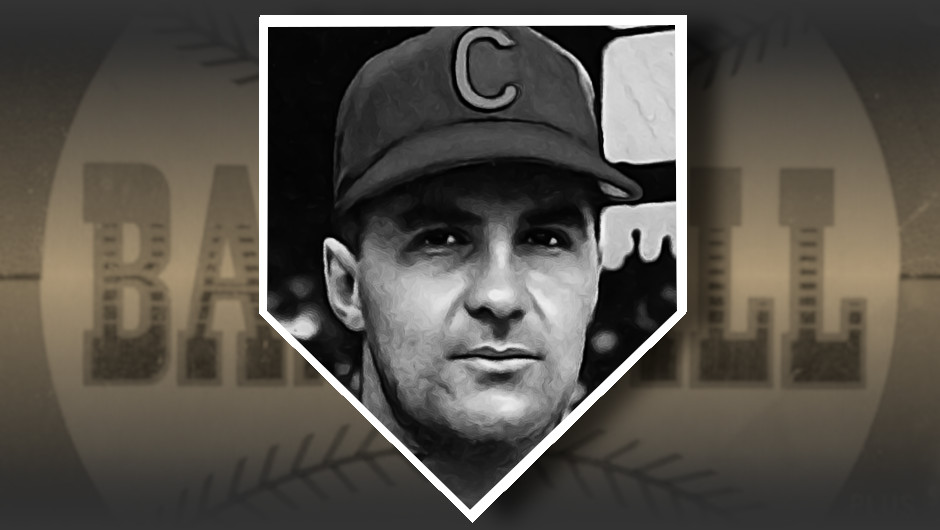
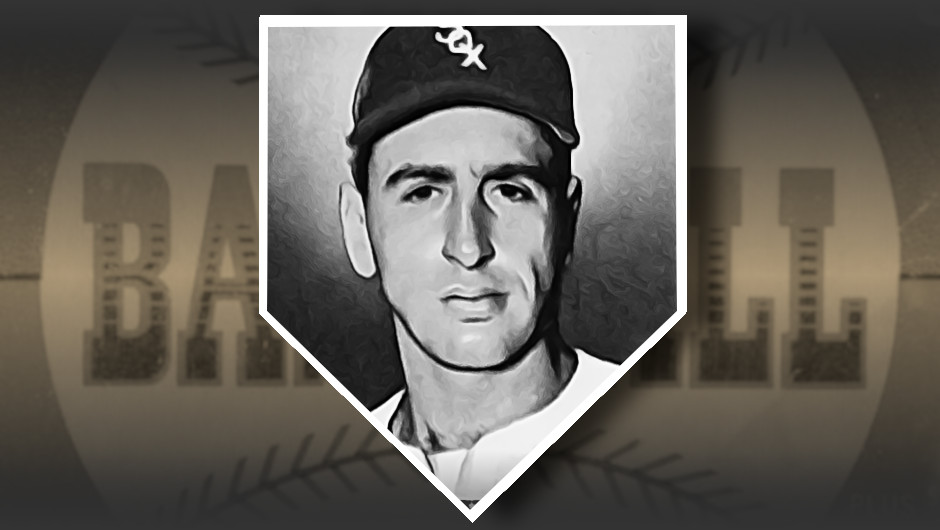
Saul Rogovin looks tired on his ’52 Topps baseball card. I guess I shouldn’t be surprised. He had relocated to Chicago from Detroit following a mid-season trade. He had just thrown 217 innings, and done so effectively enough to capture the 1951 American League ERA title. He had allowed only 67 earned runs in that span, accompanied by a dozen more unearned runs that cost him several victories. He was tired of waiting for his fielders to stop throwing the ball away.
Eventually it was his arm that tired, leading to a career 48-48 record, which obscured a tendency to get all his wins out of the way at the start of the season before evening out the tally with losses in the back half. The arm soreness was a recurring part of his career, leading to multiple stints on the disabled list and even some time in jail (a Venezuelan winter league team owner was unhappy that his expensive American import refused to pitch through arm soreness and had him hauled off for breach of contract).
Rogovin himself was perpetually tired, often falling asleep during games and in downtime at the ballpark. He had hypersomnia, which is best described as “diet-narcolepsy” or “narcolepsy-zero” in the naming convention of the heavily caffeinated sodas I am currently drinking to stay awake. Sleep simply wasn’t restorative, and he was compelled to keep resting in an attempt to find some way of refreshing himself.
Eighteen years after throwing his last pitch, Rogovin found himself selecting courses for his freshman year of college. The story goes that his guidance counselor told him he would need three physical education credits for his degree, to which Rogovin responded by pulling a baseball card out of his wallet and asking if a nearly 1700 inning career as a professional athlete would suffice. It did. Rogovin spent the 1980s teaching English literature to high school students and, I imagine, showing his wallet card to students wondering if the rumors were true about their sleepy professor.