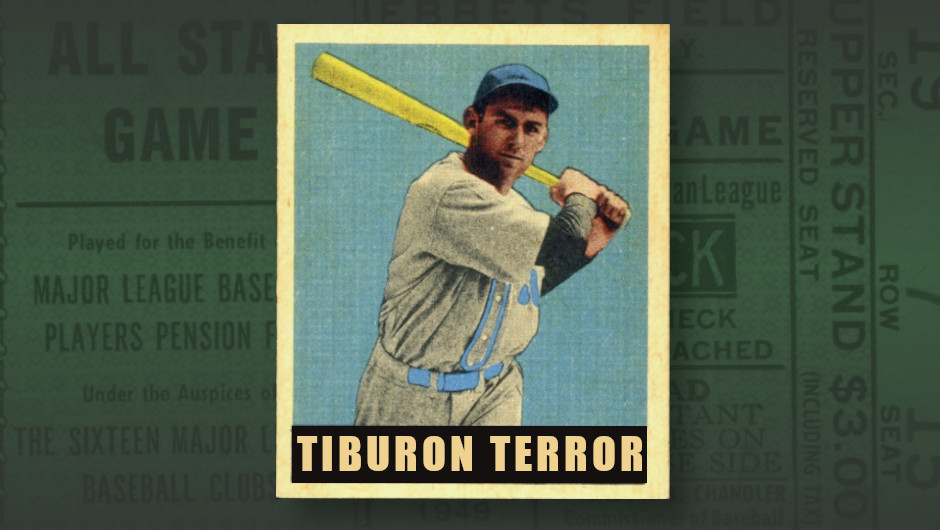
The faintly damp air of late October has arrived and in keeping with the gloom of spooky season, my All Hallows Eve Eve evening’s research project has brought me face to face with a nickname that sounds less like a contemporary of Joe DiMaggio and more like a serial killer stalking foggy pullouts on the Pacific Coast Highway.
Card #26 features a Bay Area native known as “The Tiburon Terror.” And which name in the checklist hides this alter ego?
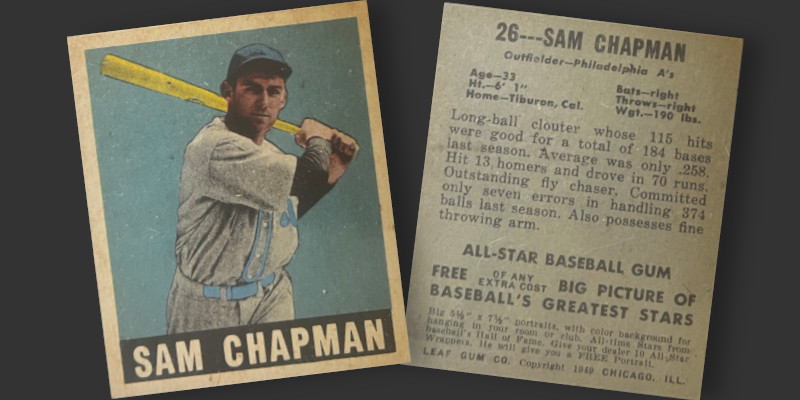
The irony is that Samuel Blake Chapman was as bloodthirsty as a golden retriever. Before the sportswriters of Northern California turned him into a mythical Bay Area monster, his Marin County teammates and coaches referred to their preternaturally calm classmate as “Sleepy Sam.” He looked less like a mysterious slasher and more like the All-American face of a mid-century action serial sponsored by canned soup. Yet if you look past the unflappable exterior and examine the trail of opponents he left in his wake across Northern California athletic fields, you can begin to imagine how a mild mannered kid managed to instill genuine fear in opposing dugouts.
Chapman was born on the northern end of the San Francisco Bay in Tiburon, California. He attended high school in Mill Valley, where he proceeded to letter in each of the four primary varsity sports. His football coach was Roy “Wrong Way” Riegels, the guy who cost the UC Berkeley the Rose Bowl by capturing a fumble and running it to the wrong end zone, setting up a safety that proved to be the decisive margin in an 8-7 loss. Riegels recognized Chapman’s innate talent and promptly steered him towards Berkeley as a belated way of making amends.
Throughout college (without an athletic scholarship), Chapman spent time as part of a construction crew building the Golden Gate Bridge. While modern high school prospects are weirdly obsessing about pickle juice and documenting their exit velocities on social media, 19 year-old Sam Chapman was hanging off iron beams over a swirling strait as a welder’s assistant atop one of the engineering marvels of the Western world.
At Cal, Chapman turned into a two-sport force of nature. In the fall, operating out of the single-wing formation as a halfback, he anchored the 1937 “Thunder Team.” They massacred opposing teams in an undefeated season, outscoring opponents by a ludicrous 201-33 margin, and then shut out Alabama 13-0 in the 1938 Rose Bowl. This remains, nearly 90 years later, the last time Cal won the Rose Bowl.
He casually earned All-American honors in baseball too when the weather turned to Spring. Professional sports teams immediately sought him out with competing offers. He was drafted by the Washington Redskins in the third round of the 1938 NFL Draft. Simultaneously, MLB’s Detroit Tigers and the NFL’s Detroit Lions attempted an unprecedented joint custody arrangement so that he could play outfield for the Tigers all summer and run the football for the Lions every fall.
So how did he end up wearing a Philadelphia Athletics jersey on a Leaf baseball card instead of a leather helmet? That was Ty Cobb’s doing.
The Georgia Peach caught wind of Chapman’s West Coast exploits and reached out directly to Connie Mack to urge immediate negotiations. Cobb interceded directly with Chapman when both the New York Yankees and Cleveland Indians came calling with $9,000 offers. Cobb definitively told Chapman that Connie Mack knew more about baseball than anyone alive, advising him to sign Mack’s lower $6,000 offer for the sake of his development. Chapman trusted Cobb and signed with the A’s.
This development involved zero minor league appearances. Instead, Chapman, who had previously only played infield positions, was issued a pair of sunglasses and made the team’s starting centerfielder in a big-league game against Cleveland. Late in the game, he chased a fly ball and lost track of it against the sky when he flipped his glasses down. The ball hit the ground and, panicking like Scottie Smalls in The Sandlot, he promptly spun around and fired the ball deep into the outfield stands. Mack greeted his embarrassed return to the dugout by complimenting his arm strength.
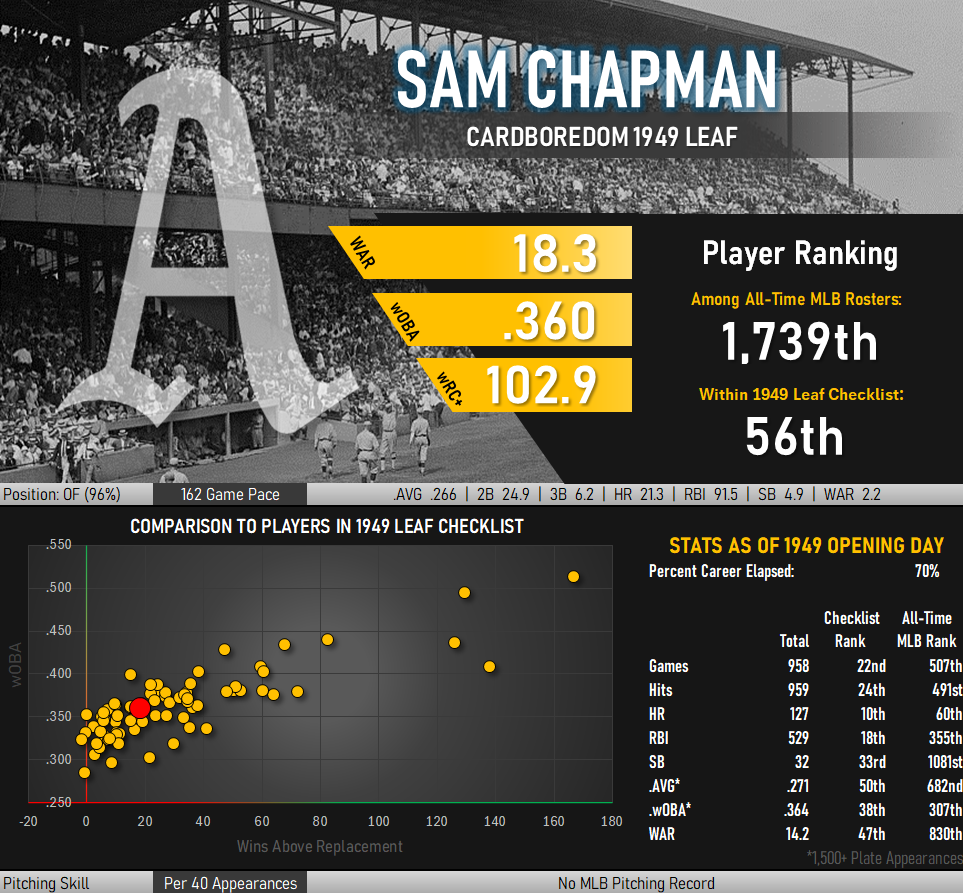
The next season he hit for the cycle, following up that performance with a multi-homer game that included a grand slam. By 1941 he was among the top outfielders in the American League. In a season defined by DiMaggio’s 56-game hitting streak and Ted William’s batting .406, Chapman quietly posted a .322 average with 25 HRs, 106 RBIs, and 300 total bases for a last place Philadelphia squad. He stepped away for three years of military service as a flight instructor, and when he returned, he was named to the All-Star Game starting outfield between Joe DiMaggio and Ted Williams.
After a brief trade to Cleveland in 1951 and a hometown victory lap with the Pacific Coast League Oakland Oaks, Chapman stepped away from professional sports in 1954. He didn’t open a bowling alley or make a living as a television pitchman. Instead, armed with a chemistry degree from Cal, he spent two decades quietly patrolling the Marin County hills and monitoring exhaust plumes as an air quality inspector for the Bay Area Air Pollution Control District.
I’ll close this out with one final thought to mull over while you pass out candy this weekend. History records Chapman spending decades quietly roaming the isolated highways of foggy cliffsides of the Bay Area during the late 1960s and early 1970s in his role as a pollution inspector.
While I am no true crime podcaster, I feel obligated to point out that nobody ever saw The Tiburon Terror and the Zodiac Killer in the exact same room at the exact same time.
Happy Halloween.