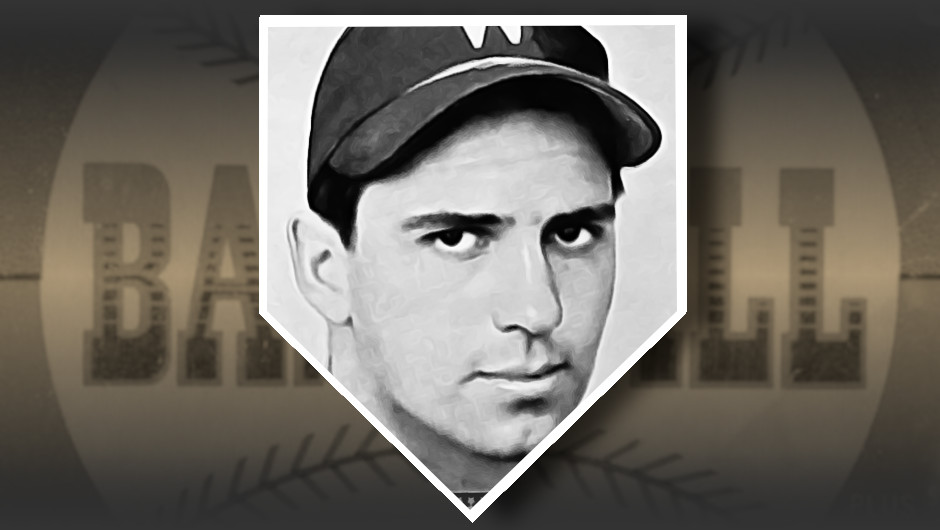
Don Johnson started his career by getting off train at the wrong station, and it kicked off a series of odd stories that would follow him through the rest of his life.
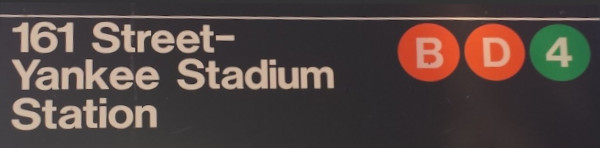
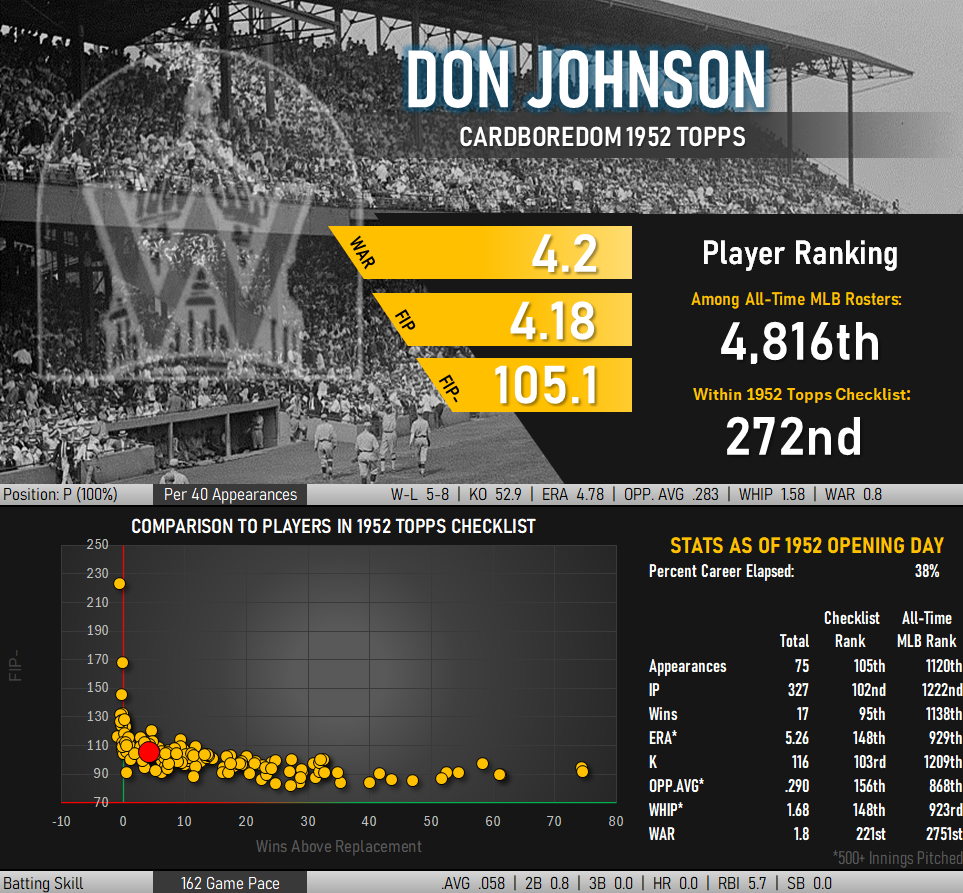
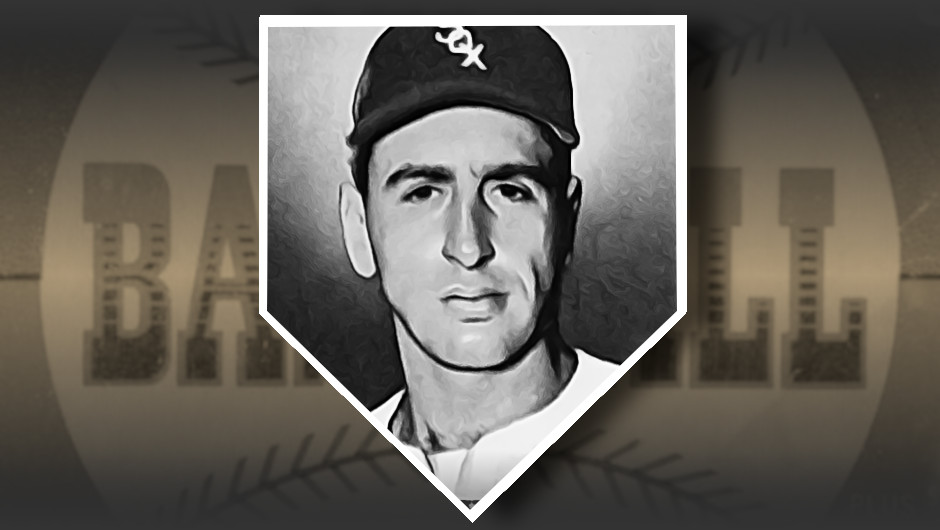
I’ll get to those in a moment, because first I need to confess that I almost got off at the wrong stop myself when sitting down the write about my Don Johnson baseball card. There wasn’t anything interesting in the stats. The biographical text was meh. The photo on the front is as generic as ’52 Topps gets, right down to the airbrushed Washington Senators logo on his cap despite the presence of Yankee pinstripes visible on his tightly cropped shoulders. I was so desperate for a narrative hook that I briefly considered using his name as part of some sort of Miami Vice joke, then I remembered that that TV show ended its run before I even took up Little League. I wouldn’t know what I was even talking about.
That’s when I went to the map by pulling up the SABR archives on this guy. I found a recording of an hour-long conversation between Johnson and Brent Kelley in SABR’s Oral History Archive.
Stop One: 125thStreet
Don Johnson, accustomed to the West Coast, found himself navigating the New York City MTA trains to get to his first Major League appearance in 1947. Signed as a teenager but temporarily shelved for wartime service, Johnson was finally going to get the ball in an early season double header against the Athletics. All he had to do was get to the game on time.
Boarding the D Train, usually a straightforward affair for quickly transiting the length of Manhattan, Johnson found himself emerging from the subway steps at 125th Street. That is squarely in 1940s Harlem, about 36 blocks from where he was supposed to be. After walking a block, he came upon an absurdly pink Cadillac parked on 124th. Johnson, who by his own account didn’t overthink things, walked up to the car and asked the man inside for directions to Yankee Stadium. The man sitting in the Caddy was nonother than Sugar Ray Robinson, who was the reigning welterweight boxing champ with a 77-1-1 record.
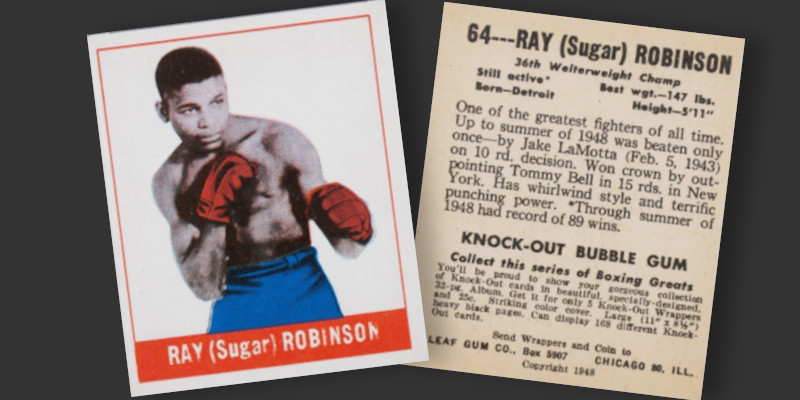
Johnson recalled this being a relatively short conversation. Upon learning that he was lost, Robinson emphatically told Johnson that he had to get out here. The door swung open and Robinson gave Johnson a very unexpected ride to the Bronx. Before climbing out of the car, Johnson made sure to get more than just directions or a ride to the ballpark: He got Robinson’s autograph too.
Stop Two: Taking it to the Bank
Johnson’s baseball cards will gladly tell you that he could throw the ball hard, reportedly getting the ball across the plate at speeds above 90 mph as a teenager in a much slower era. The stats printed below the text, however, imply that he had no idea where the ball was going to go once it left his hand. As such, the Yankees signed him to play at an annual rate of $5,000 (plus the potential for sizeable World Series shares), which Johnson repeatedly tells his interviewer is the same as the team paid Mickey Mantle the following season.
Stop Three: Wool
The interview took some detours I did not see coming. It turns out Johnson was allergic to wool. Putting on a uniform, baseball or otherwise, gave him eczema. This would probably be a footnote in most lives, but Johnson served in World War II and the United States Army was not a wool-free environment.
The allergy almost got him dismissed from service, but his Army commanders also wanted to win baseball games. They found a way to keep him on the local base and his team won more than 40 consecutive games. There has to be a file somewhere in the National Archives containing both the words itchy and forty in the same folder.
Stop Four: Jackson Hole (Maybe)
The year following his 1947 Yankee Stadium debut, Johnson was sent down to the minors for additional seasoning. He split almost identical time between the Yankees’ Kansas City affiliate and the Portland Beavers of the Pacific Coast League. These weren’t the subway commutes of New York. Johnson had to drive.
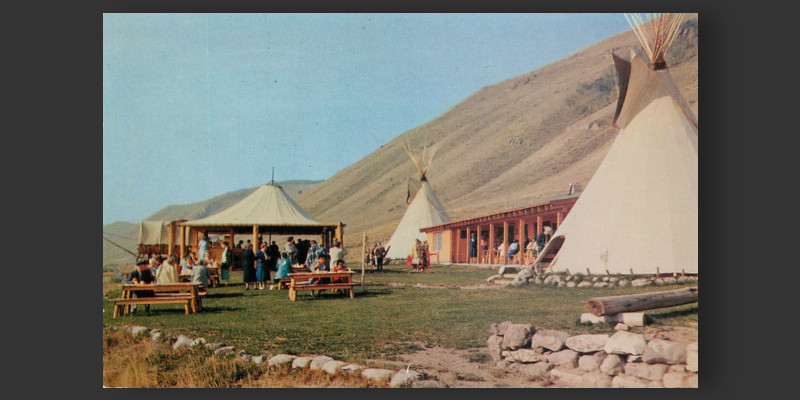
His car died somewhere in Wyoming between Kansas City and Portland. Johnson pawned his recently acquired ’47 World Series ring to pay for the repairs. Adding to the absurdity of a reigning World Series championship ring sitting in a Wyoming pawn shop is the fact that he reported sleeping in a teepee while waiting for the car to be fixed. Going by the description of events, I’m fairly sure he ended up at the classic Old Wyoming Chuck Wagon in Jackson. He couldn’t catch a break, but he could certainly catch a good story.
Stop Five: Havana
Johnson also mentions pitching in the Cuban Winter League against a team that included Fidel Castro. That bit of trivia arrives out of nowhere, and sent me down a series of rabbit holes looking to see if any American pitchers ever threw a brushback against El Comandante. It turns out Johnson’s story has a bit of tall tale flair to it, as Castro didn’t play professionally and barely cracked his intramural team as a freshman at the University of Havana. Castro’s name didn’t gain international notoriety until almost a decade later, so the pitching duel is almost certainly an embellishment.
Stop Six: The Taxi
After baseball, Johnson settled into the driver’s seat of a cab. One afternoon a robber shot him through the neck and tried to run off with nineteen dollars. Passersby managed to get Johnson to an emergency room and he survived. When he returned to the wheel, he was immediately robbed a knife-wielding man. Shortly after sorting that out with the police a drunk fare hit him over the head with a bottle.
The Man in the Next Seat
One thing that seems to run as an undercurrent below the surface of the interview is Johnson’s propensity to go out with his teammates. A formative part of his life seems to have been having been taken under the wing of the Yankees’ Johnny Lindell. Lindell was a famously hard drinker and this friendship seems to have created off-field problems for Johnson. A kid with a live arm and no control learning from a teammate with no control is not an optimal seating arrangement.
Where the Card Takes You
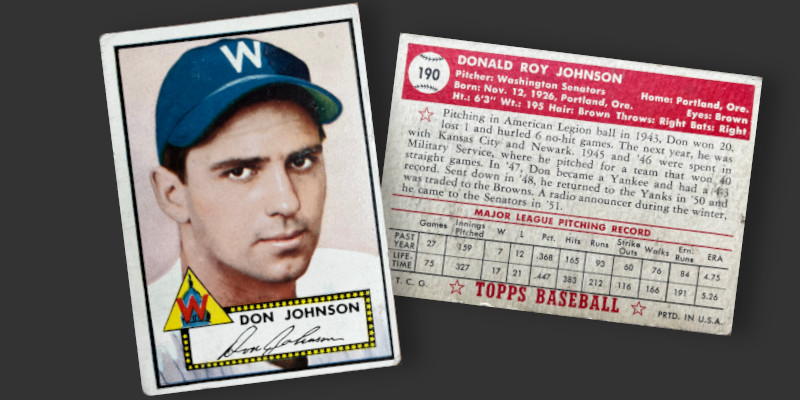
Flip over Don Johnson’s ’52 Topps baseball card. The biography on the back says he works as a radio announcer in the offseason. He never mentions this in the interview. Maybe it was a brief role, unrelated to this baseball career. Maybe Sy Berger tidied up his biography for the cardboard. Perhaps it’s just another station he got off at by accident and didn’t think was worth recounting. Johnson, after all, was a guy who could walk into the wrong neighborhood and come out with Sugar Ray Robinson.
This card tells you about the stops the train was supposed to make. Hearing from the man himself tells you where he actually went, and it’s a much better ride.