I’ve spent years much of the last 20 years returning over and over again to a particular essayist whose convictions have at times diverged sharply from my own, yet whose writing possessed such clarity and force that I emerged from each encounter refreshed, even exhilarated, regardless of whether he had persuaded me. The pleasure wasn’t in finding agreement but in the quality of the disagreement itself, in watching a skilled craftsman arrange evidence and construct an edifice of reasoning so sound that even those unconvinced must admire the architecture. I consider these literary arguments to be enjoyable sparring rather than a fist fight, and when executed by a true master they transition further to become an intellectual dance.
This blog represents my own fumbling attempt to develop my writing skills. While much improved in the last five years, this is still something I would not want to go head to head with against a professional in the field of argument.
There’s a famous Monty Python sketch in which a man enters a business offering arguments for sale, only to find himself embroiled in a dispute about whether he even has an appointment. The comedy lies in the the disagreement over the appointment actually being the purchased argument, though the confused customer doesn’t realize it until he is well underway. The whole joke operates on multiple levels, the greatest being that the customer believes he was involved in preliminary sparring before the real bout, when in fact he had been locked in genuine combat the entire time. I think about this sketch whenever I consider the case of Mike Garcia, a pitcher whose Hall of Fame credentials were never seriously debated for the simple reason that no one bothered to schedule the appointment.
Baseball is built around arguments. The game unfolds slowly enough to permit constant second guessing of strategy, performance, and historical legacy. Statistics pile up in sedimentary layers, with each generation adding new strata of analytical complexity. Some players find their careers taking place in ideal conditions and are fossilized into our memories over time, while others are quickly buried and fade into the dusty backdrop.
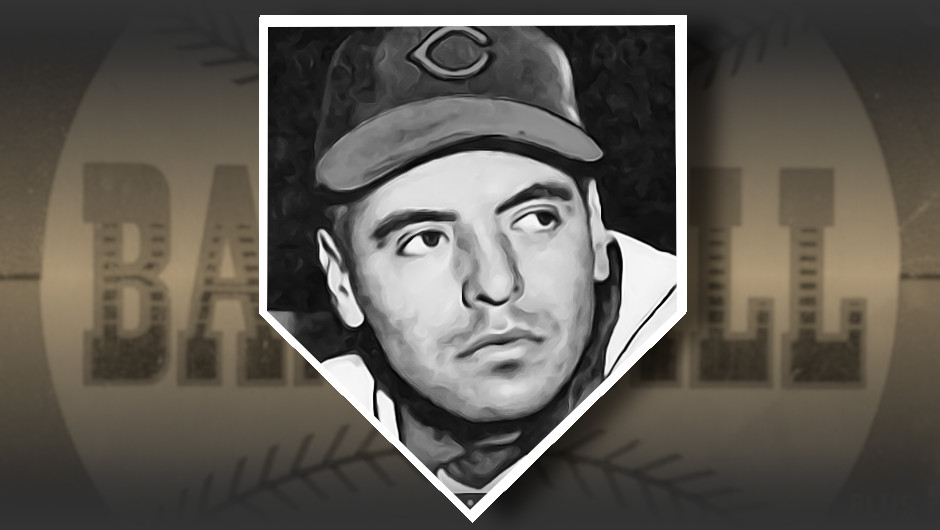
Mike Garcia provides ideal subject matter for such an exercise precisely because his case combines statistical clarity with institutional neglect. Born to Mexican immigrant parents in California, Garcia harbored childhood dreams of becoming a jockey, an ambition rendered comically absurd when he grew to 6′-1″ and filled out to 220 pounds. Baseball became the alternative, and by the early 1950s he had established himself as part of the Cleveland Indians’ fearsome starting rotation, a quartet of arms that contemporaries considered the finest collection of pitching talent ever assembled on a single roster. The other three were a still formidable Bob Feller, Bob Lemon, a converted outfielder with a devastating sinker; and Early Wynn, the glowering gruff who would knock down his own grandmother if she dug in at the plate. All three reside in Cooperstown, complete with plaques testifying to careers the baseball establishment deemed worthy of eternal commemoration.
Garcia never appeared on a Hall of Fame ballot. Not once.
He wasn’t voted down after years of consideration, narrowly missing the threshold like some borderline candidate whose statistical profile sparks endless debate. He simply wasn’t invited to the argument. Lesser pitchers received token votes: Morrie Martin garnered two, Bob Porterfield one. The Baseball Writers’ Association of America looked at Garcia’s career and decided it didn’t even merit the courtesy of preliminary consideration, the equivalent of the Argument Clinic’s receptionist informing you that you’re not in the book and should come back when you’ve scheduled properly.
Now, you’re probably shrugging your shoulders about this. Of course Mike Garcia isn’t in the Hall of Fame. How often do you hear his name? Before proceeding further, I’d like to present a modest thought experiment. Below is a statistical comparison of four pitchers, identified only as Players A through D. I invite you to examine these numbers and form your own judgments about relative quality. Note particularly the color coding: the darkest green indicates the best performance in each category, graduating through lighter shades to yellow and ultimately to dark orange for the worst. Look at the distribution of colors and ask yourself which of these four pitchers demonstrated the highest level of sustained excellence.
| STAT | PLAYER A | PLAYER B | PLAYER C | PLAYER D |
|---|---|---|---|---|
| Innings Pitched | 3,827 | 2,174⅔ | 2,850 | 4,564 |
| Win Percentage | 62.1% | 59.4% | 61.8% | 55.1% |
| Shutout Odds per Start | 9.1% | 9.6% | 8.9% | 8.0% |
| Complete Games | 279 | 111 | 188 | 290 |
| Strikeouts | 2,581 | 1,117 | 1,277 | 2,334 |
| KO % | 16.0% | 12.1% | 10.6% | 12.0% |
| Strikeout per 9IP | 6.07 | 4.62 | 4.03 | 4.60 |
| Walk % | 10.9% | 7.8% | 10.3% | 9.1% |
| WHIP | 1.32 | 1.32 | 1.34 | 1.33 |
| HR per 9IP | 0.53 | 0.50 | 0.57 | 0.67 |
| ERA | 3.25 | 3.27 | 3.23 | 3.54 |
| FIP | 3.54 | 3.20 | 3.82 | 3.68 |
| FIP- | 89 | 84 | 99 | 97 |
| WAR | 61.4 | 40.1 | 32.2 | 58.5 |
| WAR per 40 Games | 4.3 | 3.7 | 2.8 | 3.4 |
The patterns emerge with unmistakable clarity. Player B and Player A divide most of the green ink between them. Player C and Player D, meanwhile, swim in seas of yellow and orange, their numbers consistently trailing the others. If you were constructing a Hall of Fame based purely on these metrics, you’d select Players A and B without hesitation, perhaps debate the merits of Player D given his substantial innings total, and likely exclude Player C entirely. The reveal, of course, transforms this academic exercise into something more troubling.
| KEY | FELLER | GARCIA | LEMON | WYNN |
|---|---|---|---|---|
| Cooperstown? | YES | NO | YES | YES |
Garcia, who posted the second-best WAR per 40 games (3.7, trailing only Feller’s 4.3) and the lowest FIP (3.20, more than a third of a run better than Feller and substantially superior to both Lemon and Wynn) never received a single Hall of Fame vote. Despite playing across 14 seasons he never appeared as a choice on the ballot.
Contemporary observers weren’t blind to his talent. Multiple sportswriters noted that Garcia possessed a fastball quicker than Feller’s, a remarkable claim considering Feller’s heater had achieved mythological status. The back of Garcia’s 1952 Topps card, in that wonderfully compressed biographical style Topps favored before statistics colonized all available cardboard real estate, notes he was “the fastest right-hander in the American League,” a designation carrying considerable weight when Bob Feller was still firing heat for the same ballclub.
That 1952 Topps card, incidentally, resides in my collection with corners placing it in that ambiguous condition tier collectors classify as Good to Very Good, which actually means “worse than you’re imagining but better than terrible.” It was issued in the fifth out of six series, making it marginally scarcer than the earlier cards though not nearly as challenging as the infamous high numbers. Garcia shares the fifth series with Lemon and Wynn, whose cards are trumpeted as key names for collectors working on this series, while Garcia’s typically gets dumped into the common bin alongside forgettable middle relievers, backup catchers, and the single vote-getting Bob Portferfield. I acquired mine for common prices, which tells you everything about Garcia’s posthumous reputation.
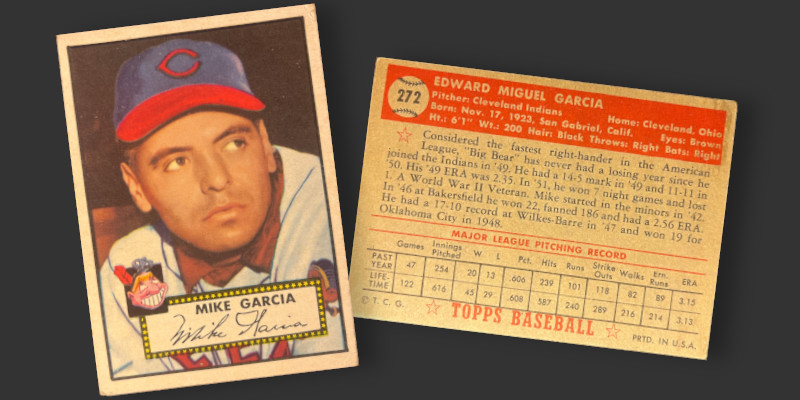
The photograph on the front appears to have been taken at night, Garcia emerging from a black backdrop under sharp artificial lighting. He looks substantial, appearing more less like a jockey and more like a boxer awaiting the bell in a ring corner. The biographical text on the back notes that in the previous season he won seven games against just one loss in night contests, suggesting either a particular aptitude for pitching under the lights or a small sample size that the copywriter transformed into narrative. Baseball card backs from this era traffic in these minor mythologies, converting statistical noise into personality traits. Whether Garcia genuinely excelled at night or simply got lucky over a dozen starts matters less than the larger truth the card accidentally captures: this was an exceptionally good pitcher whose accomplishments have been systematically undervalued.
![[Infographic]: Mike Garcia's career pitching statistics. 40.1 WAR; 3.20 FIP, 83.7 FIP-. Ranks 20th among all 407 names in the 1952 Topps checklist and 283rd among all-time baseball players.](https://cardboredom.com/wp-content/uploads/2025/10/Infographic1952_272_v3.png)
The obvious objection concerns longevity. Garcia appeared in only 2,174⅔ innings across his career, a total that, among pitchers enshrined in Cooperstown, exceeds only representatives of the bullpen. He pitched effectively for roughly a decade before arm trouble curtailed his effectiveness and led to his exit. His strengths are most apparent through modern metrics, spotlighting his omission from the ballot as an even larger oversight the further removed we become from the voting of the 1960s. The argument for Garcia’s exclusion writes itself: Insufficient career length, inadequate counting stats, a peak too brief to offset the absence of longevity.
But here’s where the argument grows thornier, where we venture beyond merely lamenting Garcia’s absence and begin questioning his teammates’ presence. If Garcia, with his superior FIP and WAR generating capacity, lacks the credentials for Cooperstown, by what logic do Lemon and Wynn qualify? Lemon pitched more innings (2,850) but posted an inferior FIP (3.82 versus 3.20), worse WAR per 40 games (2.8 versus 3.7), and a higher ERA (3.23 versus 3.27, admittedly negligible). His case rests almost entirely on accumulation: he lasted longer, therefore he belongs. Wynn accumulated the most innings (4,564) and reached the iconic 300-win threshold, but his rate stats trail Garcia’s across nearly every category. His FIP- of 97 indicates he was merely above average for his era; Garcia’s 83.7 puts him on par with Nolan Ryan, “Sudden Sam” McDowell, and Tom Seaver.
The counterargument holds that Lemon and Wynn demonstrated the durability that separates great players from merely excellent ones, that staying healthy and effective constitutes its own form of achievement. Fair enough, and this is a point I generally agree with.
I don’t want to overstate this case. I’m not convinced Garcia belongs in the Hall of Fame. The longevity argument carries weight. What troubles me is the absolute certainty with which Garcia has been excluded from even preliminary consideration while lesser pitchers received enshrinement. The Hall of Fame voting process resembles the Argument Clinic in reverse: Lemon and Wynn were waved through without serious debate, their appointments confirmed before anyone thought to question whether the dispute over their credentials merited scheduling in the first place. Garcia, meanwhile, never got past the receptionist, his case dismissed as so obviously insufficient that engaging with the evidence would constitute a waste of everyone’s time.
The statistical record suggests otherwise. When you color-code the numbers, when you strip away the names and examine the performances blindly, Garcia emerges as arguably the second-best pitcher in that vaunted rotation, trailing only Feller and clearly superior to both Lemon and Wynn in rate stats and efficiency. His fastball was legendary among those who faced it. He pitched for a genuine dynasty, contributing meaningfully to one of the great teams in baseball history. He just didn’t do it long enough to accumulate the counting stats that provide the easiest path to Cooperstown, and once his window closed, the institution collectively decided his case wasn’t worth the bother of serious examination.
I keep returning to those Hall of Fame ballots that found room for Morrie Martin (38-34, 4.29 ERA) and Bob Porterfield (87-97, 3.79 ERA) but not Mike Garcia, and the explanation that he simply wasn’t good enough starts to feel inadequate. Someone looked at Garcia’s career and decided it didn’t warrant even a single vote, a courtesy vote, an acknowledgment that here was a pitcher worth briefly considering before moving on to more serious candidates. That strikes me as less a judgment than a dismissal, less an argument than a refusal to schedule one.
The beauty of baseball cards lies partly in their indifference to these institutional hierarchies. My ’52 Topps Mike Garcia occupies the same box between Lemon and Wynn, separated by less than 5 cards in either direction. The cardboard doesn’t know or care that two of these men have bronze plaques while the third was deemed unworthy of taking the trouble to print his name on a ballot. It presents their statistics and photographs with equal reverence, each player frozen in the same moment of the same season, preserved with the same cheap materials and garish color schemes. In the hermetically sealed universe of vintage cardboard, Mike Garcia is exactly as significant as his Hall of Fame teammates, which is to say he’s whatever significance I choose to assign him. The stats on the card back speak eloquently enough.
The contemporary accounts of his fastball, the color-coded statistical comparisons, the simple fact that he held his own in a rotation with three future Hall of Famers, it all exists independent of Cooperstown’s blessing. The Hall of Fame serves an important function in baseball culture, providing a shared reference point for greatness and sparking exactly the sort of friendly arguments that make the sport endlessly fascinating. But it’s not infallible. It makes mistakes, both of inclusion and exclusion, and pretending otherwise grants the institution more authority than its track record warrants.
Mike Garcia was very likely a better pitcher than Bob Lemon and possibly better than Early Wynn. He almost certainly deserved more Hall of Fame consideration than he received, which is to say he deserved any consideration whatsoever. Whether he merits induction remains genuinely debatable. What’s not debatable is that the case should have been heard, the appointment scheduled, the argument conducted. Instead, baseball’s institutional memory has consigned him to footnote status, the fourth name in discussions of the Big Four rotation, the odd man out when the hall calls for Cleveland’s pitching legends.
I think of the Argument Clinic sketch’s final revelation, when the bell sounds and the participant realizes the preliminary dispute was the actual purchased argument all along. We’ve been having the wrong debate about Mike Garcia for decades. The question isn’t whether he belongs in the Hall of Fame, reasonable people can disagree, longevity matters, and lines must be drawn somewhere. The question is why his case never merited serious consideration in the first place, why we collectively decided this stocky right-hander with the heavy fastball and superior rate stats didn’t even warrant the courtesy of debate. That’s the argument we should be having, though, as seen by a lack of appearance on the 2025 Eras Committee docket, I suspect the appointment book remains stubbornly empty.
For now, I’ll settle for my 1952 Topps card, with its nighttime photography and its note about Garcia’s dominance under the lights, and the casual assertion that he was the fastest right-hander in the league. The cardboard tells a story that Cooperstown refuses to acknowledge, preserving a moment when Mike Garcia stood as an equal partner in baseball’s greatest rotation. I don’t want to argue anymore. I just want to look at my baseball card and wonder what might have been if someone had bothered to schedule the appointment.