So what the box score doesn’t tell you is that Whitey Kurowski never saw it coming.
It’s Game 3 of the 1943 World Series. Kurowski is intently watching a rookie Yankees infielder navigate the losing side of the plate in a 2-1 eighth inning. There’s a man on second, but Kurowski is an All-Star who already knows the exact footspeed of the man who will almost certainly come his direction when the inevitable bunt comes. The lanky Al Brazle, in line to pick up the save, rears back and lets the ball fly towards the batter. The runner breaks for third, and the batter is already breaking out of the box as he lays down a bunt that races him down the first base line.
Kurowski is ready. He’s been in this situation dozens of times in the Cardinal’s pennant run. He plants his right foot on the bag and extends his glove for the throw that will surely be coming his way. First baseman Ray Sanders picks up the rolling ball and fires it a low, true line directly to the waiting mitt with plenty of time. The approaching footsteps are telling him exactly where his target is without the distraction of visual verification. Kurowski is already picturing the arc that glove will take when he makes the tag.
What he doesn’t see is the 6-foot-4, 220-pound outfielder who left his feet somewhere between him and the shortstop. Kurowski has just a moment to realize that the footsteps have disappeared before a voice, already airborne, hollers the only warning he’s going to get.
“CANNONBALL!”
The world goes sideways. The ball pops loose. Somewhere through the growing fog of concussion and dimming vision, he has a momentary glimpse of an upright Johnny Lindell brushing dirt off his uniform on the bag Kurowski had been guarding a moment ago. The Yankees are about to score five runs.
I like replaying that play in my head and I love it every single time. It was a perfectly clean hit, but I would have hated the guy who carried it out.
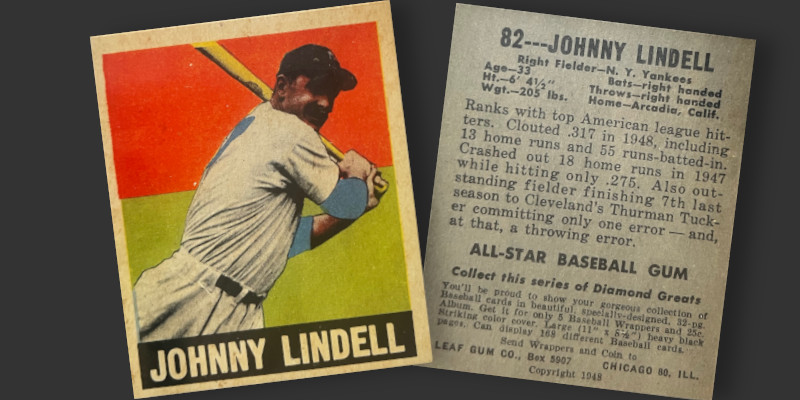
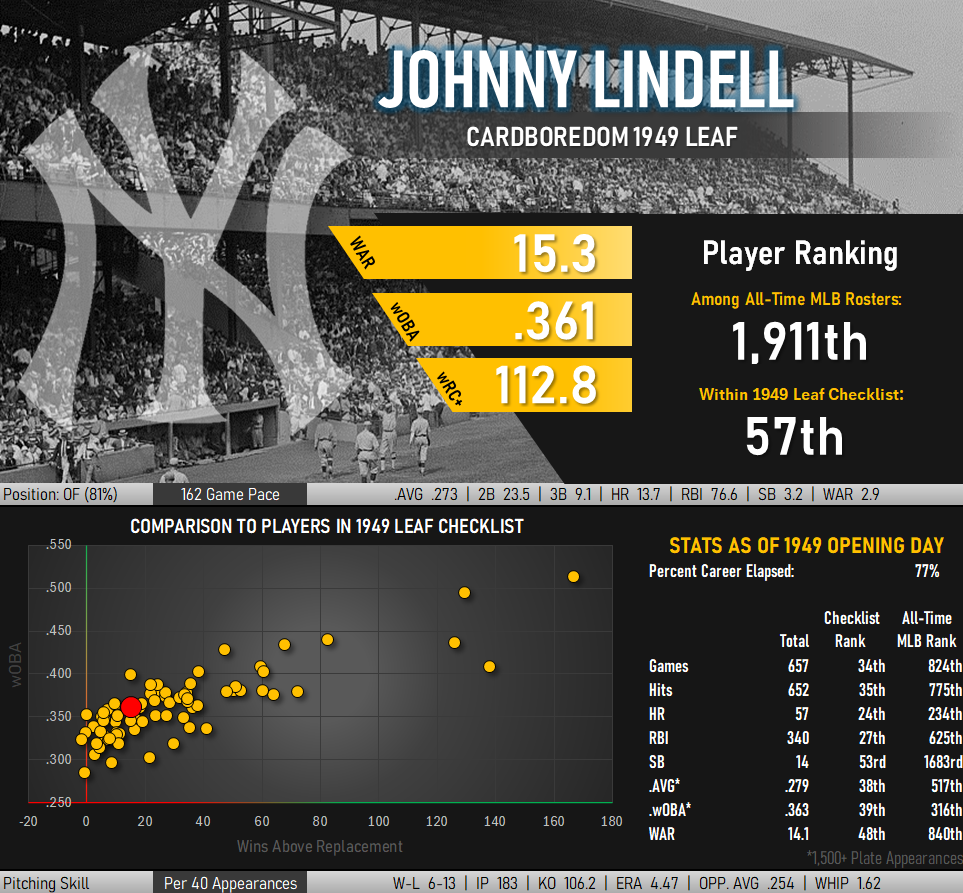
Lindell arrives as the sixth addition in my attempt to complete the ’49 Leaf baseball card set. We get a color block background alongside Lindell posed and cropped somewhat like the figurehead on a sailing ship. The back fills us in on all the heroics: a .317 batting average, the use of the suddenly popular phrase “crashed out,” and an odd sentence highlighting how good is fielding is by downplaying his only error as one that sort of doesn’t count because he was throwing the ball and not catching it.
His Bowman cards from 1948 and 1949 have much more interesting biographical notes, so much so that the same text was used for both cards. For starters, we find out Lindell started off as a Yankees pitcher before he was converted into a slugging outfielder. A year after stepping off the mound he was leading the American League in triples, and he followed that up the next season by hitting even more triples. Also, and this will become a funny if not a bit alarming fact later on, Lindell worked as a police officer during the offseason.
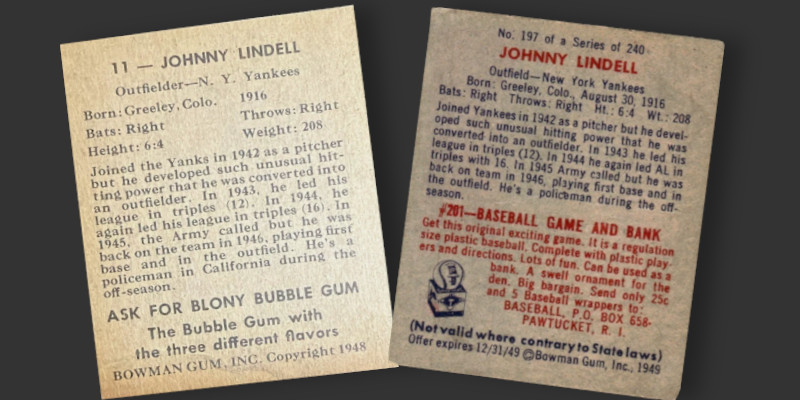
He was a pretty good ballplayer. He led the American League in triples more than once, a stat personifying the kind of full-speed aggression that got Whitey Kurowski knocked unconscious. When his legs slowed down, he didn’t retire. He taught himself the knuckleball and pitched his way back into almost 200 innings of work with the Pirates and Phillies in 1953. He essentially bookended a career built on chaos with a pitch designed to be unpredictable.
David Halberstam, in his Summer of ’49, remembers him less as an outfielder and more as the “court jester” of the whole operation. Nowhere are comedians more commonplace than a venue with a liquor license, and in 1940s Manhattan there was no bigger stage than Toots Shor’s.
This wasn’t your typical saloon. It was partly a showcase of baseball aristocracy (Joe DiMaggio had a reserved corner booth), part nighclub, and somehow a fully interactive comedy roast. Shor would insult patrons personally. He operated on an inverted logic where the more he mocked you, the more you loved. The “ribbon clerks and crumbs,” those civilians that wandered into the establishment and didn’t get the joke, were given their drinks but generally ignored. Shor was a big personality, and he particularly enjoyed those that could keep the jokes (and drinks) going.
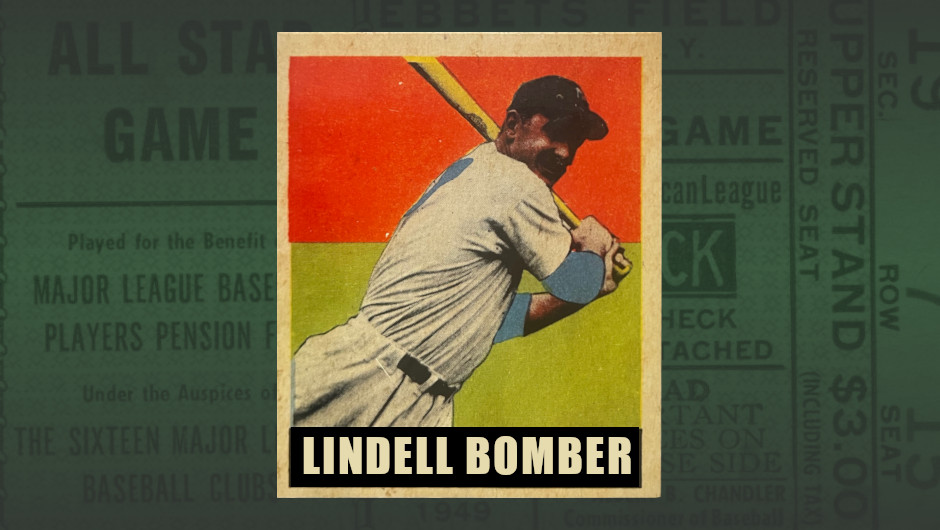
Lindell was tailor made for this setup. The story goes that he found standard cocktail glasses to be offensive on principle. What is this, a drink for ants? He wanted a martini that could be seen from across the room so Shor, who loved a good comedic bit more than he loved rules, tracked down a piece of glassware described variously as either a fishbowl or an actual birdbath, and filled it with several martini’s worth of gin and vermouth. Lindell would raise his birdbath, toast the room, drink the entire thing, and to much applause declare the festivities to be officially underway. The cocktail was christened the Lindell Bomber, apparently the only such drink in baseball history to be named after a man’s inability to handle a normal-sized anything.
This wasn’t a drink so much as it was performance art and a good performance needs an audience that is a little bit afraid of what the performer might do next. That fits the Yankees clubhouses of the late 1940s and early 1950s, and to completely understate the situation, Lindell was a terror of crude slapstick.
Phil Rizzuto, his diminutive roommate, was the most frequent victim. He was by every account absolutely terrified of bords. Lindell was keenly aware of this and made a habit of hiding live birds in Rizzuto’s dresser drawers so they would explode into flight the moment he went to retrieve his clothes. During a rain delay Lindell passed the time by coaxing earthworms out of the damp soil and methodically stuffing them into the finger holes of Rizzuto’s mitt. The shortstop only discovered their presence when he took the field and put his hand into the glove.
Nobody was immune from the guy. Not even Joe DiMaggio, who seemed allergic to physical touch and could stare down a impertinant rookie until they withered away from shame. Lindell, a failed pitcher who first put on pinstripes after Joe DiMaggio’s locker was already overflowing with MVP plaques, had no problem sneaking up on the famously proud Yankee and mussing his hair like he was a golden retriever. He once referred to DiMaggio as “hey, beautiful” when he wore a Hawaiian shirt to the clubhouse, prompting DiMaggio to promptly forgo ever wearing that shirt in public again.
Fueled by a need for chaos and birdbath quantities of alcohol, Lindell kept pushing the envelope. Halberstam recounts Lindell sneaking up on teammates laid out on the clubhouse trainer’s table, dropping his pants, and whacking them on the face with his…um…equipment. Veterans Phil Rizzuto and Joe Page were reportedly frequent victims of this.
Lindell would also take Yankees rookies under his wing and proceed to get them staggeringly drunk, a habit that gets sobering real fast when you realize the destructive habits developed by newcomers under his care like Mickey Mantle, Billy Martin, and Whitey Ford. The rookies he tortured into drinking contests they could never win were also the rookies who ended the night feeling like they were part of a championship roster. Cruelty and welcome, all dispensed from the same glass.
It was the highly public deprivations like these that prompted Daily News columnist Joe Trimble to label Lindell a “plain, unadulterated bum” in print. A normal human shrugs and moves on. Lindell reportedly cut the column out, kept it in his wallet, and carried it as ammunition to wave around at the exact moment it would embarrass someone else the most. Trimble wasn’t wrong. Lindell was the ultimate frat-bro.
I chose to introduce Lindell via the scene of Kurowski laid out with ears ringing in the infield dirt for a reason. This was Lindell distilled into a single action. He was talented enough to legitimately win you a World Series game, but constitutionally incapable of ever doing it quietly. Lindell got a birdbath-sized cocktail while Kurowski woke up with the headache.