
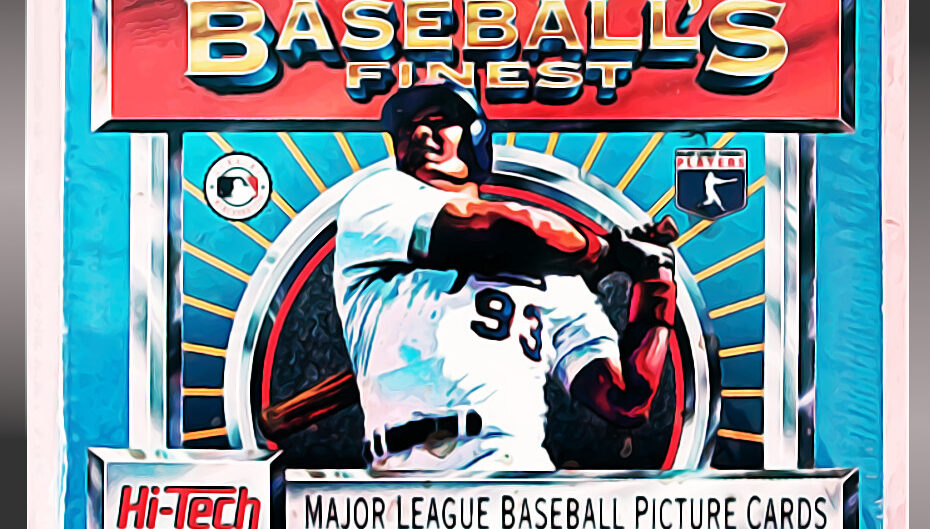
My baseball card collection includes an unopened pack of 1993 Finest, which means I know the contents of all but six cards in my 774-card collection. It is the only piece of unopened material in my possession and “Schrödinger’s Refractor,” as I like to think of it, contains something different for everyone who looks at it. Inside there are simultaneously 199 different refractors, a shiny card of your favorite player, another that can be traded for almost anything you want, or six commons accompanied by the collective cry of disappointment coming from a casino table that just rolled snake eyes after an epic run attracted a crowd of onlookers. It’s the rush of playing the game that matters, not the outcome. The real value is that wrapper, which is simultaneously author and arbiter of that mystery.
I was actively collecting cards when these first arrived in the hobby. I remember (briefly) catching glimpses of these packs at card shops. I have a visceral memory of watching a feeding frenzy of collectors develop when a box was opened at a particular show. These cards were different. A room changes when a 10 walks into it.
I have since built the 199-card refractor set, which carries with it enough hearsay and mythology to elevate it to a literal legend in the hobby. If the actual cards have this much invented folklore behind them, imagine the ghost stories drifting in and out of the mists surrounding the ones that have yet to be opened. Since returning to collecting I have taken notes whenever a box of ’93 Finest gets opened. I have the cards, the order they were pulled, and the inferred models of their packaging. I want us to gather around a metaphorical campfire to look at what is actually known about the dwindling number of unopened boxes of Finest.
How many boxes were made and how were they distributed?
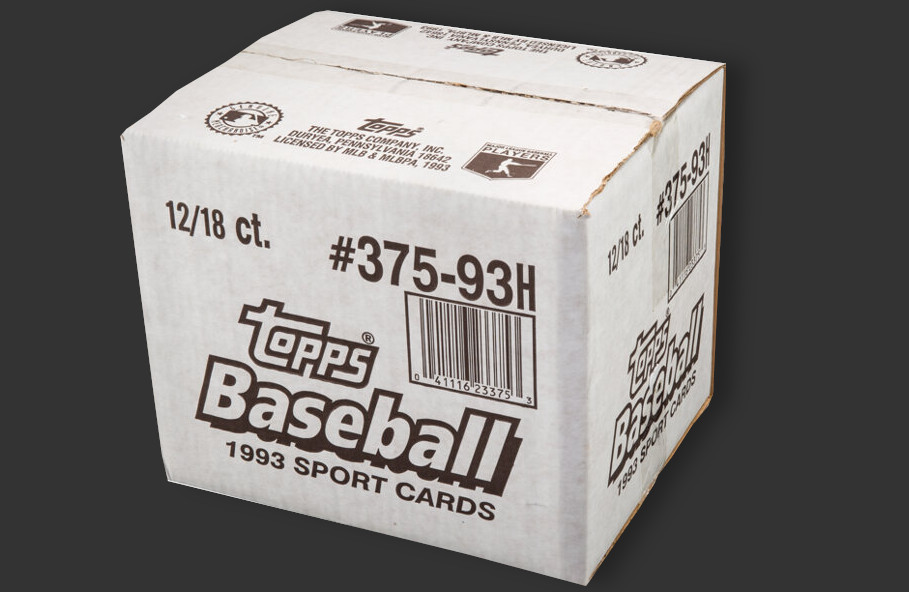
Topps manufactured 48,000 boxes of Finest cards in 1993. The firm announced the full production run would encompass exactly 4,000 dealer cases that each contain 12 boxes of 18 packs. With six cards per pack, this implies there are 26,050 copies printed for each name in the 199-card checklist, inclusive of refractor parallels. This was the first time a major manufacturer had announced the full extent of their print run, and the quantity of base cards released was to be less than 3X the production of the Donruss Elite cards that had taken the hobby by storm just two years earlier. I cannot overstate how unfathomably different this was compared to the abundance of cards being pumped out by the literal truckload. The entire print run of all ’93 Finest would have fit inside a trio of 40′ shipping containers. Where those pallets went sparked a controversy.
Your local card shop primarily got its Topps products in one of two ways. They curated an assortment of Topps products to carry, independently assessing the commercial viability of each product and ordering them by the case. The other way to stock the shelves was to have a standing order with Topps to take delivery of anything the card manufacturer shipped in their direction. The latter resulted in robust inventory but the occasional useless pallet of Topps Coins or Topps Big.
Topps introduced Finest to the hobby in late July at the 1993 National Sports Collectors Convention. The cards left Topps’ facility in the final week of August, and some collectors still have their receipts showing pick up dates later that week as the calendar flipped to September. Because of the limited size of the production run, the shops with standing orders received allocations leaving nothing for those going the manual order placement route. The result was the packs becoming highly concentrated in a distribution bottleneck. Collectors picking up their boxes or being told none would be arriving were witnessing in real time a hobby making the transition from product quantity to product access.
You get a box. What does it look like?
The first tactile impression of a box of Finest is the one that immediately makes you wonder if it is legit. Every factory box came shrinkwrapped in cellophane. There is no branding anywhere on this outer layer, just plain, clear plastic that is nowhere near the tightness of a professional giftwrapper. The only way to determine if this is the factory issue wrapping is to look for two small breather holes that let air escape during the sealing process, one on each “half” of the sealed plastic. The wrapping gets a makeover to tighter, better looking branded plastic if you pick up box from the authenticator BBCE.
If you are used to the massive wax boxes of the junk wax era, the dimensions of a box of Finest cards will come as a surprise. The box is much, much thinner than a traditional 36-count wax box. Six-card packs are arranged in stacks of up to five, meaning the box is barely larger than a stack of 30 cards (thinner than what you find in many cello packs of the era). It’s not much bigger than a boxed VHS tape, which is something you can learn about by asking anyone who opened junk wax when the cards were considered “modern.” The box feels light, like a bag of chips. It is after all, mostly air and foil wrappers.
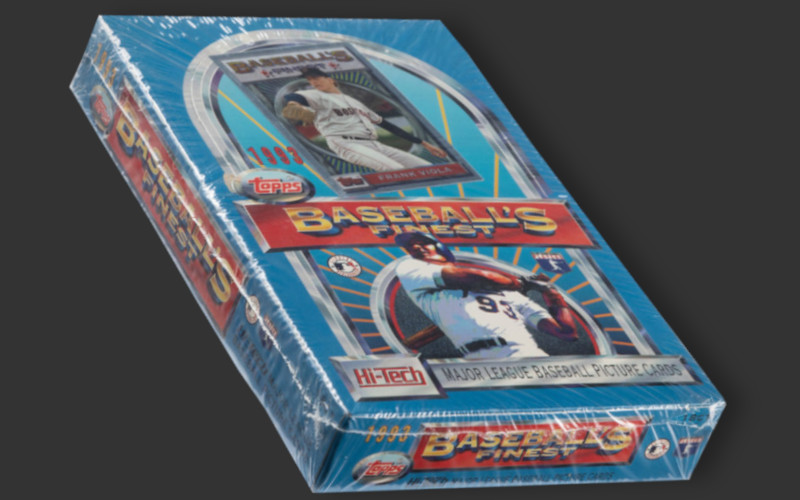
Getting past the useless wrapper, a couple things stand out about the graphic art on the box. First, Topps did a good job of incorporating elements of the underlying cards into the packaging. The silver bevel is present around the items commanding your attention. The blue and yellow sunburst of lines radiating from behind the pictured players closely resemble the cards inside the box, and elements of the card nameplates tell the observer that this box contains “Hi-Tech Major League Baseball Picture Cards.” I wholeheartedly support any manufacturer effort to make the display box look like the cards inside, as this makes identification of unopened products easier and makes for a great display piece when married with a collection of the set.
The box, like the actual cards, states the name of the set as “Baseball’s Finest” rather than “Topps Finest” or just “Finest.”
The player pictured swinging a bat in his new Rangers uniform on every box is Jose Canseco, presumably launching the MLB licensing logo to his left into the upper deck of Arlington Stadium. This is the same photo used on the Canseco card in the Topps Finest checklist. However, instead of the usual number 33 on his uniform we see “93” to drive home the fact that these are indeed 1993 baseball cards.
There is an interesting design element located near the top of each box in the form of a picture of one of the silver base cards in the set. The boxes seem to have an equal distribution of each of the 166 different base cards, and if the junk wax tradition of saving “box bottom” cards is any precedent, there just might be some player collectors who appreciate cutting out these sample blank-backed “box top” cards for their collection. I haven’t heard of anybody actually collecting these, but with only 48,000 boxes produced, this implies 289 theoretical copies of each player. Be careful around sellers claiming these cutout “cards” are blank back errors. The box top cards do not have the fully metallic surface of an actual finest card and have a matte white cardstock background rather than the heavy gloss of an original.
Let’s talk about the jumbo box toppers
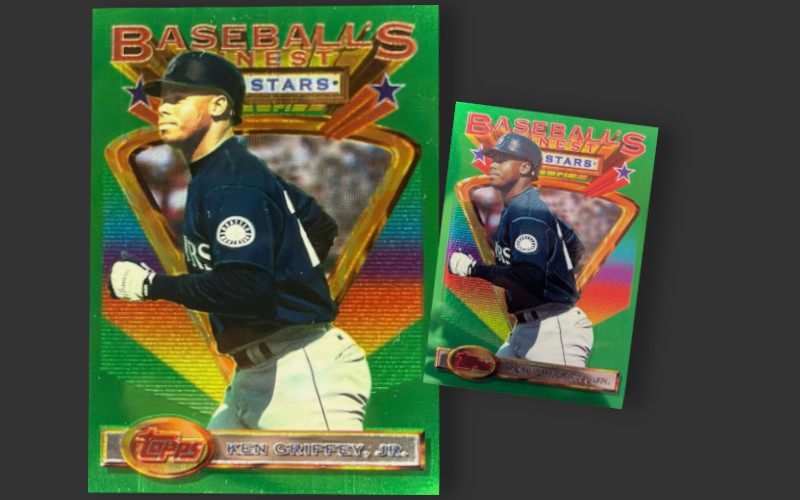
Upon opening the box, collectors are greeted with an actual box-topper card. Each box contains one jumbo version of the set’s 33 different All-Star subset cards. Dividing the ’93 Finest print run by the number of possible jumbo cards generates an estimated total population of 1,455 of each card (48,000 boxes / 33 possible cards = 1,455). Again, Finest provides collectors with an extremely limited production card, but these are not popular pieces. My guess is their large size makes them unwieldy to store, limiting the number of collectors interested in chasing them down. The jumbo cards do not come in a refractor version.
Let’s Open Some Packs
You didn’t open the box to just stare at packs. You took off the plastic wrap so you could start piling up discarded foil wrappers on the floor, pull a Griffey card, and then run around the room screaming, “I’m as rich as an astronaut!”
If you want to recreate the whole breaker experience, you’ll fan the packs out in front of you with the showmanship of a riverboat faro dealer and then wonder out loud about a physical quirk of the now empty box. There is a raised cardboard platform near the top of the box that seems to generate commentary from almost anyone who comes across it, often speculating about what it was to be used for. The answer is straightforward math: Each box contains 18 unopened packs, a number indivisible by the four stacks of packs arranged in a 2×2 grid. That “shelf” is exactly the size of two packs placed side by side, filling the void that would have been left by the remainder and preventing the packs from sloshing around inside the box.
Peeling off the first wrapper, you will notice a few things. The cards have a lightly curved surface from top to bottom, bowing towards you in the middle. This is a function of the composite mix materials used to manufacture the cards, several of which react and expand with ambient environmental conditions at different rates. While this subtly warps the shape of the card, it is not considered a condition flaw among collectors.
Collectors familiar with opening high gloss cards that have been sealed for decades are familiar with “bricking,” a phenomenon that occurs when the glossy coating of tightly packed cards fuse to those next to them. This results in cards accruing surface damage and renders many popular unopened products of the era unsuitable for actually opening. ’93 Finest, on the other hand, does not suffer bricking. Cards will sometimes have a bit of a static charge that making them briefly stick together, but you can open a pack today without worry of finding permanently conjoined cards.
Aside from the risk of a randomly off-center card, the only condition issue to watch out for directly out of a pack is surface scratching. Later years of Finest products would try to remedy this with the application of a protective layer of plastic that was to be peeled away by collectors. My experience with the set is that the bigger risk of scratching comes not from cards sliding against each other in the pack, but from collectors improperly storing the cards without the buffer layer of a penny sleeve in hard plastic holders.
There are six cards per pack, though every now and then a 7th card seems to slip in due to the static that sometimes holds them together. I saw one pack likewise missing a single card, so the number of cards may occasionally deviate ±1 in either direction. Another anomaly that sometimes appears is a card randomly facing a different direction.
Collation and Set Building
Assuming the advertised 6 cards per pack, each box contains 108 cards, good for roughly half a set of the 199-name checklist. Some of the cards will be duplicates, and despite the apparent bin method of collation used, I have seen a small run of packs from the a box that duplicated a single card in each pack. I also witnessed one pack that contained a blank piece of printer’s scrap instead of the pack’s sixth card.
Pulling from observed history of the contents of multiple cases, I have found a box contains an average of 91 unique base cards and 16 duplicates, good for about 45.6% of the checklist. The range of unique cards fluctuated between 82 and 101 different cards per box.
Patterns emerge when seeing so many packs being opened, leading me to conclude that Topps packed out these cards by sorting cards into hoppers containing specific runs of checklist numbers (e.g. 1-33, 34-67, etc.) and built the packs by taking one card from each bin. The majority of boxes I observed followed a pattern where each pack contained cards in a certain order, followed by a pack with identical spacing of card numbers shifted up by 1 until they reached the end of their range, followed by the pattern starting over again at the low end of the numbering range. A typical run of packs might look like this:
| Pack | 1st Card | 2nd Card | 3rd Card | 4th Card | 5th Card | 6th Card |
|---|---|---|---|---|---|---|
| Pack One | 20 | 61 | 84 (All-Star) | 131 | 154 | 188 |
| Pack Two | 21 | 62 | 85 (All-Star) | 132 | 155 | 189 |
| Pack Three | 22 | 63 | 86 (All-Star) | 133 | 156 | 190 |
| Pack Four | 23 | 64 | 87 (All-Star) | 134 | 157 | 191 |
| Pack Five | 24 | 65 | 88 (All-Star) | 135 | 158 | 192 |
| Pack Six | 25 | 66 | 89 (All-Star) | 136 | 159 | 193 |
| Pack Seven | 26 | 67 | 90 (All-Star) | 137 | 160 | 194 |
| Pack Eight | 27 | 68 | 91 (All-Star) | 138 | 161 | 195 |
While fairly persistent, this pattern is not universal. There might be a run of 10-15 packs following this pattern, followed by a shift to a jump to a new mix of predictable numbers. Some boxes had more random mixes of cards than others, and those following the sequential pattern sometimes saw jumps when there was a packing anomaly, such as cards sticking together in the previous pack. Sometimes bins appear to be refilled with a different group of cards. It’s all useless trivia anyway.
Some dealers took the extra step of shuffling packs to further randomize the results, preventing note-taking collectors from opening one pack and using the contents to predict a higher likelihood of pulling a key name like Ken Griffey, Jr., though for my purposes the overall pattern can still be constructed in hindsight when the contents of the entire box are mapped out after opening.
All-Star subset cards (#84-116) appear on average one per pack, with 5% of the packs I observed lacking one. Of these packs with missing All-Stars, all but one had a refractor in that particular slot. Two of the observed packs contained two All-Star cards (both packs were also from the same box).
Refractors
While the base cards are challenging to collect, nobody is buying a box of ’93 Finest for them. We want Refractors, and they are the first thing people ask about when talking about this set.
How Many Refractors Per Box?
When introducing the Finest product in 1993, Topps told collectors to look for refractors at a rate of about one per box. Hobby lore quickly latched onto that phrase and omitted that key word “about,” and extrapolating a one per box rate into the mythical print run of 241 cards (I guarantee there are many more). Opening boxes of Finest revealed a refractor at a rate of 1 per 15 packs. That is an average of 1.2 refractors per box or 14 per case, implying every sixth box has two refractors inside. I have never seen a box not contain a refractor somewhere inside. Topps wrapped the refractor packs separately from the base packs and had workers manually mix them into boxes, ensuring every box got at least one.
Are packs containing refractors always in the same spot in each box?
Nope. Refractor packs can be found at any position within the 18 packs in the box. Any tendency to be packed out with higher probability in a specific region of the box typically gets further offset by the practice of dealers shuffling packs upon setting up a box for display.
Within the packs themselves, refractors are almost always found in the third or fourth slot. I have seen one outlier pack where a refractor appeared as the last card of the pack, but that one was already anomalous as it contained two refractors. Refractors do not appear to follow the numbering sequence pattern observed in most packs and can be a parallel of any card in the checklist.
Can you tell which packs have refractors in them? How?
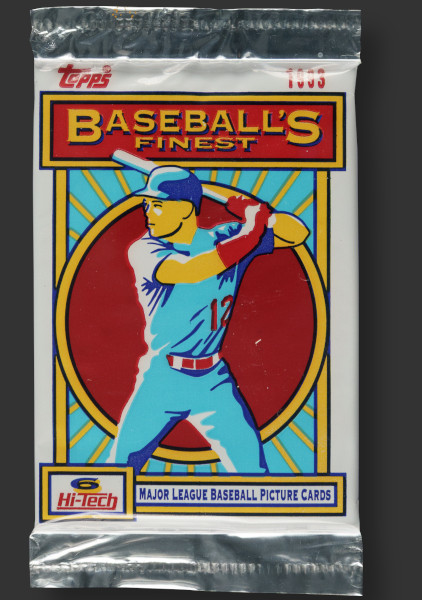
Yes, you can absolutely identify which packs contain refractors. Despite what you may hear at a card show or your buddy who knows a guy, it is not the way the pack is sealed, product codes, small print on the back, or anything like that. The key is on the front of wrapper in the form of the uniform number of the batter. On most packs the red ink of the uniform number is identical to the red backdrop the player is posed against. Packs containing a refractor have a different, lighter shade of red on the uniform. The difference is very subtle, but becomes visible when packs are placed next to each other.
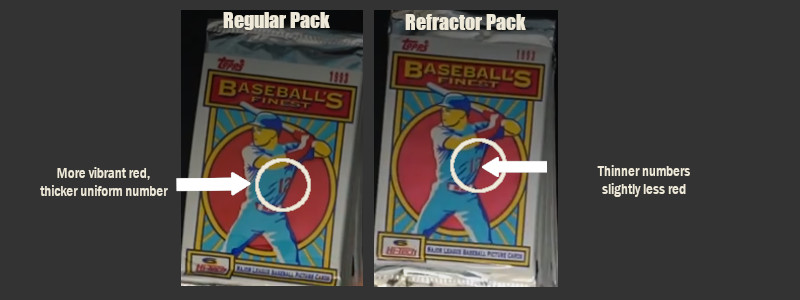
This isn’t a new discovery. Collectors 30+ years ago were aware of this method of identification, and for a while there was a taboo against telling others about it. Hobby shops in the know at the time often purposely affixed price tags over the number to prevent pack searching.
The Hot Box Mystery
This should all be pretty straight forward, right? Slightly better odds than one per box of pulling a refractor? Not quite.
In 1994 I personally witnessed a box of ’93 Finest being broken up at a card show at Patrick Henry Mall in Newport News, Virginia. A dealer was selling the cards by the pack, and after a few had been sold everyone realized this was a hot box – every single pack held a refractor. The packs were immediately marked up to $250 each with a guarantee that a refractor would be pulled, the caveat being that the buyer had to open the pack in front of everyone. It turned into a spectacle as the box was broken opened (the best refractor pulled if I remember correctly was George Brett).
This wasn’t an isolated event. Other collectors have reported the existence of other hot boxes of ’93 Finest. Some basketball boxes from the same year also were found to contain a refractor in every pack.
How could this have happened? Topps wasn’t advertising the possibility of hot boxes, so I doubt this was a purposeful marketing tactic. Was a dealer going through multiple cases and systematically pulling the “extra” refractor packs to make a Frankenstein box he could then mark up? That theory falls completely flat given the difficulty of obtaining product, and the already high prices that packs could be sold for – there wasn’t all that much extra cash at stake.
Here’s my theory: Someone forgot how to count. The refractors were put into packs separately from the main batch of 100% base packs. Line workers were to insert refractors at specific ratios. But what happens if someone goes a shift putting them in at one per box instead of 1 every 15 packs? They have a remainder, and that remainder gets dumped into a single box to “catch up” when the mistake is noticed. Or perhaps even more innocently, the packs look identical to the untrained eye and someone simply reached into the wrong bin of packs when filling out a few boxes.
Thoughts on Financial Viability of Opening a Box
I want to be perfectly clear that opening a box of ’93 Finest is a terrible (but fun!) decision from a financial standpoint. The premium placed on these products comes from their limited production and the even smaller number of boxes that remain sealed.
A typical box goes for $1500 or so at the moment, or about $80 per pack. This works out more than $13 per card, all but one or two of which will be a base card from a set that can be purchased in its entirety for about $250. When you do pull a refractor, which overwhelmingly will be singular rather than plural, it has about a 4% chance (25:1 odds!) of being able to be resold for the cash outlay of the box it came from. That’s assuming you get it graded and it comes back as a well-centered 8 or a 9. For the same price I’d rather assemble a stack of commons and minor stars representing a third of the refractor checklist. With 199 cards in the checklist, the overwhelming odds are that you will get a shiny card of a good player but underwhelming as a baseball card. Unless you really want that Tom Henke or Bob Tewksbury card for your collection, I recommend keeping the box sealed.