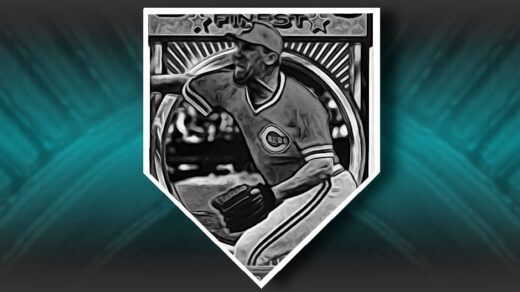
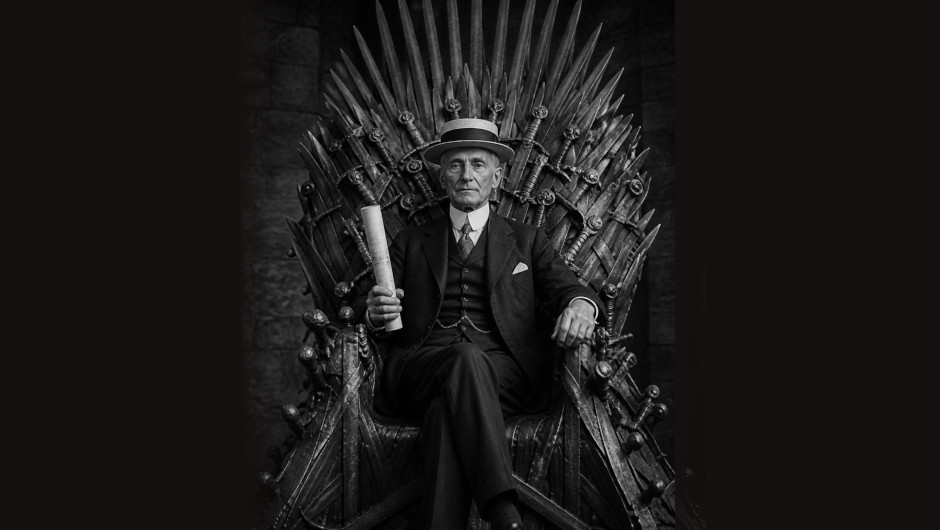
A Mack always pays his debts…or so prayed the players bound to the family’s White Elephant standard. Payroll checks within the Philadelphia Athletics organization were earned, not just through the struggle of playing stronger teams but through the chaotic race of the front office across the land to secure the treasury before those claims were presented for payment. The frantic activity of the men signing their name, McGullicuddy, to the paper emblazoned with stamped values in fittingly red ink was its own exercise in petty intrigue. Writing sums was a theoretical exercise. Having enough coin to cover the inevitable presentation was another.
Earle and Roy McGullicuddy, warring lords known alongside their ancient father as “The Macks,” staggered vendor payments and the mortgage on their crumbling citadel, Shibe Park, to avoid excessive calls on their meager operating cash on any given day. Those precious days between writing a check and the time it took to wind through the banking system were of inestimable value inside the business office. Both men knew what it was like to raid the change tills of the stadium concession stands to make payroll when the gate receipts where even lower than the soothsayers had foretold.

I hold evidence of this desperation in my hands.
A family connection of mine was once on the receiving end of these increasingly precarious paper promises from the Macks. Charlie Bishop had joined the club after an improbable journey toiling as a wilding in the minor league hinterlands, signing for the league minimum of $6,000 and just hoping that neither his curve ball or paycheck would bounce in the dirt.
I have collected various relics of Bishop’s career, most of which are colorful cardboard rectangles sold alongside bubble gum to kids. However, one item in the collection stands out as being more personal, more significant for having been there. There is no indication that this pitcher, who at this point carried a 5-5 career record, gave even a momentary thought to his baseball cards. There is every reason to believe he thought hard about exactly when to present this item to his bank in Upper Darby, PA.
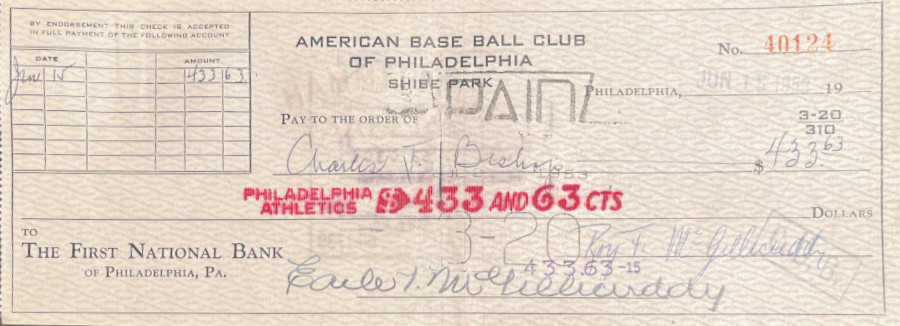
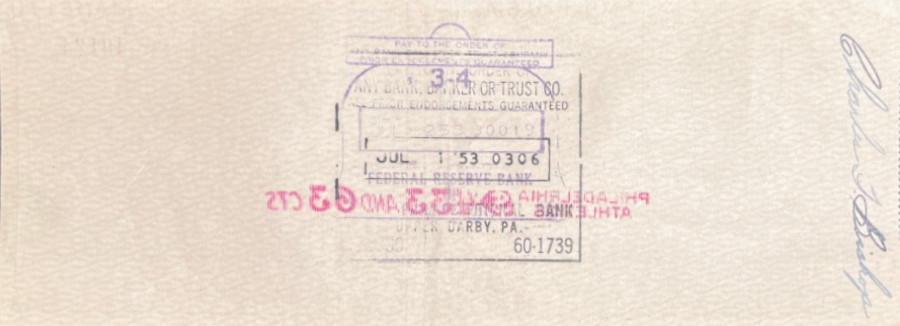
The front shows his position as the recipient of the league minimum salary, alongside the dual signatures of Earle and Roy Mack warily looking over each other’s shoulders at anything coming out of the team treasury. The endorsements and routing stamps on the back show this payroll check being cashed the same day as Bishop taking the third of what would become 17 consecutive losses and hurrying to take a night train for another lengthy series of away games.
The spectators will say baseball is just a game. Those who fought it out behind the scenes know it as a game of thrones. Bishop, like all the other men bearing the crest of a white elephant on their uniform, was there to witness the fall of the House of Mack. Let’s get an AI telling of the story of civil war and struggle for the throne that engulfed the Philadelphia Athletics.
In the dawn of the twentieth century, a great schism threatened to tear the realm of baseball asunder. Lord Ban Johnson, a visionary with eyes set upon conquest, declared his Western League a major power, renaming it the American League and marching his banners eastward to challenge the fat, complacent lords of the National League. To capture the great, sprawling city of Philadelphia, Johnson needed a commander of uncommon cunning. He summoned a tall, statuesque former catcher named Cornelius McGillicuddy, known to his men as Connie Mack, to raise a host capable of defying the city’s entrenched rulers, the Phillies. Mack had been a journeyman catcher during the rollicking 1890s, offering more in cunning and gamesmanship than raw physical prowess. He would tip bats and mimic the sound of foul tips to deceive the arbiters of the game, learning early that the mind was a sharper weapon than the body. After a vicious spiking injury ruined his legs, he transitioned to command, realizing his destiny lay not on the battlefield, but above it. He was a man of quiet dignity and cold pragmatism; he did not command from the field in the soiled armor of a uniform, but rather sat upon the bench clad in a high starched collar, business suit, and derby hat. He carried no sword, only a rolled-up scorecard that he wielded like a king’s scepter to direct his forces in battle. They called him “The Tactician”.
To wage this war, Lord Mack required a treasury. He forged an alliance with Ben Shibe, a wealthy merchant of sporting armaments, promising him half the dominion of this new franchise in exchange for gold and the royal decree that Shibe’s company would supply the baseballs for the entire new league. With their pact sealed, they erected Columbia Park, a modest palisade built upon a vacant lot, to serve as their first stronghold. But a fortress is nothing without champions, and Mack waged a ruthless war of coin, raiding the cross-town Phillies for their greatest knights. For a princely sum of four thousand dollars, he lured away Napoleon “King Larry” Lajoie, alongside stalwart hurlers like Chick Fraser and Bill Bernhard. In that inaugural campaign of 1901, Lajoie was a terror upon the realm, claiming the batting crown with an unprecedented .422 average and leading the league in home runs and runs batted in. Yet, the old lords of the National League would not suffer this treason. They appealed to the high magistrates, and before the next spring could bloom, the Supreme Court of Pennsylvania decreed that Lajoie and his brethren were bound by their old oaths and could not take the field for any team save the Phillies within the borders of the commonwealth.
Stripped of his vanguard on the very eve of battle, Mack was forced to adapt or perish. The loss of his champions invited the scorn of his rivals, none more venomous than John McGraw, the combative, fiery lord of the New York Giants. Lord Muggsy mocked Mack’s fractured army, dismissing the Philadelphia Athletics as nothing but a “White Elephant”—a burdensome, worthless beast of a franchise. Mack, displaying the iron will and cunning that would make him a legend, did not rage against the insult. Instead, he claimed the beast as his own. He sewed the White Elephant onto the tunics of his men, transforming a badge of shame into a fearsome sigil of defiance that his soldiers would wear into battle for decades to come.
Bereft of Lajoie, Mack summoned new sellswords and knights to his banner. He called upon a mercurial, wild-eyed left-hander named Rube Waddell, a man he had commanded in western lands, who would go on to strike out legions of batters and post a dominant 2.05 earned run average that season. Waddell joined a rotation anchored by the twenty-five-year-old southpaw Eddie Plank and the mighty slugger Socks Seybold, who hit a record sixteen home runs to crush their enemies. This newly forged host shocked the realm by capturing the American League pennant in 1902. They claimed the first flag for the City of Brotherly Love since 1883, drawing massive crowds that more than doubled the attendance of the rival Phillies, who had been left jilted and abandoned by the very knights who had fled. Though they missed the chance to fight in a modern World Series that year because the National League champions refused to take the field against them, the Mackmen returned to glory in 1905. Waddell and Plank won twenty-six and twenty-five battles respectively, and a young Native American marksman named Chief Bender added sixteen victories. Fate, however, is a cruel mistress. Waddell fell to injury before the 1905 World Series, leaving Mack’s forces vulnerable to McGraw’s Giants. Clad in menacing new black uniforms, the New York host routed the Athletics, with the legendary Christy Mathewson tossing three shutouts to deny Philadelphia the ultimate crown.
Defeated but not broken, Lord Mack retreated to his war room to play the long game. Over the following years, he scoured the sandlots and school grounds of the realm, seeking young squires he could mold into an unstoppable force. By 1908, he had given the field to three young prodigies: a twenty-one-year-old second baseman named Eddie Collins, a twenty-one-year-old shortstop named Jack Barry, and a twenty-two-year-old third baseman named Frank Baker. The following year, the Athletics abandoned the wooden palisades of Columbia Park and moved their seat of power to Shibe Park, a magnificent new fortress of concrete and steel. Shibe Park was a marvel of the modern age, a temple where the Athletics would establish a dynasty. By 1910, these young defenders were joined by first baseman Stuffy McInnis, completing a quartet of infielders so flawless and valuable they became known throughout the lands as the “$100,000 Infield”.
With Shibe Park as their stronghold, the White Elephants marched to absolute supremacy. The 1910 campaign saw the Athletics steamroll all challengers, winning over one hundred games. Jack Coombs claimed thirty-one victories, Chief Bender won twenty-three, and the veteran Plank added sixteen. In the World Series, they crushed the Chicago Cubs, taking the championship four games to one and bringing Lord Mack his first ultimate triumph. In 1911, the Mackmen returned to the Fall Classic, winning over one hundred games once more, to face their old tormentor, Lord McGraw, and his black-clad Giants. This time, the Athletics would not be denied their vengeance. Frank Baker struck mighty blows, earning the fearsome moniker “Home Run” Baker by hitting crucial blasts into the stands, while Bender, Coombs, and Plank dismantled the New York host to secure a second consecutive championship. After a brief stumble in 1912, the Tactician’s forces regrouped in 1913, finishing miles ahead of the Washington Senators. Once more, they met the Giants on the field of the World Series, and once more, the White Elephant trampled the men of New York, claiming the crown in five games behind the pitching of Plank and Bender. The Athletics were undisputed lords of the realm, having claimed three World Series titles in four years, cementing Connie Mack’s legacy as a grandmaster of baseball strategy.
In 1914, they captured their fourth pennant in five years with a staggering ninety-nine victories, and it seemed no force on earth could break their iron grip on the junior circuit. But winter comes for all great houses, and the fall of the Athletics was not born of a lack of skill on the field, but of the whisper of foreign gold and the specter of war. A new usurper faction arose: the Federal League, backed by wealthy lords who sought to lure away the stars of the established realm with unimaginable riches. Distracted by the clinking of Federal League coin and internal strife, the mighty Athletics marched into the 1914 World Series against the lowly Boston Braves and suffered a shocking, humiliating sweep. The “Miracle Braves” broke the aura of invincibility that surrounded the Mackmen in a bloodless slaughter.
Lord Mack, a pragmatic ruler whose only source of wealth flowed from the turnstiles of Shibe Park, saw the storm clouds gathering across the horizon. The Great War had broken out across the sea in Europe, devastating the local economy and causing attendance to dwindle. Unwilling and unable to bankrupt his house in a ruinous bidding war against the Federal League “moneybags,” Mack made a harsh, calculating decision that would echo through history. He would not watch his men abandon him one by one; instead, he would swing the executioner’s sword himself, declaring that if his players were going to “cash in” and leave him holding the bag, he would cash in too. In a move that shocked the realm, he ruthlessly dismantled his own championship machine. He allowed his loyal veteran arms, Plank and Bender, to leave for the usurpers without demanding a single copper in return. He sold the great Eddie Collins to the White Sox for fifty thousand dollars in cash, dispatched Jack Barry to Boston for a pittance, and traded the stubborn Home Run Baker to the Yankees after a bitter contract dispute. He released the ailing Jack Coombs. When questioned why he did not fight to keep the loyal half of his army, Mack reasoned that a disintegrating team was like a dam breaking; those who remained would lose their spirit and seek brighter fortunes elsewhere.
The great host of the Philadelphia Athletics was scattered to the winds. The mighty dynasty that had struck fear into the hearts of men from 1910 to 1914 was reduced to ash and ruin. From the absolute heights of a ninety-nine win season, the scuttled squad plummeted to a miserable forty-three wins in 1915, and then descended even further into madness with a dreadful thirty-six victories and one hundred seventeen losses in 1916. The proud White Elephants would languish in the dark, cold cellar of the American League for seven long consecutive seasons. The first great era of House Mack was dead, buried under the weight of economics and pragmatism, leaving the Tactician to wait in the shadows of Shibe Park for the day when he might once again forge a new host and reclaim his stolen throne.
For seven long years, a bitter winter gripped House Mack. The proud White Elephants languished in the dark, cold cellar of the American League, plumbing the depths of despair with a wretched thirty-six victories and one hundred seventeen losses in 1916. As Lord Mack neared and passed his sixtieth name day, whispers echoed through the realm that the old Tactician’s mind had grown dull, and that he should surrender his seat in the dugout to a younger lord.
But Connie Mack was a master of the long game, plotting his return to power in the shadows. As the Great War ended and crowds slowly returned, Mack plowed the gold from Shibe Park’s turnstiles—which had dwindled to a paltry 177,926 patrons in 1918 before swelling to nearly 870,000 by 1925—right back into his armory. He scoured the minor-league outposts for raw, untested squires, purchasing the contracts of fierce warriors who would become legends. Into his ranks came the mighty sluggers Al Simmons and Jimmie Foxx, the brilliant backstop Mickey Cochrane, and a terrifying, hot-headed left-hander named Robert “Lefty” Grove. Grove was a mercurial beast of a man who would hurl chairs and menace lockers in defeat, yet Lord Mack, who never drank, smoked, swore, or raised his voice, handled the wild pitcher with quiet, unyielding calm.
Before they could claim the throne, however, Mack’s new army had to face a terrifying shadow in the North: the New York Yankees, a ruthless empire commanded by a fearsome vanguard known throughout the lands as “Murderers’ Row”. In 1927 and 1928, Mack’s resurgent host battled valiantly but fell just short, finishing second to the mighty men of New York. During this grueling campaign, legendary sellswords Ty Cobb and Tris Speaker donned the armor of the Athletics to close out their glorious careers, lending their ancient cunning to Mack’s young host.
By 1929, the young knights of House Mack had matured into an unstoppable juggernaut, embarking on one of the greatest campaigns in the history of the realm. They laid waste to the American League, winning one hundred and four battles and finishing a staggering eighteen lengths ahead of the Yankees. In the World Series, they faced the Chicago Cubs, and Lord Mack unleashed a masterstroke of deception. He called upon the veteran Howard Ehmke to start the first battle, a surprise maneuver that yielded a complete-game 3-1 victory. In the fourth clash, trailing eight to nothing, the Mackmen staged a miraculous ten-run ambush in the bottom of the seventh inning to break their enemies, ultimately claiming the crown in five games. Mack would later call Ehmke’s unexpected triumph his “greatest thrill”.
The White Elephants reigned supreme, capturing one hundred and two victories in 1930 and crushing the St. Louis Cardinals to retain their championship. In 1931, their dominance reached its zenith with one hundred and seven wins, finishing thirteen and a half games ahead of the Yankees. Though they fell in a seven-game Fall Classic rematch to the Cardinals—tormented by the wild running of a rogue known as Johnny “Pepper” Martin—the Athletics had secured their place as a dynasty to rival any in history, winning three hundred and thirteen games over three seasons.
Yet, winter comes for all great houses, and the doom of the Athletics was forged not on the battlefield, but in the banking halls. A blight far crueler than any opposing army descended upon the realm: the Great Depression. It devastated the economy of Pennsylvania, and the gold ceased to flow. Though the Athletics were undisputed champions, attendance at Shibe Park plummeted from over 839,000 in 1929 to a mere 405,500 by 1932.
Lord Mack found himself trapped in a devastating siege. He possessed no streams of income save his fortress, yet his champion knights commanded the highest payroll in the league. With his coffers running dry and his empire teetering on the edge of ruin, the pragmatic lord made a heart-wrenching choice. To save his house, he had to sell his greatest warriors to rival lords whose treasuries were deeper.
In September of 1932, he dispatched the fearsome Al Simmons, Jimmy Dykes, and Mule Haas to the Chicago White Sox for a hundred thousand dollars in gold. The butchery continued the following winter; the fierce Lefty Grove, Rube Walberg, and Max Bishop were sold to the Boston Red Sox for one hundred and twenty-five thousand dollars, while the brilliant Mickey Cochrane was traded to Detroit for another hundred thousand. By the winter of 1935, the mighty Jimmie Foxx was traded away, returning one hundred and fifty thousand dollars in cash to the depleted treasury.
The second great dynasty of House Mack was dismantled piece by bloody piece, scattered to the winds to pay the debts of a dying realm. Bereft of his champions, Lord Mack watched helplessly as his White Elephants plummeted back into the dark cellar of the league, where they would languish in the shadows and sorrow for decades to come.
The Long Winter had come again to the realm of Philadelphia, and this time, it brought no swift reprieve for the fading House Mack. Having surrendered his greatest champions to rival lords for the gold needed to survive the Great Depression, Lord Connie Mack watched his once-fearsome White Elephants descend into the darkest, coldest crypts of the American League. Between the years 1935 and 1946, a brutal twelve-year epoch of humiliation, the Athletics finished dead last in the standings nine times. They were a shattered host, a mockery of the mighty juggernaut that had won over three hundred battles from 1929 to 1931,.
Yet, even as his armies faltered on the field, Lord Mack proved himself a ruthless and calculating player of the great game of power within his own fortress. For decades, the rule of the franchise had been a peaceful duality, a pact forged between the Mack family, who commanded the baseball host, and the Shibe family, wealthy merchants who controlled the business and the treasury,. When the old patriarch Ben Shibe perished in 1922, his sons, Tom and John, inherited the mantle of the presidency and the family’s share of the kingdom. But mortality is the great undoer of alliances. In February of 1936, Tom Shibe took his last breath, passing the presidency to his brother John. John’s reign was tragically brief; stricken by a terrible illness, he relinquished his seat in August of that very same year, and by 1937, he too was dead.
Sensing a fleeting moment to seize absolute dominion, the Tactician struck with bloodless precision. Lord Mack reached into his depleted coffers and purchased one hundred and forty-one shares of stock from John Shibe’s estate. This single, masterful stroke of political maneuvering altered the balance of power forever. For the first time in the history of the realm, the Mack family held an undisputed majority—eight hundred and ninety-one shares against the Shibe-MacFarland faction’s six hundred and nine. In January of 1937, Connie Mack ascended to the presidency of the Philadelphia Athletics, consolidating the titles of owner, president, and field commander into one solitary, towering figure. The era of shared rule was dead; the era of absolute monarchy for House Mack had begun.
However, absolute power does not fill an empty treasury. Lord Mack reigned supreme, but he reigned over an impoverished kingdom. Unlike the fabulously wealthy lords of New York, or the affluent Carpenter family who would purchase the rival Phillies in 1943 and pour their vast family fortune into the team, Mack possessed no streams of gold outside the turnstiles of his aging ballpark. He ran his major-league empire as a simple, meager business. Desperate for coin to maintain his fortress, he was forced to invite his historic rivals, the Phillies, into his very home. In 1938, he signed a pact allowing the Phillies to play their campaigns at Shibe Park as tenants, exacting a meager toll of ten copper cents for each admission as rent,. In 1939, seeking to draw the common folk after their daily labors, he erected massive towers of artificial fire above Shibe Park, making the Athletics the first team in the American League to host battles under the black canvas of the night sky.
But Shibe Park itself, once a marvel of concrete and steel erected in 1909, was beginning to show the cruel wear of time,. The fortress had been designed in an ancient era, before the great metal chariots known as automobiles dominated the streets, making it ill-suited for the modern age. Yet Mack had no wealth to construct a new citadel, nor to properly mend the old one.
Worse still, as the aging king sought to secure his legacy, the seeds of a devastating civil war were sown within his own bloodline. The fractures within House Mack were deep and complex, divided by generation, by marriage, and by sex. Connie Mack had sired two distinct families. His first wife, Margaret, had borne him two sons, Roy and Earle, before passing away in her youth. His second wife, Queen Katherine, had given him four daughters and a much younger son, Connie Mack Jr.. Lord Mack dreamed of an eternal dynasty, where his three sons would rule the Athletics in harmony long after he was gone,.
To lay the foundation for this succession, the king divided a portion of his kingdom, granting one hundred and sixty-three shares of stock to Roy, one hundred and sixty-three to Earle, and one hundred and sixty-three to young Connie Jr.. To his wife Katherine, he granted one hundred shares, while hoarding three hundred and two shares for himself to maintain his ultimate grip on the throne. But in doing so, he gave nothing to the four daughters of his second marriage.
This decree ignited a fierce rebellion within the royal household. Katherine, a fierce and protective matriarch, demanded that her husband distribute the stock equally among her, Roy, Earle, and all five of her children—thus transferring the ultimate control of the franchise from the men of the first marriage to the women and heirs of the second. So violent was this clash of wills that the Tactician, rather than yield, abandoned his own keep, separating from his queen in 1946 and 1947,. Though they eventually reconciled, the bitter resentment lingered like a slow poison in the veins of the family.
The three heirs themselves were horribly mismatched. Roy, the eldest, had labored for years in the minor-league outposts of Baltimore and Portland before returning to the capital in 1936 to serve as vice president and secretary,. He was a man of the ledgers, fiercely protective of the purse strings, but bereft of charisma or vision,. Earle, the second son, had served a brutal, decades-long apprenticeship as his father’s bench coach and heir apparent on the battlefield. Yet Earle possessed no true fire; he was a passive, docile figure who commanded no respect from the knights he was supposed to lead,,. One player muttered that Earle knew little of the art of war, stating bluntly, “You wouldn’t listen to him”.
Standing against these two aging brothers was young Connie Jr., a prince separated by twenty years of age from his half-siblings. Raised managing the concession stands of Shibe Park, the younger Connie saw his brothers as ancient mossbacks, stubbornly resisting the modern world, while Roy and Earle viewed their young brother as an arrogant upstart whispering half-baked heresies.
While his sons bickered in the shadows, the true tragedy was unfolding on the bench. As the 1940s marched on and the world was consumed by the Second Great War, Lord Mack crossed his eightieth name day,. The brilliant mind that had outwitted McGraw and conquered the realm five times was succumbing to the cruel ravages of senility,. The Mad King of Shibe Park became a figure of tragic pity and terror to his own men. He would fall asleep during the heat of battle, absentmindedly waving his rolled-up scorecard while his team fought on,. In fits of delusion, his mind would wander back to his glory days, and he would cry out for ancient, long-gone knights to pinch-hit in modern games,. He refused to use the mechanical far-speaking devices (telephones) in the dugout, relying instead on a series of obtuse, frantic hand signals that his loyal squires and coaches quietly ignored or countermanded to save the team from ruin,,. If awoken suddenly, the old man would fly into inexplicable, irrational rages, and the players lived in fear of the team’s “kangaroo court” if they dared disturb his slumber.
Under his decaying leadership, the host suffered profound miseries. In 1943, they endured a horrifying string of twenty consecutive defeats,. They finished that wretched campaign with forty-nine wins and one hundred and five losses, sitting forty-nine lengths behind the vanguard and a staggering twenty games behind the team in next-to-last place. When asked of the slaughter, the bewildered lord could only whisper, “I can’t understand it… It would seem, under the very law of averages that we would get in a winning game somewhere”.
Yet, as if summoned by some ancient, dying magic, the Philadelphia Athletics staged one final, miraculous charge before the darkness claimed them. As the late 1940s arrived, Mack miraculously steered his host out of the cellar. In 1947, the White Elephants posted their first winning record in fourteen long years, drawing a massive horde of 911,566 loyal subjects to Shibe Park,. For a fleeting three-year period (1947-1949), the franchise generated a bounty of $450,000 in profits.
The crescendo of this twilight renaissance came in the campaign of 1948,. To the shock of the entire realm, Mack’s men rode out to challenge for the American League pennant, spending forty-nine glorious days atop the standings. The crowds swelled to a record 945,076, the absolute peak of their attendance, and the last time they would ever outdraw the ascendant Phillies. It seemed as though the Grand Old Man would conjure one last championship to silence his doubters forever.
But the Mad King’s temper proved to be his own undoing. On a fateful summer day, the thirteenth of June in 1948, the Athletics were locked in combat with the St. Louis Browns. They held a three-run advantage in the eighth inning when Mack called upon a veteran relief knight, Nels Potter, to hold the line. Potter faltered, surrendering four runs and blowing the lead.
When the defeated pitcher returned to the dugout, Lord Mack descended upon him with a wrath so terrible it shattered the spirit of the entire host,. Before the shocked eyes of the clubhouse, Mack berated Potter, crying out that the twenty thousand dollars he had paid for him was a tragic waste, and commanded that Potter be instantly stripped of his armor and banished from the team,. Potter bore the public execution in silence and departed, only to be claimed by the Boston Braves, where he pitched valiantly to help them win the National League crown.
The abrupt, senseless banishment of a loyal soldier by an erratic king broke the Athletics. Mack had already dismissed another arm, Bill Dietrich, and the exile of Potter left the pennant-contending army with only five healthy hurlers for the remainder of the brutal summer. The fragile magic dissolved. The exhausted pitching staff collapsed, and the team faded down the stretch, tumbling to a fourth-place finish,. The dream of a final pennant for Connie Mack was dead, sacrificed on the altar of his own deteriorating mind,.
As the decade drew to a close with another respectable, but ultimately fruitless, winning campaign in 1949, the illusion of stability vanished,. The brief influx of gold from the late 1940s could not mask the rot eating away at the foundation of the franchise. The patriarch was eighty-seven years old, a captive to his own fading wits, stubbornly clinging to a throne he could no longer defend,. Beneath him, the fractured alliance of Roy and Earle on one side, and Connie Jr. and the resentful Queen Katherine on the other, sharpened their daggers,. The treasury, despite the recent spoils, was fundamentally hollow, lacking the deep resources of the rival lords who were modernizing the game and building vast minor-league systems,. The Great Depression had wounded House Mack, but it was the toxic brew of senility, familial civil war, and desperate, penny-pinching pragmatism that was about to bring the mighty White Elephants to their knees. The 1950s loomed, bringing with them a final, devastating storm that would threaten to erase the fading banners of the Athletics forever.
The year of our Lord 1950 was ordained to be a grand Golden Jubilee, a year of feasting and celebration to honor the fiftieth year of Lord Connie Mack’s reign over the American League, and the birth of the Philadelphia Athletics. Instead, it proved to be a year of bitter ashes and unending winter. The once-fearsome host of the White Elephants was slaughtered on the fields of battle, suffering a humiliating one hundred and two defeats. They were cast into the deepest, darkest dungeon of the league standings, finishing a staggering forty-six lengths behind the vanguard. The golden jubilee was an unmitigated disaster that bled the royal coffers dry, costing the franchise a disastrous three hundred and fifteen thousand dollars in a single season.
But the true carnage was not found upon the diamond; it was waged in the shadows of the royal court. The Mad King of Shibe Park, Lord Connie Mack, was nearing his eighty-eighth name day, his brilliant tactical mind swallowed by the creeping fogs of senility. He had become a tragic, spectral figure, falling asleep on the bench while the battle raged around him. According to the veteran knight Ferris Fain, the old lord would slumber, absentmindedly waving his rolled-up scorecard, and any squire who dared wake him was subjected to the hasty, brutal justice of the team’s “kangaroo court”. In fits of madness, he would call out for ancient champions long dead or retired to take up their bats.
As the Mad King’s grip on the realm withered, a vicious war of succession erupted, tearing House Mack asunder. The king had sired two distinct families, and between them lay a chasm of resentment, ambition, and greed. On one side stood the sons of his first marriage: Roy, a man of ledgers and coin who served as the team’s vice president, and Earle, the docile, passive heir apparent who had waited twenty-six years in his father’s shadow as a bench coach. Against them stood the second family, fiercely defended by the king’s current wife, Queen Katherine, and her son, young Connie Mack Jr., a prince separated by two decades of age from his elder half-brothers.
Roy and Earle viewed young Connie as an arrogant, interfering upstart whispering half-baked heresies of modernization, while the young prince saw his elder brothers as ancient mossbacks, stubbornly steering the kingdom into financial ruin. The young prince chafed at the family’s bargain-basement approach to ruling the realm, but the elders refused to untie the purse strings.
In a masterstroke of political maneuvering, young Connie forged a secret pact with his mother and the heirs of the Shibe-MacFarland family—the ancient merchant lords who had helped found the kingdom. By combining their banners, this new coalition commanded an army of eight hundred and seventy-two shares of stock, vastly outnumbering the six hundred and twenty-eight shares held by the king, Roy, and Earle. With this newfound power, the prince moved ruthlessly to purge the court. He banished Earle from the bench, stripping the heir apparent of his title as assistant manager and demoting him to a mere chief scout of the minor-league outposts. The legendary knight Jimmy Dykes was raised to command the host in his stead, while another former champion, Mickey Cochrane, was named general manager.
But young Connie’s ultimate design was not to rule the Athletics; it was to abandon them. Believing his half-brothers incapable of saving the realm, he sought to sell the entire kingdom to a wealthy local lord, James P. Clark, and wash his hands of the rotting empire.
Faced with the utter annihilation of their birthright, Roy and Earle set aside their mutual disdain and struck back. They demanded a thirty-day parley, securing an option to purchase the shares of young Connie’s coalition for the staggering sum of 1.74 million dollars. The prince scoffed, believing his brothers possessed no such wealth. But Roy, desperate for power, turned to the Iron Bank of their age: the Connecticut General Life Insurance Company. Pledging the very stones and steel of Shibe Park as collateral, Roy and Earle secured a massive mortgage.
On the twenty-eighth day of August, 1950, the deed was done. Young Connie, Queen Katherine, and the Shibe-MacFarland faction were bought out in a bloodless slaughter of ink and parchment. The young prince was banished to the sweltering southern lands of Florida to peddle shrimp, forever exiled from the realm.
Roy and Earle stood victorious, the undisputed masters of the realm, but their prize was a poisoned chalice. The kingdom was now shackled to a crushing debt—a brutal toll of two hundred thousand dollars to be paid to the moneylenders every single year.
To survive the crushing weight of the mortgage, the brothers bled the franchise dry. They ruthlessly purged the ranks to cut costs, stripping the armor from expensive knights like Harry Byrd and Eddie Robinson, trading them to the hated New York Yankees for mere coppers and untested squires. They fired the general manager, Arthur Ehlers, to save his twenty thousand dollar salary, and released Jimmy Dykes, replacing him with the shortstop Eddie Joost, who was forced to serve as player-manager for a pittance. They even cannibalized their own minor-league farm keeps, reducing their outposts to six in a desperate bid to stop the hemorrhaging of gold.
And yet, the smallfolk did not return. The people of Philadelphia, weary of the endless losing and captivated by the ascendant Phillies—who had captured the National League pennant in 1950—abandoned the White Elephants. Attendance plummeted to a miserable 362,113 patrons in 1953, and a horrific 304,666 in 1954.
Inside the towering concrete fortress of Connie Mack Stadium—as Shibe Park had been renamed in 1953—the victorious brothers ruled a dying, miserable kingdom. Having vanquished their half-brother, Roy and Earle now turned their daggers upon each other. They sniped and plotted from separate offices within the stadium, a house divided against itself. Roy, a man of ruthless ambition but dubious competence, coveted the title of president above all else, desiring absolute rule even if it meant moving the team to foreign lands. Earle, passive and broken by the years of struggle, wished only to sell his shares and retire in peace, declaring he would not follow the team if it fled the city. Lord Connie, the Grand Old Man, was reduced to a figurehead, his mind wandering, his pleas to keep the team in Philadelphia ignored by the sons he had empowered. When Roy and Earle pleaded with Mayor Joseph Clark to rally the city to their cause, the mayor proved an apathetic ally, and the “Save the A’s” campaign fizzled into dust.
Sensing the blood in the water, foreign lords and wealthy merchants began to circle the wounded beast. The lords of the American League, furious over the meager spoils they claimed from the sparse crowds when visiting Philadelphia, began whispering that the Athletics must be relocated or destroyed. Precedent had been set; the Boston Braves had fled westward to Milwaukee, and the St. Louis Browns eastward to Baltimore, discovering vast new treasures of attendance in their new domains. The whisperers demanding relocation were led by the dark, powerful empire of the North: the New York Yankees.
The Yankees backed a formidable usurper: Arnold Johnson, a wealthy merchant of vending machines from the midwestern stronghold of Chicago. Johnson was deeply entangled with the New York lords; he owned Yankee Stadium itself, and held the deed to Blues Stadium in Kansas City, the home of the Yankees’ top minor-league host. Johnson offered four and a half million dollars to purchase the Athletics and drag them westward to Kansas City. “There’s been no secret about our position,” declared Dan Topping, lord of the Yankees. “We think it would be best for the American League and best for us to move the A’s to Kansas City”.
Roy Mack, however, stubbornly refused to yield the crown to Johnson. He did not act out of loyalty to his city, but because no foreign lord—Johnson included—wished to install a man of Roy’s dubious talents as the president of the new realm. Roy desperately sought an infusion of coin from local lords that would allow him to buy out his brother and father, retaining absolute control of the franchise for himself.
In October of 1954, as the lords of the American League grew impatient and demanded a resolution, a glimmer of hope appeared for the smallfolk of Philadelphia. A syndicate of local merchants, led by an auto dealer named John Crisconi, rode to the rescue of the beleaguered franchise. They offered a king’s ransom of four million dollars to buy the team, pay off the Iron Bank, and keep the Athletics within the city walls. Under this pact, Lord Connie and Earle would receive vast sums of pure cash for their shares, while Roy would receive two hundred thousand dollars in gold, reinvesting the remainder of his fortune to become a partner in the new syndicate with a senior post in the front office.
On the seventeenth of October, in a chamber filled with flashes of light and the scribbling of scribes, the Macks signed the pact. Roy, his face masked in a broad smile, proclaimed to the realm, “I am very, very happy to be able to keep the A’s in Philly. That has always been my goal”.
It was a lie born of desperation, and it would not survive the night.
When word of the syndicate pact reached Arnold Johnson, he was flying upon a great metal bird from Chicago to Philadelphia. Thunderstruck and furious at the announcement, Johnson immediately dispatched a raven—a telegram—to Roy Mack’s keep, warning him not to jump off the deep end and promising a far richer prize if he would abandon the Philadelphians. “Your future and your son’s future are at stake,” the usurper threatened.
The very next morning, the eighteenth of October, Johnson arrived at Roy’s home. In the quiet shadows of the parlor, a sinister, treasonous bargain was struck. Johnson whispered sweet promises of absolute wealth. Unlike the syndicate’s deal, which required Roy to risk his own gold as an investor, Johnson offered four hundred and fifty thousand dollars in pure cash upfront for Roy’s shares. Furthermore, he guaranteed lucrative front-office posts for both Roy and his son, Connie Mack III, in the new Kansas City empire. Roy’s wife, seeing the gleam of guaranteed gold and fearing financial ruin, fiercely urged her husband to accept the usurper’s offer. Roy, consumed by avarice and seduced by the promise of security, turned his cloak. He secretly pledged his allegiance to Johnson and the Yankees, plotting in the dark to betray the Philadelphia syndicate and his own blood.
The autumn wind that howled through the streets of Philadelphia in late October carried a bitter, biting chill, a harbinger of the long winter that was about to descend upon House Mack. The trap had been set in the quiet shadows of the parlor on Fishers Road, baited with the promise of gold and secured by the treacherous ambition of a son who coveted power more than honor. The players upon this grand, tragic stage knew not the parts they were about to play. They packed their trunks and boarded the iron trains bound for the great northern stronghold of New York City, believing they rode toward salvation, oblivious to the slaughter that awaited them.
The lords of the American League convened their council on the twenty-eighth of October, 1954, within the opulent, soaring walls of the Waldorf-Astoria. It was a fortress of marble and crystal, far removed from the crumbling concrete and rusted steel of Connie Mack Stadium. To the casual eye, it was a gathering of noble peers meeting to bestow their blessing upon the transfer of a kingdom. The great chamber was thick with the fragrant, suffocating smoke of expensive cigars and the murmur of polite, false pleasantries. Men of unimaginable wealth—the grand lords of baseball—sat in high-backed chairs of dark mahogany, their faces masked in the practiced neutrality of those who deal in empires.
Among them sat Dan Topping, the powerful lord of the New York Yankees, a predator cloaked in fine wool and silk. Topping and the Yankee empire had long desired the Athletics removed to the western frontier of Kansas City, where they might serve as a vassal state, a glorified minor-league outpost to feed the insatiable hunger of the Bronx. They had whispered their poisons in the dark, laying the groundwork for the massacre.
Outside the heavy oaken doors of the council chamber, the men of the Philadelphia syndicate waited like triumphant knights expecting a feast in their honor. John Crisconi and Ted Hanff paced the lavish carpets, their chests puffed with the pride of local heroes. They had pledged four million dollars to slay the beast of debt and keep the White Elephants within the walls of Philadelphia. They had the signed parchments in their satchels, the ink dry upon the agreements forged just days prior with Connie, Earle, and Roy Mack. They smiled at the passing servants, utterly blind to the fact that they were already dead men, walking blindly into an ambush.
Inside the chamber, the atmosphere was fraught with a heavy, unspoken tension, the quiet before the drawing of blades. The frail, towering figure of Lord Connie Mack stood before the assembly of league owners. He was ninety-one years old, a ghost of the tactician who had once terrorized these very men with his genius. His high, starched collar hung loosely around a neck thinned by the ravages of time. His mind, so often lost in the fogs of senility, possessed a tragic, crystalline clarity for this one fleeting moment.
For fifty-four years, Connie Mack had served this league. He had built it, bled for it, and brought it glory. Now, his voice thin and trembling, he asked for a single favor—the first and only favor he had ever begged of them.
“Let the team remain in Philadelphia,” the Grand Old Man pleaded, his pale blue eyes searching the stone-cold faces of his peers. “I do not care who wears the crown. I do not care who owns the club. Only let the Athletics stay in the city they have called home.”
Earle Mack sat beside him, docile and passive, nodding in solemn agreement. Earle believed the battle was already won, that the syndicate’s gold would allow him to retire in peace and honor.
But Roy Mack sat perfectly still, his face an impenetrable mask of stone. Beneath his fine suit, he clutched the invisible dagger Arnold Johnson had handed him on Fishers Road.
The presiding lord, American League President Will Harridge, a man who had long believed the Athletics must be ripped from Philadelphia, called for the secret ballot. The rules of the realm dictated that a simple majority of five votes was required to approve the sale to the Crisconi syndicate.
The silence in the room deepened, growing heavy and suffocating as the votes were cast. The scratching of quills upon parchment sounded like the distant sharpening of swords. The ballots were collected. The count began.
The lords of Cleveland, Washington, Chicago, and Detroit remained true to the spirit of the game, casting their votes in favor of the Philadelphia pact. Four votes. They needed only one more.
But the axes began to fall. New York voted against. Baltimore voted against. Boston voted against.
The tally stood at four in favor, three against. The fate of the Athletics, the fate of the Crisconi syndicate, and the fate of the city of Philadelphia rested upon the final ballot—the ballot cast by the Athletics themselves. The ballot cast by Roy Mack.
Harridge looked at the parchment, then looked up at the room.
“The vote is tied,” Harridge announced, his voice echoing off the marble walls like a death knell. “Four in favor. Four against. The sale to the Philadelphia syndicate is rejected.”
For a moment, the chamber was plunged into an abyssal silence. Earle Mack stared at the league president, his eyes wide with a profound, uncomprehending horror. Connie Mack sank into his chair, the last spark of hope extinguished in his ancient chest.
Then, the realization swept through the room like a torrent of freezing blood. The New York faction had struck their blow, yes, but they only had three votes. The lethal, deciding strike—the fourth ‘No’ vote—had come from the Athletics’ own seat.
Roy Mack had drawn the dagger and plunged it directly into the back of his father, his brother, and his city.
The massacre was bloodless, yet the devastation was absolute. The legally binding pact with the syndicate, signed by all three Macks, was instantly abrogated by the league’s refusal to approve it. With a single word, Roy had severed the head of the Crisconi syndicate and laid the kingdom at the feet of Arnold Johnson.
When the heavy doors of the chamber opened and the verdict was delivered to the waiting Philadelphians, the reaction was swift and violent. The syndicate members, reeling from the sudden, shocking slaughter of their dreams, glared at the retreating lords. John Crisconi’s face twisted in fury and despair as he realized the depth of the treachery.
“I have reason to believe that someone handed us a double-cross!” Crisconi bellowed to the scribes of the press, his voice echoing through the opulent halls of the Waldorf-Astoria. “The citizenry of Philadelphia should join with me in this demand for a complete and public explanation of their action!”
But the lords of the league offered no explanation. They merely stepped over the metaphorical corpses of the syndicate and adjourned, instructing the shattered Mack family to return to Philadelphia to “work out their own problems.”
Roy Mack offered only cowardly deflections to the press. “I don’t know what to say about anything right now,” he muttered, refusing to confess his treason in the light of day, though every man in the room knew it was his hand that held the bloody knife.
The retreat to Philadelphia was a funeral march. When the full scope of Roy’s betrayal was laid bare within the walls of the Mack stronghold, the familial civil war erupted into an inferno of rage. Queen Katherine, the fierce matriarch of the second family, realizing her husband’s life’s work had been assassinated by his own son, took up the mantle of vengeance.
On the twenty-ninth of October, Katherine Mack summoned the scribes and read an open letter to the realm on behalf of her broken husband. Her words were dipped in venom and fired like flaming arrows at the traitors. She aimed first at the lords of the league, exposing the shadow war orchestrated by the Yankees.
“They simply don’t want those men to have the club,” she declared, her voice trembling with righteous fury. “It’s a runaround with an awful lot of pressure to take the A’s to Kansas City… New York wants this club to go to Kansas City, and when New York’s in the back and pushing it, well, there’s your answer.”
But she reserved her most lethal strike for her stepson, stripping away Roy’s cowardly denials and laying his treason bare for all of history to witness.
“He’s been behind everything since May, telling everybody one thing and doing something else,” the Queen read, her eyes blazing. “Actions speak louder than words, and Roy’s been doing all the talking.”
Earle Mack, utterly broken and bewildered by the betrayal, could only whisper to the shadows, “Dad was in the league fifty-four years, and only one time did he ask a favor… They turned him down. Fifty-four years in the league and they turned him down.”
Yet, the massacre was not entirely complete. The wounded beast of House Mack still breathed, and Arnold Johnson, the usurper, meant to see it finished.
With the syndicate murdered in the crib and Roy already bought and paid for with a promise of four hundred and fifty thousand dollars in cash, Johnson descended upon Philadelphia to mop up the survivors. He brought with him his lawyer, Edward Vollers, a ruthless inquisitor armed with contracts and ledgers.
They cornered the passive, defeated Earle Mack in a grueling siege of negotiation that lasted all day and deep into the black of night. Johnson battered him with threats of financial ruin, pressing the blade of the Connecticut General mortgage against Earle’s throat. Earle, who possessed no fire for a prolonged war, finally cracked. He capitulated, agreeing to surrender his shares, subject only to his father’s final approval.
Armed with Earle’s surrender and Roy’s treason, Johnson marched into the royal chambers to confront the Mad King and Queen Katherine. The treasury was bare. The league had turned its back. The family was shattered beyond repair. Seeing no path to salvation, and staring down the barrel of total bankruptcy, Queen Katherine lowered her sword.
She drafted a final, fatal raven to League President Will Harridge, a letter of unconditional surrender.
“This letter is being sent to you by Cornelius McGillicuddy, Earle T. McGillicuddy and Roy F. McGillicuddy,” the parchment read, sealing the doom of the dynasty. “To inform you that we have made an agreement with Arnold M. Johnson to sell all of the stock of the Philadelphia Athletics. This agreement contemplates the transfer of the franchise to Kansas City.”
Arnold Johnson claimed his prize. He paid six hundred and four thousand dollars for Connie Mack’s shares, and four hundred and fifty thousand each to the treacherous Roy and the broken Earle. He assumed the two million dollars in crushing debt. The mighty fortress of Connie Mack Stadium, now a hollow tomb, was sold off to Bob Carpenter and the rival Phillies for 1.67 million dollars, a final indignity for the once-proud White Elephants who now had no home to call their own.
The final execution took place on the eighth of November, 1954, when the lords of the American League gathered one last time to formalize the slaughter. Roy Mack, completing his descent into infamy, stood before the council and urged them to approve the sale to Johnson and allow the Usurper to drag the Athletics to the Midwest.
The vote to sell was a formality, easily achieving the five votes required, with Chicago’s Comiskey joining New York, Baltimore, Boston, and the traitorous Philadelphia seat.
But moving the franchise across the realm required a three-fourths majority—six votes. For a fleeting moment, the lords of Cleveland, Washington, and Detroit held the line, refusing to grant Johnson the relocation. But Johnson, backed by the sinister might of the New York Yankees, who immediately offered to waive the indemnity payments for moving their minor-league host out of Kansas City to sweeten the pot, relentlessly pressured the holdouts.
The siege broke when Spike Briggs, the lord of Detroit, weary of the endless wrangling and the stench of the bloodletting, finally threw up his hands and surrendered. Briggs changed his vote.
The deed was done. The pact was sealed.
The great dynasty of the Philadelphia Athletics, born in 1901, conquerors of the realm in 1910, 1911, 1913, 1929, and 1930, builders of the legendary hundred-thousand-dollar infield, masters of the diamond who had once won over three hundred games in three seasons, was extinguished. They were not defeated by a superior army on the field of battle. They were destroyed from within, gutted by the greed of a son, the creeping rot of debt, and the political machinations of rival lords who smiled to their faces while plotting their demise.
To add insult to the fatal injury, Arnold Johnson tossed a scrap from his table to the vanquished king, naming the 91-year-old Connie Mack the “honorary president” of the new Kansas City Athletics. Roy Mack, having sold his honor for coin, was given his promised vice presidency, only to find himself stripped of all true power in the new regime, a despised figurehead who would quietly abandon the franchise after a single miserable season in the West.
The host of the White Elephants was packed into trains and sent marching toward the setting sun, leaving behind a city in mourning and a legacy stained by a cowardly, devastating betrayal. All that is left 73 years later are the signatures of Earle, Roy, and a pitcher named Bishop on a piece of paper. Winter had come, and the Philadelphia Athletics were no more.