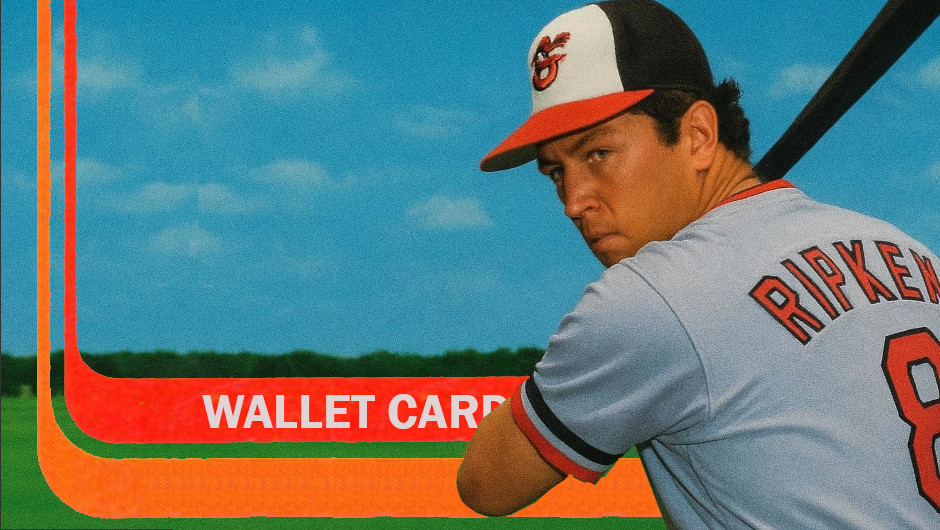
[Author’s note: Every year on my birthday I select a handful of instantly recognizable baseball cards to become “Wallet Cards.” The cards are always chosen with a theme in mind and are subsequently deposited for the next 12 months into my wallet. The cards are not encased in any sort of protective sleeve and quickly accumulate significant damage and wear. I document the before and after states of these cards and will sometimes keep a photographic journal of the adventures on which they have accompanied me. Each of these cards has its own story behind it, and at a later date I take them out and find out all I can about their history. This exploration of the 1982 Topps Traded Cal Ripken, Jr. baseball card is the latest in this series.]
This Card Could Start Arguments
“What do you mean you won’t trade this card? Isn’t the set called Topps Traded? It’s not even Ripken’s rookie card!”…….[fistfight ensues]
The idea of a rookie card seems simple, like some sort of immutable law of nature. However, as a concept inside a hobby now well into its second century, the goal of finding rookie cards is a relative newcomer. Looking back 50 years or more the hobby was distinctly focused on building sets. Current year cards were easily obtained, a task as simple as locating the nearest retailer with a Topps logo appearing on their candy shelf. Older cards needed to be purchased or traded for. Given the general upward trend in production that culminated with the Junk Wax Era, this meant the older cards needed to build a collection were usually harder to find. The further a collector needed to reach back in time, the more likely they were to see lower print runs augmented by the natural attrition of cards being damaged or discarded over time. And what card of any particular player is likely to be the hardest to find under these conditions? The earliest: A player’s rookie card.
Rookie cards become more of a focal point for collectors when two additional factors are considered: The rise of player collecting and social proof. Player collecting has been around for much of the hobby’s history, but it was the influx of new collectors in the early 1980s that brought it to the forefront. These collectors were unconstrained by previous hobby norms, either through ignorance of hobby tradition or through the lens of seeing cards with fresh eyes. Rising pack prices and exponential growth in card offerings combined in the 1990s to significantly scale back the idea of traditional set building. Faced with this dual threat, hobbyists unconstrained by the past pivoted much harder towards player collecting.
There’s a bit of social proof and internal validation in seeking out rookie cards. Hanging onto a player’s first cardboard appearance is a symbol that a collector had the foresight to see future on-field success, the cardboard equivalent of being a successful scout. Your card looks at you and compliments your skill in identifying baseball talent. You’re so smart. Reflecting the rising demand for rookie cards against the fixed supply of previously issued cards, the figures reported in hobby price guides reflected this increasingly upward sloping price curve for rookies. You’re so smart again! New entrants to the exploding hobby of the 1980s took their cues from this data and concluded that rookie cards were the future cornerstones of their collections, collections that were becoming increasingly player-centric.
Collectors tend to gravitate towards keystone pieces, and rookie cards, as potentially harder to find targets with plenty of other collectors chasing them, are an excellent starting place for identifying a player’s key card. If you wanted to acquire just one card of your player, it was almost certainly his rookie card.
Arguing About Rookie Cards
Identifying a rookie card is a simple process when you don’t think too hard about it. Is it a player’s first card? If yes, rookie. Cal Ripken appeared in four different major baseball card sets in 1982, a fact that provides Ripken collectors with four different rookie cards to chase. Maybe.
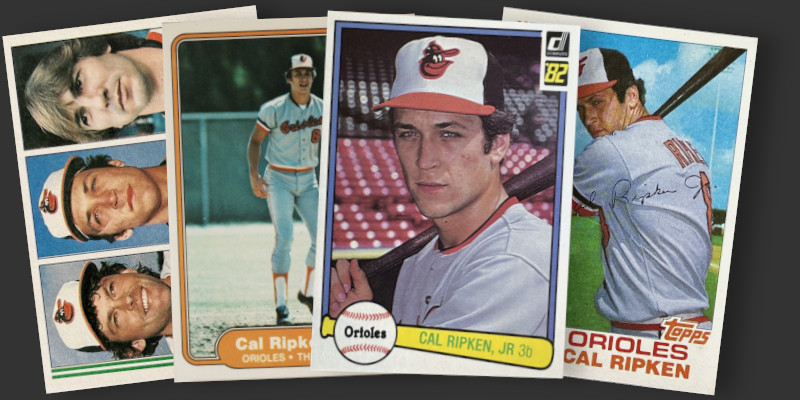
Imagine being a collector in 1983. Ripken is coming off his ’82 American League Rookie of the Year season and you want to get his rookie cards. What exactly does that potential shopping list look like?
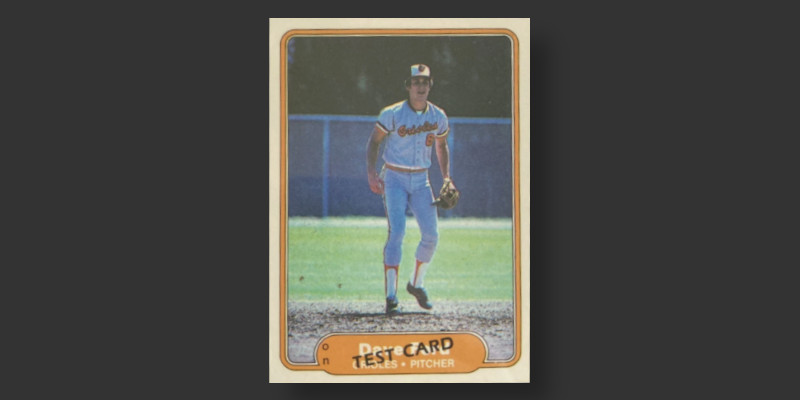
The Donruss card above pretty much gets universal acceptance as a rookie card. So does the Fleer example, though the same may or may not apply to a test issue produced by International Paper in hopes of convincing Fleer to outsource its printing needs. Muddying the waters even further is that International Paper screwed up these samples, producing an error that combined Ripken’s photo with the nameplate of Orioles pitcher Dave Ford. Is this a rookie in the hobby canon?
The straightforward multiplayer offering of Cal Ripken, Bob Bonner, and Jeff Schneider even drew a minor twinge of controversy. Hating the multiplayer dumps of rookies that began with Topps issues of 20 years earlier, a minority of collectors held fast to the idea that a player’s “true” rookie card did not come until he was afforded the respect of a solo baseball card. It’s very much a minority take today, but the echoes of this preference can still be seen in demand for the ’64 Topps Pete Rose, ’69 Nolan Ryan, and the Traded cards of 1981-1982. Among those collectors, cards like the ’82 Traded version were the preferred rookie representation of Ripken.
There was simultaneously pushback against products like Topps Traded, which were made available solely through the era’s then limited hobby channels. It felt to some collectors like this was Topps creating a side door to sneak out rookie cards to hobbyists in more well-connected regions of the hobby. Did Topps produce a rookie card? It depends on who you asked and which card they were looking at.
Things could get even more complicated. As a Ripken collector, did you consider his team issued postcard to be a baseball card, and therefore, a rookie? What about the cutout “card” that could be cut out of that year’s MLB All-Star Game program? What if there had been some sort of obscure regional food issue? What about bootleg junk printed in some guy’s garage? Clearly there is room for debate.
The question of what constitutes a rookie card gets even more complicated when a player appears on multiple cards in the same set. Collectors generally developed preferences for certain cards when given multiple appearances in the same checklist.
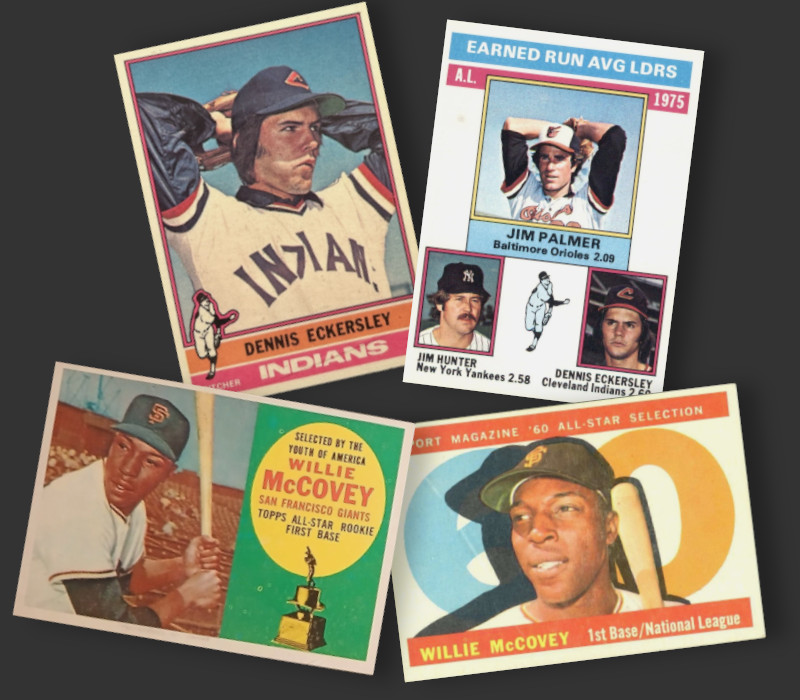
A clear collector preference emerged in these situations for players’ solo, non-subset cards. Importantly, this preference emerged organically and began to be reflected in the relative prices collectors offered to add cards to their collections. Price guides sought to denote which cards were considered rookies. One way to accomplish this would be to let the hobby sort it all out via relative pricing, but this could take months or years before any sort of consensus emerged for a particular card.
The Extended Phenomenon
The big debate around Ripken rookies during his career centered on his appearance in the ’82 Topps Traded set, and with it, the identifiers that accompanied it in hobby publications.
What purportedly drove the discussion was the distribution method of these cards. Beginning in 1981, Topps began selling a supplemental 132-card product exclusive to hobby dealers. These cards were initially distributed as boxed sets, completely bypassing the wax-pack opening experience of set-building collectors. To a material portion of collectors assembling cards of current players, buying pre-packaged sets didn’t feel like the cards had “earned” their way into hobby respect (No word on what they thought of factory-sealed sets from manufacturers’ regular season offerings). To a not insignificant number of collectors, a card either came from a wax pack or it didn’t count. The hobby is a broad church, but it has its share of denominations and is no stranger to ideological conflicts.
Topps hadn’t expected such a reaction. The company had numbered its 1981 addendum as #727-858, continuing right where the regular season set had left off and making it clear the manufacturer saw this as part of one large set. Although advertised on the box as the “Traded Series,” the set was often marketed by hobby shops as “Topps Extended,” implying an expansion of the checklist fans had spent the summer completing. Topps responded to the hobby’s insistence that this was a separate issue by introducing a new numbering scheme, identifying the sophomore checklist with a “-T” suffix and restarting the numbering as 1-132.
In 1982 this was largely just a point for passing discussion. However, hobby trends were changing in favor of collecting rookie cards. They were beginning to matter. Furthermore, the financial architecture of the hobby was beginning to come together with cards changing hands for coins instead of simple one-for-one swaps of similar cardboard. To keep track of the emerging pricing structure and relative values of cards, price guides had begun to emerge at the end of the 1970s. By late 1984 the annual Beckett guides were being augmented by a monthly magazine edition focused on the most popular postwar sets. These guides included notations intended to help collectors, such as denoting cards of MVP, Cy Young, and Rookie of the Year winners.
Crucially, the magazine noted rookie cards with an “RC” designation following a player name to aid readers in identifying the first cards of their favorite players. When it came to the recently developed Traded sets from Topps, Beckett reflected the hobby’s ambiguity by adding a “?” to the RC designation. Players previously appearing on multiplayer rookie cards, such as Ripken, had the designation omitted entirely (Ripken was simply labeled “ROY” for Rookie of the Year). This obviously wouldn’t be a long term solution, so the magazine split the difference with the creation of an entirely new label, “XRC,” to denote a card as an “extended” rookie card. This shifted the interpretation of just how much importance to place on these cards back to the reader. The Ripken, however, remained completely unlabeled as either an RC or XRC given his previous appearance on a multiplayer card.
Stepping Back: What Is a Rookie Card?
The whole RC/RC?/XRC construct and related designations (e.g. FTC for First Topps Card) wasn’t Beckett making up rules for a fractured hobby. It was an editorial guess about the unwritten rules of disparate collectors who have a general idea of what constitutes a rookie card but harboring different personal views on the matter, views that are often at odds with each other. Beckett‘s whole business was based on reporting the midpoint of large sample sizes. They weren’t setting the rules, the hobby was in its own messy way. Beckett’s issue was that the act of codifying the rules in print instantly made them largely inflexible lines in the sand. A rookie card is or is not an RC based on the guidelines. Pluto is or is not a planet based on meeting the three planetary rules. We didn’t even know rookie cards or Pluto existed 100 years ago. We’ll do just fine a century from now regardless of what we call them.
I’ve written over 3,000 words at this point discussing what other people consider rookie cards without offering anything novel on my part. Based on the way the hobby treats cards, regardless of the designation in guidebooks, the passionately written message board manifestos, or the MLB Players’ Association attempt to legislate what constitutes a rookie (defined most simply as whether or not the MLBPA can charge a licensing fee), I have settled on a definition that fits the world as it is rather than as it should be.
A rookie card is the earliest card of a player that instantly comes to mind when someone asks if you have THE card of that athlete. It represents concentrated collector interest in a single piece of cardboard. Ripken, like most modern players, had multiple cards issued by multiple manufacturers in his rookie year, including multiple offerings from the same same manufacturer (Topps). In my mind all can make some claim of being a rookie card, but only one can be “the” rookie card. For a while the hobby fought this out, but you would be hard pressed to find someone who claims the Traded card isn’t the definitive Ripken debut. Despite what the MLBPA wants to tell you, there is no “official” rookie card in the hobby – there are only rookie cards that collectors want more than others. For the last 45 years, that Ripken card has come from the ’82 Traded set.
A Test of the Definition
Collectors love to write on social media, message boards, carrier pigeons, and whatever else the use to talk about their collection about how this card or that is a player’s true rookie card. They will argue all day about what constitutes a rookie card in a series of justifications that never change anybody’s mind. Hobby demand doesn’t care about those rules, and there is a test you can perform to see exactly where people stand.
Ask a collector if they have “the Griffey rookie.” Despite having numerous issues to choose from, the answer you get back will almost always refer to whether or not they have a 1989 Upper Deck Ken Griffey, Jr. card. It is the consensus rookie card. Perform the same experiment for “the Jeter rookie” and you will get either response about his ’93 SP or ’93 Topps base cards. Jeter’s other brands and parallels are generally ignored in this conversation, as is his even earlier cardboard appearances for Classic or Front Row in 1992. Despite the MLBPA criteria for identifying rookie cards, absolutely nobody will bring up his cards from 1996 in response to the question. A critical mass of collector interest has congealed around these very specific cards as the ideal rookie cards despite the presence of alternatives, sometimes from different seasons.
Remember, the only reason we even chase after rookie cards are because they represent the focusing of collector interest into a single, identifiable piece of early cardboard. You need that mass appeal to generate the demand, and once it hits a certain point it becomes almost self-reinforcing in the hobby.
Why the ’82 Traded Card?
This has long been seen as a significant card. Mike Payne penned a retrospective of the 100 most significant cards of the postwar era in 1993 (1st Place: 1952 Topps Mickey Mantle). He ranked the Ripken card as the 20th most important, coming in ahead of rookie cards of Stan Musial, Roger Maris, Yogi Berra, Roy Campanella, and Eddie Mathews. In 2024 Beckett ran a countdown of the greatest cards of the 1980s, ranking the ’82 Traded Ripken in 3rd place behind the ’89 Upper Deck Griffey and ’84 Donruss Mattingly rookies and just ahead of the 1980 Topps rookie of Rickey Henderson. Countless other lists have been compiled, with this card becoming a regular within the ranks.
I can certainly see the appeal. It looks better than any of the other offerings. Fleer was blurry. Donruss gave us a closeup of Cal on a bad skin day. Topps had initially thought people wanted to see Bob Bonner and Jeff Schneider. The Traded card features Ripken in his first solo Topps appearance, and the layout happened to capture something that would only become apparent with time for the Baltimore infielder. He is captured holding a bat inside Miami Stadium, which was the site of the longest professional baseball game in history. Ripken had played every out of that 33-inning contest, getting 2 hits in 13 at-bats in what almost amounted to a quadruple-header for the Rochester Red Wings. He would go on to become even better known for playing more consecutive games than anyone else.
The photo was taken in either 1981 or 1982. Identifying the photographer behind the image would depend on which year it was captured, as there was a change underway among Topps-affiliated photographers during this period. Mickey Palmer was Topps’ primary photographer for East Coast Spring Training assignments through 1981. Michael Ponzini started to take on this role in 1982, though there may have been some overlap, especially in the early days of Spring Training.
Topps brought back facsimile autographs in 1982 after skipping the design element in 1981 and 1978-79. Topps first introduced facsimile autographs in 1952 using signatures lifted from contracts signed with players. By 1982 the card manufacturer had graduated to purpose-built sheets requesting a player sign their name multiple times for the purpose of reproducing their signature for cards. A Ripken collector posted his original sheet for others to see showing Ripken signing three times to get just the right look to his name.
The back of the card is an improvement over the base Topps set as well. The orange/blue palette is much easier to read than the green/blue pack-issued cards. It even color matches the hockey stick bars on the front of the card.
Ripken was one of 11 players to get their own solo cards in the Traded series and to have been featured on the multiplayer Future Stars cards in the base set. Neither Bonner or Schneider appear in the late season release.
Production/Distribution/Rarity
These cards were sold as boxed sets through hobby dealers and heavily advertised in their hobby catalogs. The dealers themselves ordered them in 100 set cases direct from Topps, who printed them to order. Topps required orders to be submitted midyear and accompanied by a refundable deposit. Dealers had done well with the 1981 offering and I suspect the print run is higher than the prior year, though not nearly as high as in future years. Looking at the available quantities of common players in the low-turnover COMC inventory, it appears there are about 30% more ’82 Traded cards than the ’81s. That feels about right.
The entire set was printed on a single 132-card sheet. Ripken appears on each one in the 5th column, 10th row down. For anyone with a severely miscut card wanting to know if they inadvertently have a piece of a Ripken card in hand, Ripken’s cardboard neighbors were Alex Trevino (top), Ivan DeJesus (right), Chili Davis (bottom), and Dave Lopes (left).
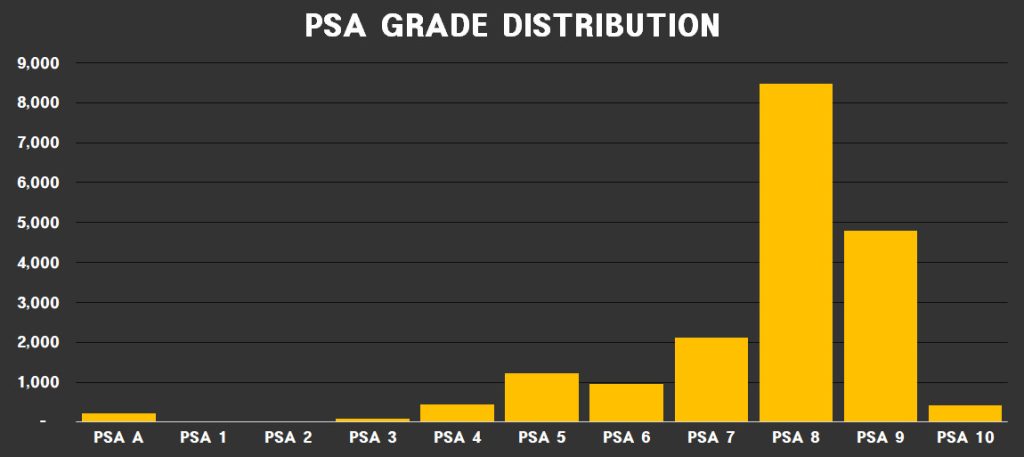
Aside from centering issues, the most common defect appears to be “fish eye” print imperfections. The four major grading services have examined 27,865 cards. PSA accounts for about 19K of these, with grades breaking down as follows:
Hypothetical Trading
The ’82 Traded Ripken is a bit of a misnomer when it comes to what could be done with one. Growing up in an area where almost everyone was an Orioles fan ensured that this card only had permanent homes. Even that idea is purely theoretical. A trade involving this card was the kind that would be followed up by an angry parent calling your house to have the trade unwound.
Even Ripken, the human being, was untradeable. The team moved players like Doug DeCinces to other teams to make room on the roster, and once people started to notice the consecutive games streak Ripken became completely untouchable from a trade perspective. There was no way Orioles fans would let that happen.
There is no way any collector I personally knew would ever be able to trade away this card. Maybe if he had doubles, but those would have already been snapped up by the ever present swarm of local Orioles fans by the end of 1984. I had a friend in middle school whose dad had a wall display of Ripken cards. He had almost the full run, but left a blank space for the ’82 Traded. This card was seldom in the same conversation as modern cards. Ripken was a throwback and somehow his 1982 card felt more vintage than anything else from the era.
So let’s play my usual game of hypothetical trading. Assuming a sufficiently slow kid was encountered with an ’82 Traded Ripken on the local playground, what kinds of baseball cards would need to be handed over in an even trade to obtain it? The local rules were simple: Even value must be received in any trade. A deal was fair if a price guide blessed it with identical values for both parties, and every single trade conducted in my neighborhood had to pass this test. The examples below largely represent the average of the HI and LO columns from Beckett guides of the eras.
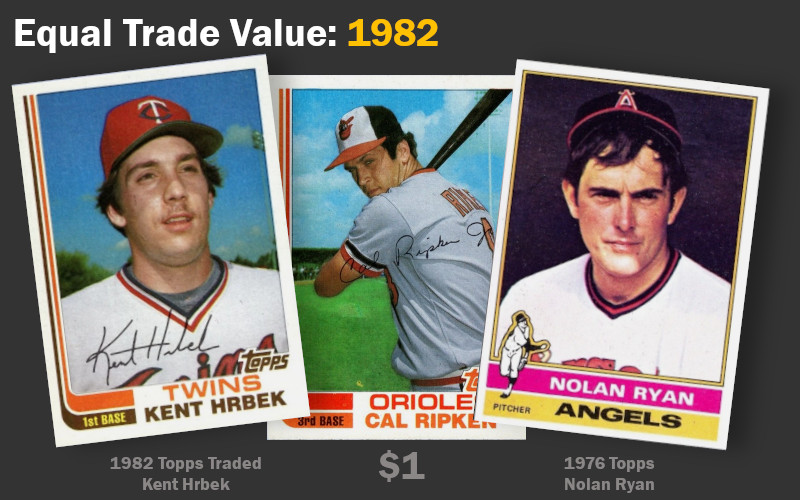
At the end of 1982, any collector with an ’82 Traded Cal Ripken found themselves holding a card of the reigning AL Rookie of the Year. Similar single player debut cards of his National League counterpart (Steve Sax) and the AL runner up (Kent Hrbek) were being traded for the same price, though this was a bit of a theoretical exercise given they were all sold in the same boxed set. You either had all of them or none of the above. However, the reported going rate for any one of these interchangeable ’82 rookies was enough to evenly swap for cards like a 1976 Nolan Ryan, 1972 Tommy John, or 1963 Richie Ashburn. Interestingly, collectors were then expressing a decided preference for the Traded Ripken by pricing it $0.15 higher than his multiplayer card in the base set.
Volume 4 of The Sport Americana Baseball Card Price Guide, in which I found an entry stating that the price of the ’82 Traded Ripken, contained a few dozen advertisements from card dealers. Of these ads, 90 percent offered various complete sets for sale. 39% of dealers advertised the availability of ’82 Topps Traded sets. Tellingly, only 3 dealers bothered to mention rookie cards as being part of their inventory, and one of those only brought up a popular rookie as a way to get collectors to buy surplus 1980 Topps packs (tag line: “Look for Hendersons!”). While the idea of collectors paying $1 for a current year card indicated a budding interest in chasing rookie cards, the state of those advertisements made it clear that rookies were far off the main hobby’s radar screen.
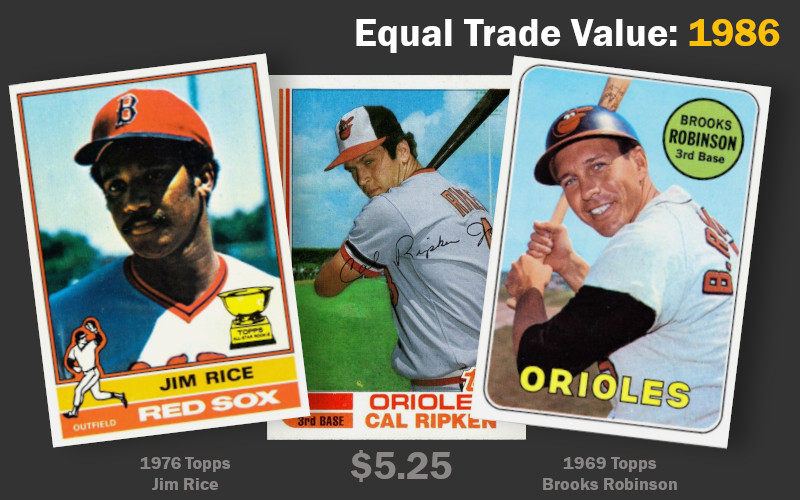
By 1986 you could get a 1976 Jim Rice or a Brooks Robinson from his World Series era. All three cards feature images captured in Spring Training facilities. Note how much the pose of the rookie 3rd baseman Cal resembles the legendary 3rd baseman Brooks Robinson’s 1969 Topps card. I wonder if that was just a coincidence when it came time to select the photo for the Traded card.
The regular, multiplayer Ripken rookie in the base Topps set was trading for $6.50 at this time, about the only point at which the Traded card was in less demand than the base version. This also corresponds with the peak of the arguments over whether or not Traded cards could be considered rookies.
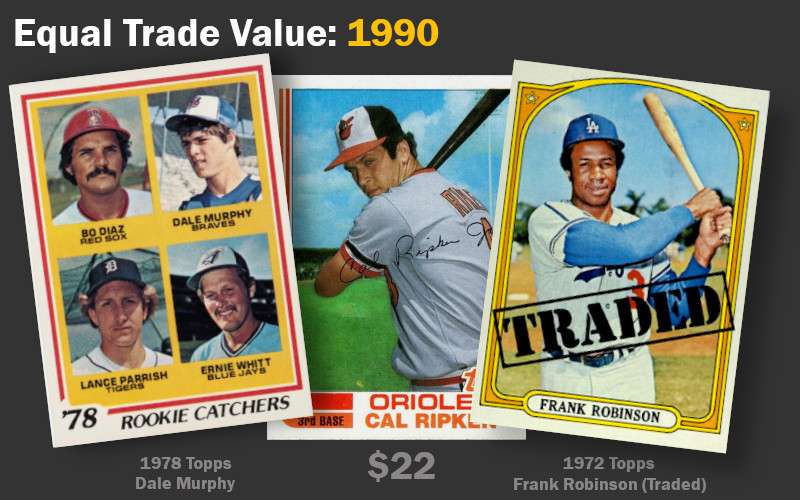
By 1990 we’re still sticking with somewhat older cards in a trade scenario. A Dale Murphy non-rookie “rookie” card (it’s actually his second year after appearing on a similar multiplayer rookie card in 1977) would be considered an equal trade. At the opposite end of the career lifespan spectrum is a 1972 Topps Frank Robinson from the set’s scarce high number series. The Robinson card shows him having recently been traded to the Dodgers and is a forerunner to the cards that would eventually become the bedrock of the Topps Traded product a decade later. These are very ’70s cards, and Ripken himself was looking more and more like a ’70s style player in the guise of a better version of the durable Steve Garvey.
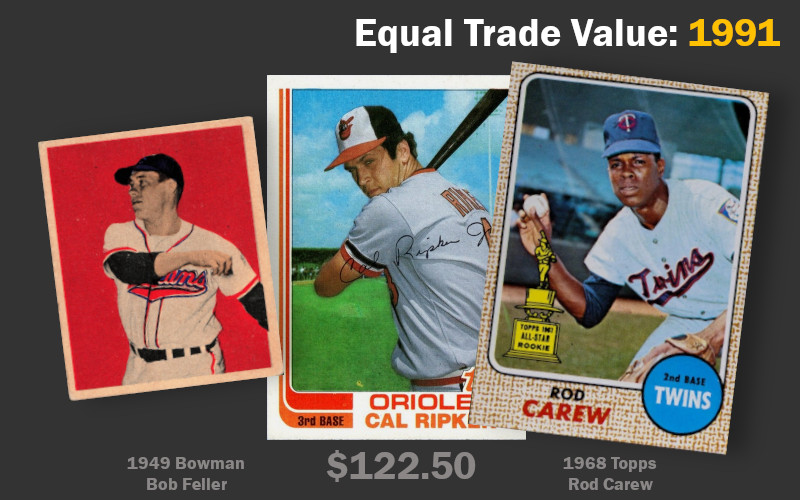
Just one year later Ripken had the best season of his career (10.6 WAR!) and the public awakened to the possibility of beating Gehrig’s consecutive games streak. This was also a big year in the hobby, with record prices grabbing headlines for the T-206 Honus Wagner and 1952 Topps Mickey Mantle. The spread between the Ripken’s high and low prices tightened considerably, indicating steady demand for the card. Suddenly it cost more than $100 to nab a copy for your collection, and any trade had to include some of the biggest names in baseball. If you wanted a Ripken rookie (and didn’t want to settle for the $50 multiplayer card), you needed something like a 1949 Bowman Bob Feller or the first solo appearance in 1968 of Rod Carew, the newest member of the Hall of Fame.
Ripken surpassed Gehrig’s mark in 1995, and I know exactly where I was when it happened. My sister was working at a television station and she invited me to sit in the control room while the game unfolded. Her station wasn’t broadcasting the game, but it did have an uninterrupted live feed without commercials, so I got to learn that camera operators tend to zoom in on attractive fans when stations pause for a break.
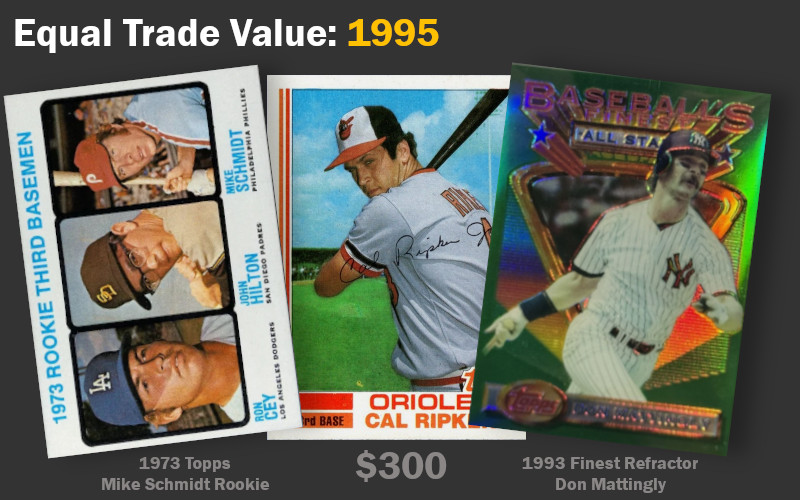
This was also the peak of the post-strike Ripken-mania. His cards were rivaling those of Ken Griffey, Jr. and news reports were talking about the Iron Man having saved baseball from itself. Obtaining the ’82 Traded card would require something equally hot in return. Mike Schmidt, the latest 500-HR Hall of Famer, conveniently had a multiplayer rookie card that might get pried from someone’s hands. The ’93 Finest Refractors were also popular, but it would take a really good one like Don Mattingly to land a Ripken card.
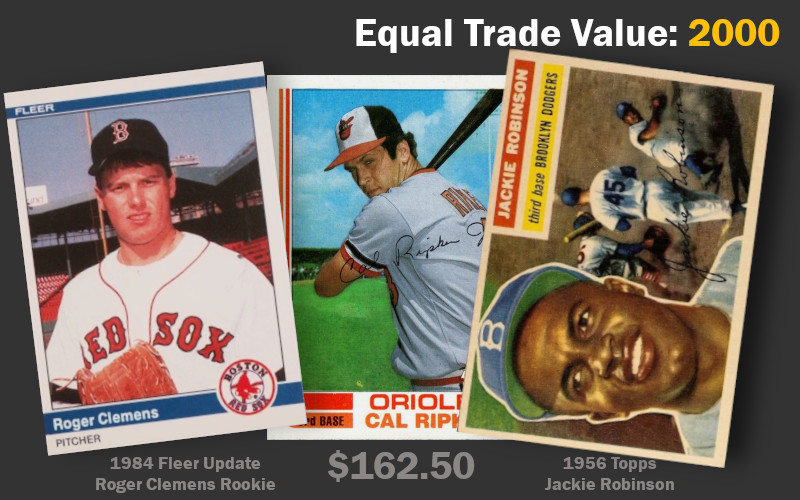
By the turn of the century Ripken had achieved legend status. The post-streak surge in interest was subsiding, but any ’82 Traded Ripken could more or less be instantly converted in other classic cards such as Jackie Robinson’s final card or the cardboard debut of Roger Clemens. The Clemens card was at one time, alongside the Ripken, one of the most controversial symbols of the XRC/RC debate. By this point it was pretty clear that collectors had designated the extended Clemens and Ripken cards over their base cards as the primary choices to represent each player.
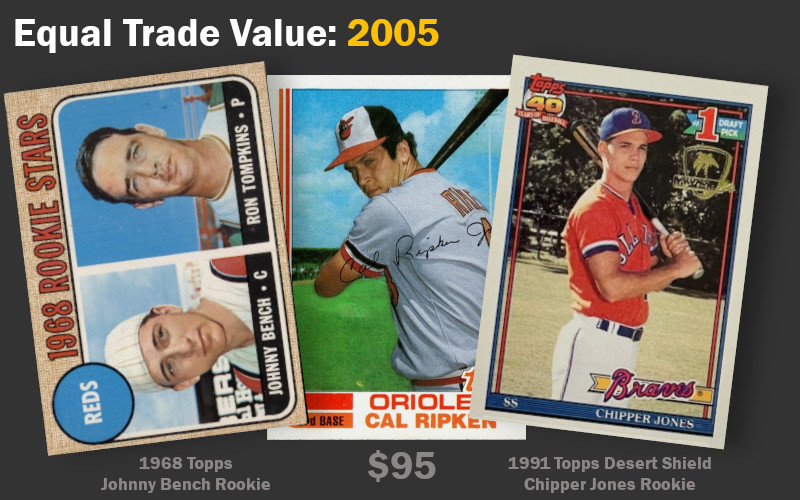
Oh dear. The novelty of 1995 was wearing off a decade later and the mix of what someone would be willing to trade was changing. Sure, Beckett put out another one of their important cards rankings (Ripken was #43) and there was still a vintage multiplayer rookie card of a Hall of Famer (1968 Topps Johnny Bench) that could be put to use in acquiring a Ripken, but that was a ’68 Topps card and nobody liked those burlap-themed borders. Chipper Jones, however, was still going strong and appreciation of the Desert Shield set was building. For a moment these two cards stood equally interchangeable.
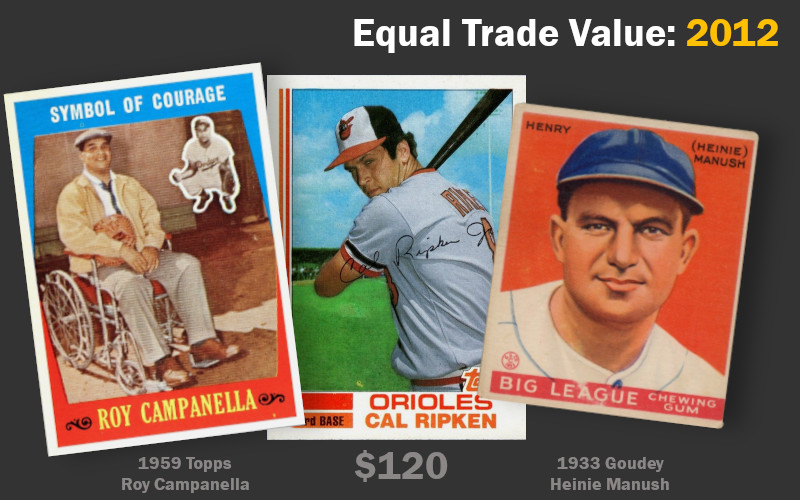
In 2012 it would take a little bit more to trade for the Ripken card, and you would still be deep into card show showcase material to swing a deal. These weren’t top tier cards, but they were quality vintage. The base multiplayer Ripken was down to $27.50 at this point.
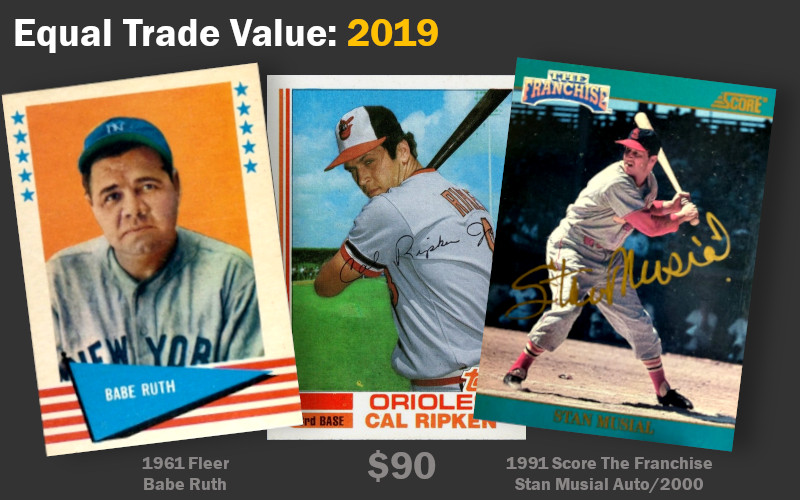
Things start to get interesting again in 2019. Ripken is being seen more and more as one of the vintage players. His Traded card is again going for $90, but some previously ignored post-career cards of some of the biggest names in the game were now picking up similar levels of collector interest. Babe Ruth’s 1961 Fleer card stood on equal footing. So did a numbered, pack-inserted Stan Musial insert from 1991 Score.
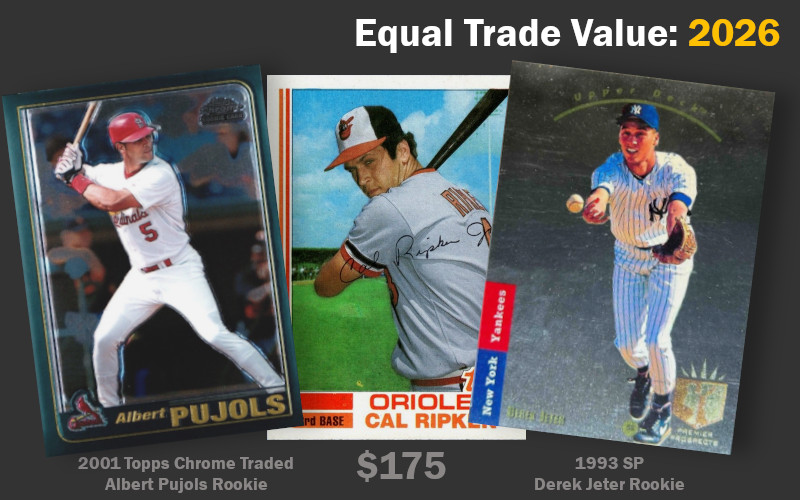
Like a lot of cards, the Ripken has seen a resurgence in demand in 2026. Completed sales or raw copies routinely comp out at around $175, similar to high end rookies of Albert Pujols and Derek Jeter. The Pujols card has fallen off this pace in recent months, so perhaps this could be switched to a raw 2011 Topps Update of Mike Trout.
The real fireworks have been among the examples graded PSA 10. In 2025 demand for high grade ’82 Ripkens took off (alongside other major 1980s rookies), with prices reaching $6,500 by year end. A Gem Mint PSA 10 ’82 Traded Ripken sold for $9,156.10 in September and other similarly graded examples have eclipsed $8,000 in the past week.
And what about that pesky multiplayer base card of Ripken/Bonner/Schneider? They are routinely seen outside of slabs for a little bit under $20.
My Ripken Rookie
So what does my slightly off-center, hairline crease Ripken card that I rescued from a bargain bin look like after spending a year in my wallet?

After a year I still call it my Ripken rookie. It’s from his first year of MLB cards. It has the best aesthetics. It’s print run is far lower than contemporary peers and rivals the production run of many older vintage sets. My collection includes exactly two Cal Ripken cards and this is the only one I sought outside of a set collecting goal. It is part of that demand focused on a single point in cardboard time, which is what a rookie card truly is. It is “the” Ripken card.
Apparently I’m not alone in this. I just store my card in a different place than most.