What did the mid-twentieth century smell like? Probably cigarettes.
Trains, planes, and automobiles all had well-used ashtrays, and so did restaurants and hotels. Smoke was a constant background presence, infused directly into every upholstered surface in American life. Mark Twain, decades earlier, had written about his own devotion to tobacco and marveled at the quantities fellow travelers carried on shared voyages. To the most American of American writers, a suitcase full of tobacco would have been seen as proper provisioning for an adventure. The locomotive and the Lucky Strike were twin emblems of American mobility, each leaving its own haze in the air.
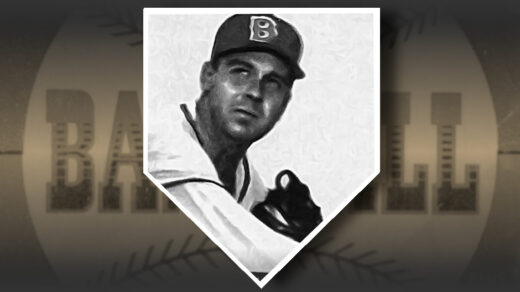
George Stirnweiss arrived in Norfolk, Virginia in 1940 with a suitcase of which Twain would have approved. When he reported to his first minor league assignment with the Norfolk Tars, teammate Henry Majeski took one look at the young infielder’s luggage, stuffed predominantly with tobacco products rather than the usual gloves, bats, and spare socks, and delivered what may be the finest piece of ironic nomenclature in baseball history. “What? No snuff?” Majeski asked, surveying the chewing tobacco and cigars that threatened to crowd out Stirnweiss’s baseball equipment entirely. The name stuck like tobacco juice on a dugout floor. From that moment, George Stirnweiss was Snuffy, a moniker that would follow him through his career, onto the back of his baseball cards, and past the end of his life. Some teammates pushed the joke even further, calling him “Snuffy the Bear,” an unmistakable jab at Smokey Bear, the forest service’s wildfire-prevention mascot who made his debut in 1944 and was soon inescapable on posters from coast to coast. It was a tidy bit of dugout wit: the same decade that taught America to fear a stray cigarette in the woods also produced a ballplayer who seemed to carry a lit one in his hand at all times.
There is something absurd about hauling a suitcase of tobacco into Virginia. This was, after all, the tobacco capital of the country, home to the American Tobacco Company monopoly before its court-ordered breakup, and to the companies that rose from its wreckage, Allen & Ginter and Philip Morris among them. Virginia’s own regions had lent their names to cigarette brands: Piedmont, Chesterfield. Did Stirnweiss really believe tobacco would be unavailable in the a state practically built on growing and selling it? Or did he imagine it would somehow cost more at the source? Whatever his reasoning, the irony compounds itself: Majeski’s joke about “no snuff” landed on a man who had, in effect, packed sand for a trip to the beach.
The nickname’s irony runs deeper still. Majeski’s quip had been sarcastic, yet “Snuffy” captured the essential truth of the man’s relationship with the stuff. The name was simultaneously a joke about what he lacked and a monument to what he possessed in abundance. It serves as the kind of compressed biography that makes baseball nicknames superior to those of any other sport. Of course he’s called Snuffy.
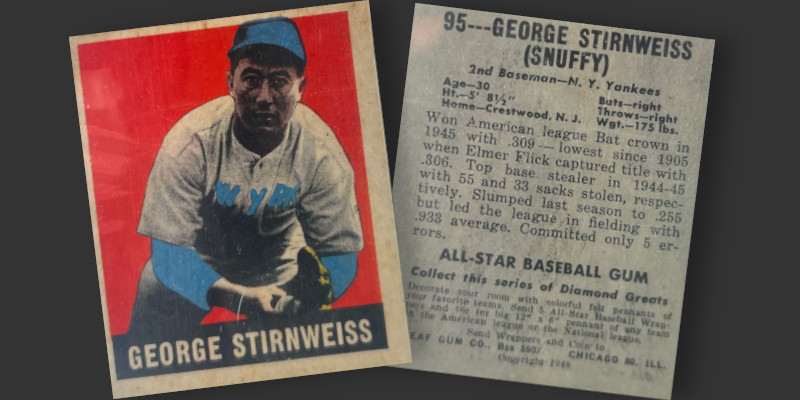
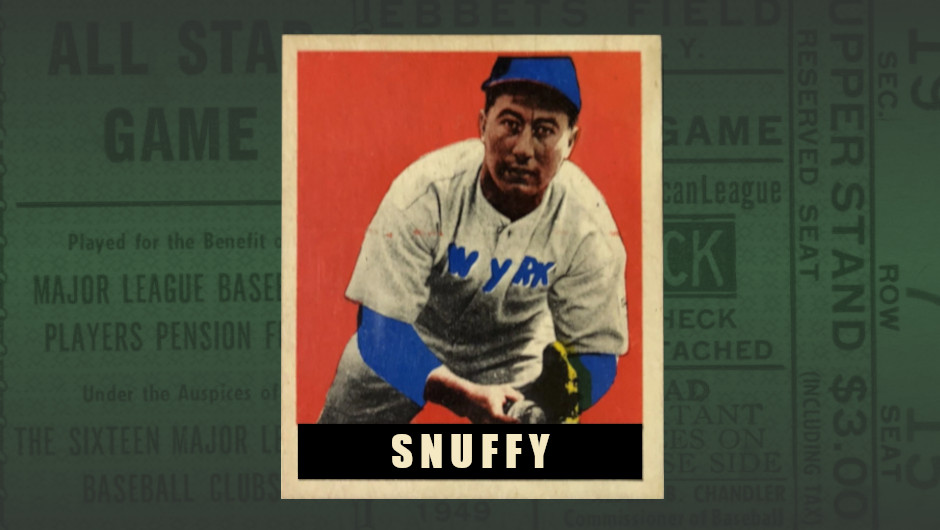
The 1949 Leaf card of George Stirnweiss dutifully notes his nickname on the reverse. The artwork is a chromatic disaster: the Yankees’ second baseman appears against a red background, his hat and sleeves rendered in a blue so bright he looks to be moonlighting for the Brooklyn Dodgers rather than playing in the Bronx. The illustration shows Stirnweiss pulling a ball from his glove, and the back supplies the statistical record: American League batting champion in 1945 with a .309 average (noting this was the lowest mark to win the crown since Elmer Flick’s .306 in 1905); the league’s top base stealer in 1944 and 1945, with 55 and 33 swipes; and defensive excellence at second base, five errors and a league-leading .933 fielding average.
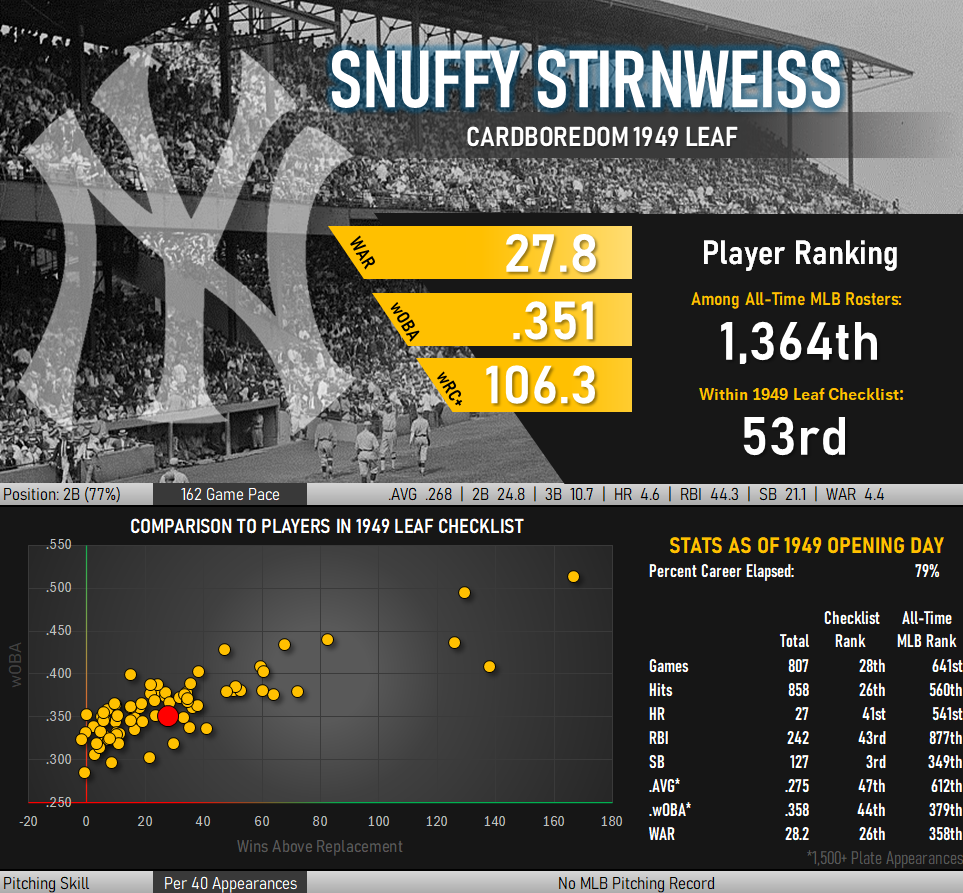
Those numbers tell a story Stirnweiss might not have wanted told. The 1945 batting title came during baseball’s wartime nadir, when rosters were filled with players too young, too old, or too impaired to serve overseas. Stirnweiss himself was 4-F for ulcers, perhaps aggravated by all that tobacco. A .309 average was low by batting-champion standards and gave evidence to the depleted quality of wartime play. When the “real” players came home, his batting average cooled to a career mark of .268—modest by batting-title standards, but a misleading measure of the whole player. Stirnweiss finished his career with 27.8 wins above replacement, averaging better than 4 WAR across his full seasons, a genuinely above-average return built as much on his glove as his bat. What pushed him out of the everyday lineup wasn’t a collapse in ability but reinforcement: Phil Rizzuto and Joe Gordon came home from military service and reclaimed the middle infield, squeezing a still-productive Stirnweiss into a part-time role. On almost any other roster in baseball, he would have kept his job as a top-flight starter.
Before baseball claimed him, Stirnweiss had been a genuine two-sport star at the University of North Carolina, captaining both the football and baseball teams—accomplished enough that the St. Louis Cardinals took him in the second round of the 1940 NFL Draft. He faced a binary choice: pursue football with a team in a distant city, or sign with his hometown Yankees and bet on a longer baseball career. He chose the Yankees, calculating correctly that baseball offered more years of employment and fewer concussions. The NFL in 1940 was not yet the behemoth it would become; choosing baseball over football was still a rational economic decision.
During the early 1940s, while establishing himself in the Yankees organization, Stirnweiss worked off-seasons as an athletic coach at the College of William & Mary in Williamsburg, a town so steeped in its colonial past that it is not uncommon, even today, to see a George Washington or Patrick Henry reenactor buying a pack of cigarettes at the local convenience store, complete with full wig and breeches. The Yankees were paying for teammate Vic Raschi’s education at William & Mary during this same period, making it likely the two future teammates crossed paths in that peculiar colonial-modern landscape years before they shared a Yankees clubhouse.
The nickname followed Stirnweiss through his best playing years and the crowded infield that ended them, through trades to the St. Louis Browns and Cleveland Indians in search of a starting job, and into a retirement that proved brutally brief. He died at 39, in a manner so improbable it almost comes across as dark comedy with a punchline so inappropriate that laughter dies in the throat.
He had suffered a heart attack two years earlier, probably related to decades of heavy smoking, as the tobacco that gave him his nickname slowly worked on his arteries. But what killed him wasn’t cardiovascular decay. It was a commuter train that blew past multiple stop signals and plunged off an open drawbridge into the waters off New Jersey. The Bay Head train crash of September 15, 1958, killed forty-eight people, Snuffy among them.
The irony is almost unbearable: a man devoted to a substance that kills slowly and reliably instead died in a freak accident. The tobacco didn’t kill him, though it was certainly trying. An open drawbridge and a conductor’s failure claimed him instead, at an age when he should have had decades remaining, his children still young, his life after baseball just beginning to take shape.
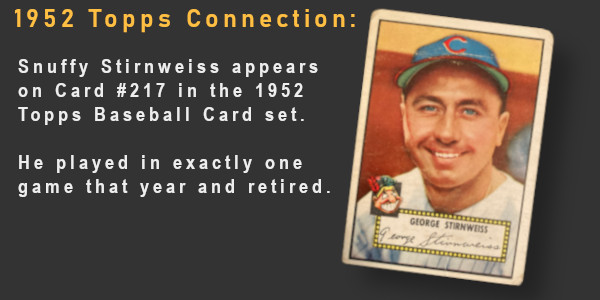
Nicknames in baseball are supposed to be affectionate, monuments to personality compressed into a word or two. “Snuffy” did that perfectly, telling you exactly who George Stirnweiss was and what he carried with him. But nicknames outlast their owners, becoming the primary way we remember men we never met. Stirnweiss is remembered now, when he’s remembered at all, for three things: a nickname born of ironic abundance, a genuinely strong career that a crowded postwar infield cut down to a part-time role, and a randomly tragic death. This card gives us a portrait of a man who packed his life with tobacco, in a state built on the stuff, only to be undone by something else entirely.