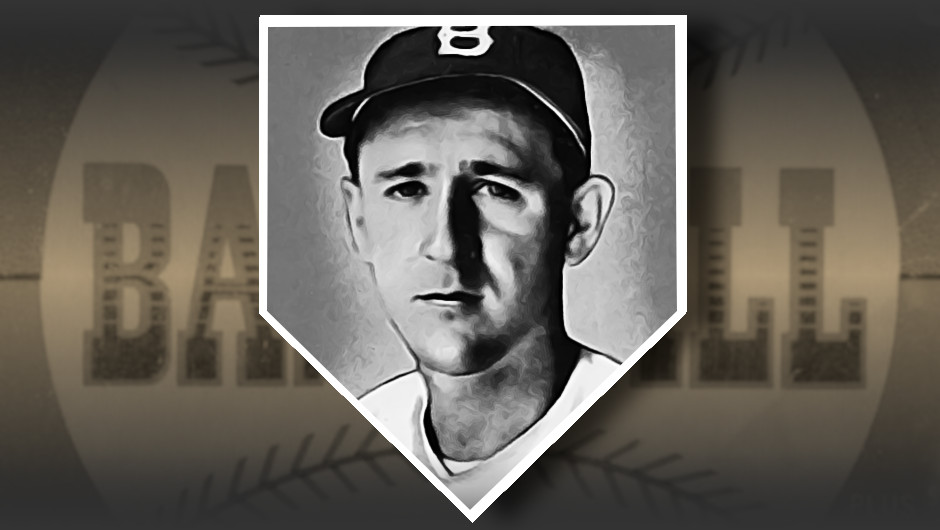
Johnny Schmitz threw an entire decade with the Cubs and is one of the first Brooklyn Dodgers pitcher to appear in the 1952 Topps baseball card checklist, yet he will always be a Washington Senator in my mind. That association sticks with me as a reminder of the way I acquired vintage baseball cards as a kid.
I had ended up on several dealers’ mailing lists, many of which had catalogs with page after page filled with dense text listing the availability of various card numbers. A typical setup would read “1954 Topps Commons (EX-MT $12/VG-EX $5/FR-GD $2): 8, 9, 11, 12, 18, 28, 31, 33,…” There would be no pictures, and truthfully no guarantee that any particular number was in stock in that exact condition. I would write a letter requesting a few randomly chosen numbers, indicate where to send the low grade cards, hand $10 to my parents, and obtain from them a check made out to the dealer. About a month later I would get an envelope in the mail with the requested cardboard.
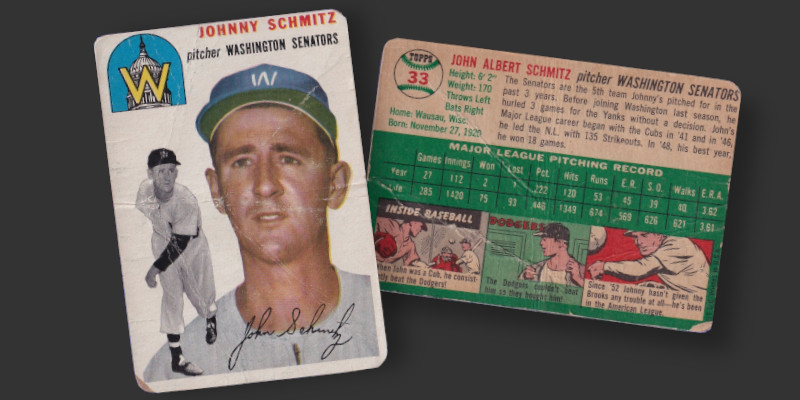
I acquired exactly two 1954 Topps examples in this manner, specifically cards #18 (Walt Dropo) and #33 (Johnny Schmitz). I knew the ’54 set as one characterized by bright colors, so it was a surprise to 9-year-old me that the Schmitz card had a white backdrop. Ever since that time, Schmitz’ card and the accompanying Washington Senators’ logo are what come to mind when I hear “1954 Topps.”
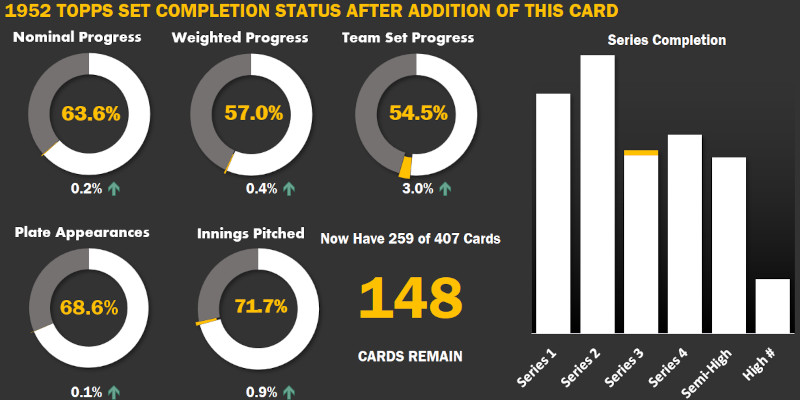
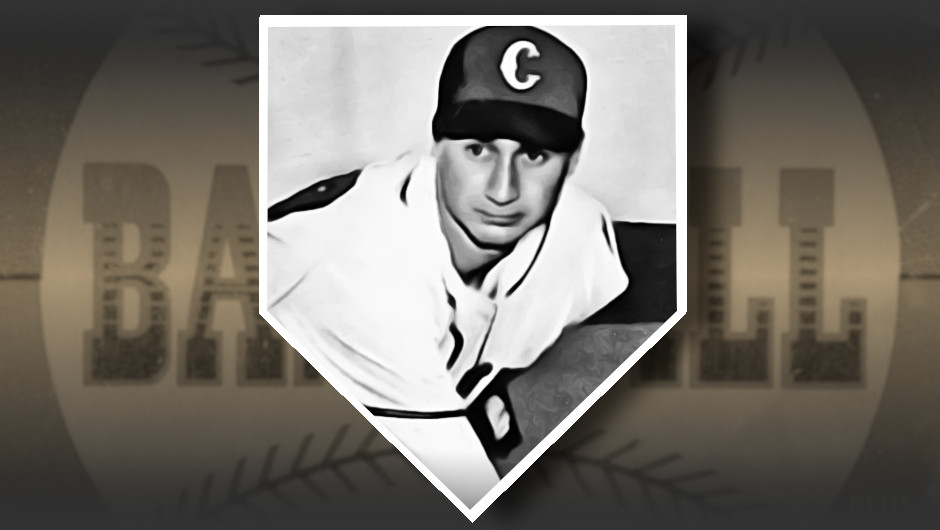
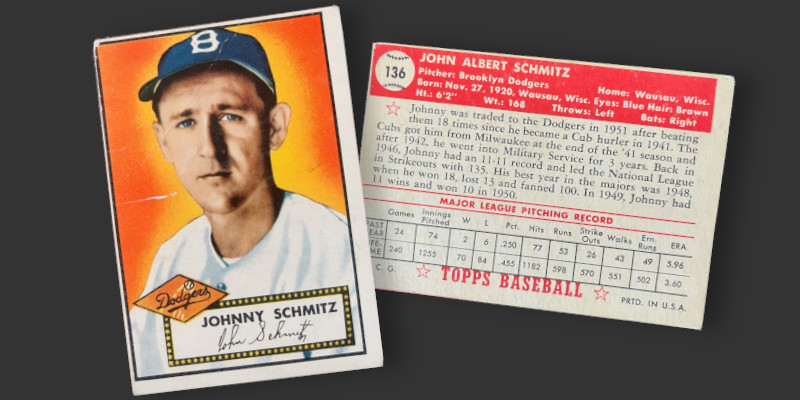
The thing about this affiliation with Washington is the fact that he was with the team for exactly one season amid an end-of-career flurry of address changes. His 1952 Topps card, shown below, resides as part of my ’52 set building project and shows him on the pitching staff of the Brooklyn Dodgers. He was traded multiple times in August that year, first going to the Yankees and then to the Reds. In ’53 he went back to the Yankees and then caught a southbound train to the Senators. After posing for his ’54 Topps card he was traded to the Red Sox and shortly thereafter sold to the Orioles where he wrapped up his career in 1956.
A journeyman reputation is not what one would have expected at the outset of the 1950s. He had been a mainstay of the Chicago Cubs teams of the 1940s, playing 8 seasons for the North Siders bookending a three year absence for military service. During this time, he proved himself as the capable lefty saddled with a low-scoring team. His 13-18 record led the National League in losses in 1947 despite finishing near the top of the leaderboard in shutouts. The pattern repeated in other years with similar dual-top 10 finishes in these categories. He even won the NL strikeout total in 1946, though his tally of 135 punchouts pales in comparison to what such mark brings to mind.
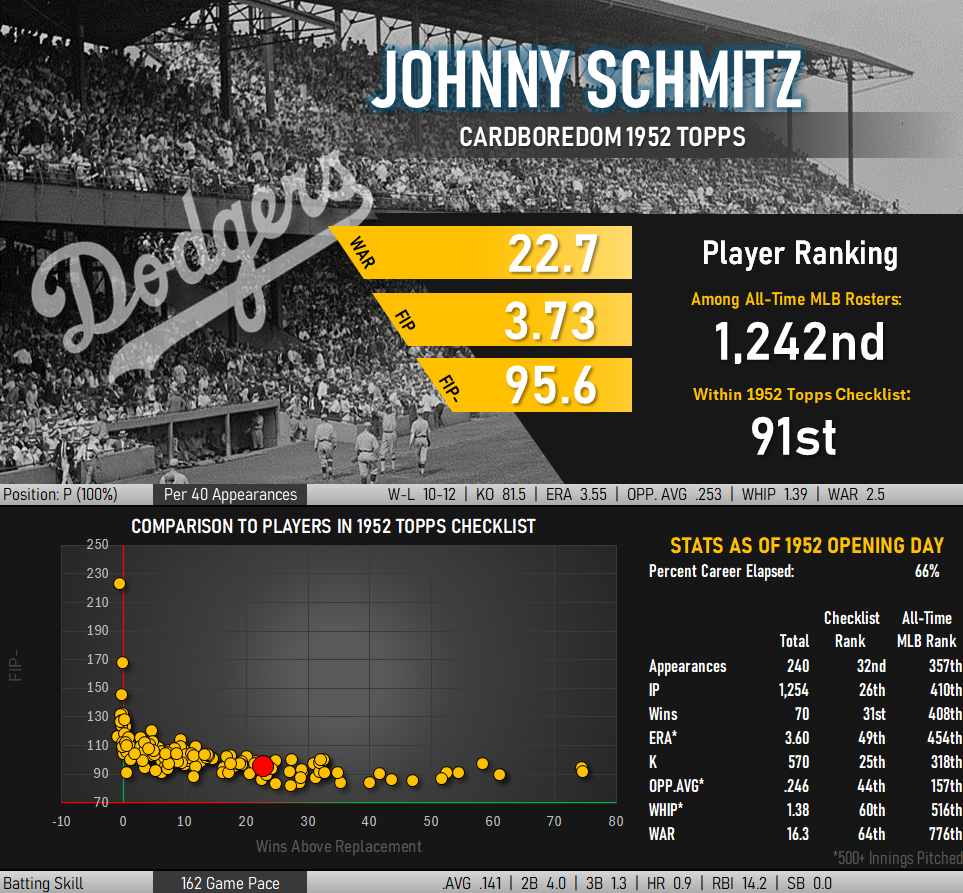
Schmitz’s debut with the Cubs wasn’t his first brush with a major league club. He was actually the left handed part of a pair of hard throwing teenagers signed by the Cleveland Indians in the mid-1930s. The righty, Bob Feller, went on to set records almost immediately. Schmitz was deemed to be a bit more prone to missing the strike zone, and as such was kept in the minor leagues until Cubs scouts made a move to get him into the National League.
The southpaw’s record through the end of the 1940s was all you could hope for in a top-line starter: A 3.15 ERA, 15 WAR, 200+ innings per season, a positive strikeout to walk ratio, and an ability to limit opposing hitters to minimal home runs and a batting average approaching the Mendoza Line. What curtailed his success and sent him packing on a tour of MLB clubhouses was an arm that gave out around 1950. Schmitz’s career stat line, already very respectable, looks like it belongs in the “Hall of Pretty Good” camp alongside Dave Koslo and Joe Nuxhall when his military interruption and later attempts to play through injury are taken into account.
Not bad for a Washington Senators pitcher.