I like my clothes fitted. Most off-the-rack short sleeve shirts come with way too much material, almost obscuring the entire upper arm as if the clothing is apologizing for the physical condition of the person underneath. Not me. I’ve spent an embarrassing number of afternoons looking for exceptions to this trend: An observable tapered drop from shoulder to waist, and a sleeve ending just above the horseshoe of the triceps. Not on it or below. Above. There is a mental pleasure finding something like this, but the visual effect is noticeable and I enjoy it more than I probably should.
I am not the first to feel this way. Baseball flannel was made to order towards the baggy end of the spectrum for generations, only giving way en masse to modern, tighter fabrics in the 1970s. Leading up to this change, a handful of players were experimenting with different looks. Boston’s resident perfectionist Ted Williams sent his uniforms out for tailoring to cut down the sack of laundry look that dominated the 1940s. He cared for his baseball silhouette.
He wasn’t the only Ted working on the same problem in the same decade. Williams sent his shirts out to be taken in. Ted Kluszewski took a pair of scissors to his, and in the process became something of a reverse Samson, gaining strength from cutting things away.
A decent tailor will tell you the sleeve is the hardest part of any garment. It has to move with the shoulder, clear the elbow, and hang right at the wrist, all while the man inside is doing something other than standing still. I wonder what they would think of Kluszewski’s 1957 Topps baseball card.
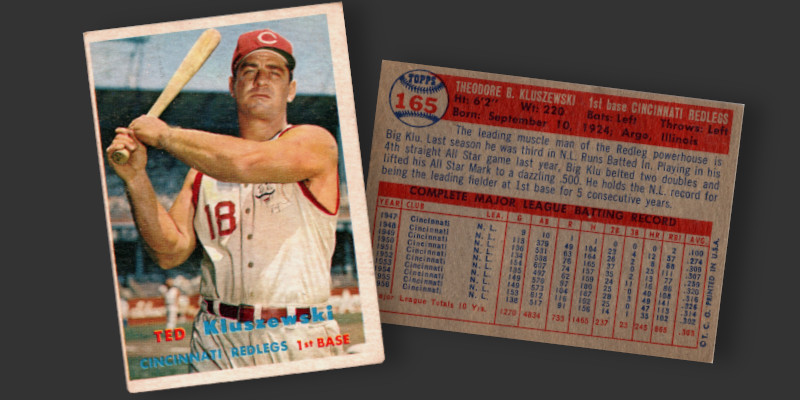
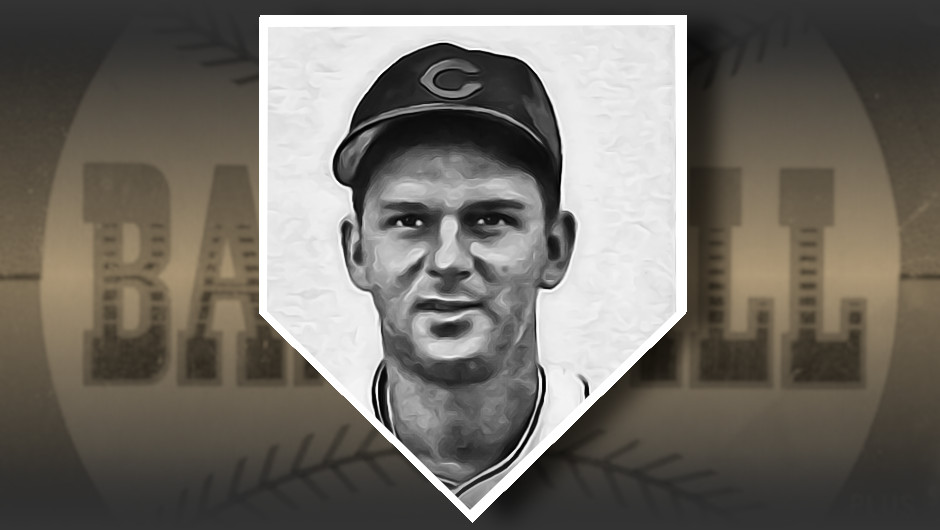
Identified for obvious reasons on the back of the card as “Big Klu,” he is depicted in most of his Cincinnati uniform. The usual long-sleeve red undershirt is omitted, as is any semblance of sleeves on the outer uniform itself. All that is left is an expanse of bare arms that look like they are waiting to be tattooed with the phrase “sun’s out, guns out.”
The standard story that goes along with the card goes like this: Klu stood 6’2″ and weighed 225 pounds with a good portion of that mass originating in his arms. The heavy flannel sleeves of a 1940s uniform bound up his swing, so he hacked away the restrictive material until he could freely launch moonshots into the outer reaches of Crossley Field. Management reportedly hated it and then hated it a bit less when longballs began to appear in greater quantities. It’s a pretty good origins story, but the timeline has never quite sat well with me.
Klu first cut back his sleeves during 1948, but didn’t hit 40 home runs until 1953. In between, he was a promising first baseman with a bat mostly used as a delivery vehicle for line drives. If the sleeves had been holding back his power, one would expect a quicker payoff. Instead, there was a five year gap, a long time to wait for a reaction from a cut of fabric. Furthermore, he had already hit just fine with full sleeves in the minors, winning batting titles at both Columbia (.352) and Memphis (.377). The dude could undeniably hit in a long-sleeved shirt.
My theory, stated out loud with the unshakeable confidence of a guy who last played organized baseball in fourth grade, is that the sleeves (or lack thereof) were theater. Either he felt a bit superhuman with bare arms or he made pitchers 60’6″ away feel a little smaller. Perhaps it was a combination of both. A hitter’s job is half mechanical and half scaring somebody, and those arms were capable of both.
It is worth remembering that Klu wasn’t supposed to be on a baseball diamond at all. Although he played baseball in school, he was primarily an All-American end on a football scholarship with the Indiana Hoosiers. With wartime travel restricted, the Reds couldn’t go south for spring training in 1945. They elected to train on Klu’s nearby Indiana campus, and the university lent a groundskeeper and some students to get the baseball field in shape to host a major league team. One of those students was Kluszewski, who stepped into the cage after the field’s completion and proceeded to launch multiple 400-foot shots beyond the reach of the newly arrived Cincinnati players.
Cincinnati manager Bill McKechnie was watching and soon made a deal with the football player: Finish your senior year of school and sign the next piece of paper the Reds put in front of you. Klu went undefeated that year on the gridiron, won a Big Ten title, ignored interest from NFL clubs, and then signed a professional contract with the Reds for a $15,000 bonus. Baseball paid better and its athletes lasted longer. The sensible man chose the sensible sport, and then proceeded to visually look like the least sensible guy on the field.
The guy dressed like a caveman hit 35 or more home runs every year from 1953-1956 and is the only player in baseball history to do that while striking out fewer times than he homered in each of those four seasons. In 1954 he led the National League with 49 home runs and 141 RBIs while hitting .326, numbers that would have been good enough to win the NL Triple Crown in 10 of the last 100 seasons. His career strikeout rate was 5.6%, which would still lead the majors today. His worst strikeout season matched Tony Gwynn’s worst, with both whiffing 40 times. Gwynn did this while hitting singles and doubles for a living. Klu did it while repeatedly hitting 40 home runs.
Perhaps the best evidence that the sleeves didn’t make the man is that he built himself into a baseball monster one piece at a time. He was initially a defensive liability when he joined the Reds, with an initial assessment of his abilities summing up his chances at staying in the big leagues as pretty good, but only if he could hit .400 to offset his fielding. Klu was moved to first base and spent years getting intensive development at the new position. By the time Topps put him on that ’57 baseball card he had led the league in defensive play for five consecutive seasons. At the plate he focused on improving contact at the major league level, working his way up to .300 three years into his career. Then, and only then, did he go after power. He took his time learning his own measurements.
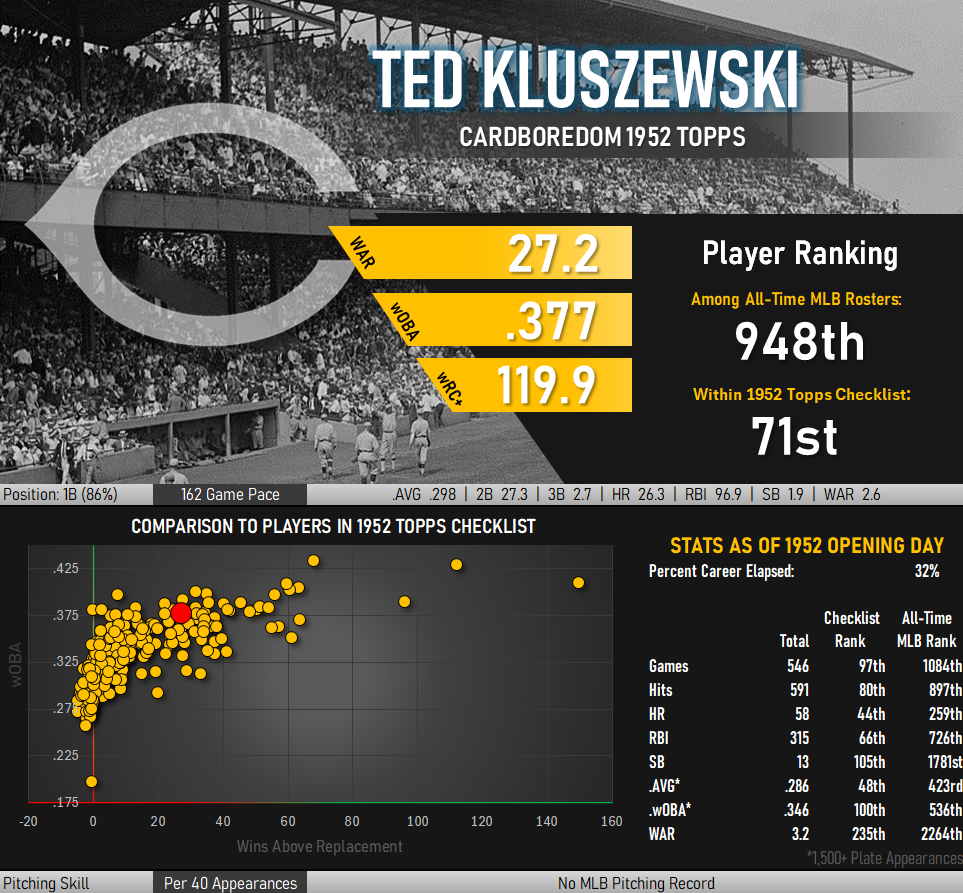
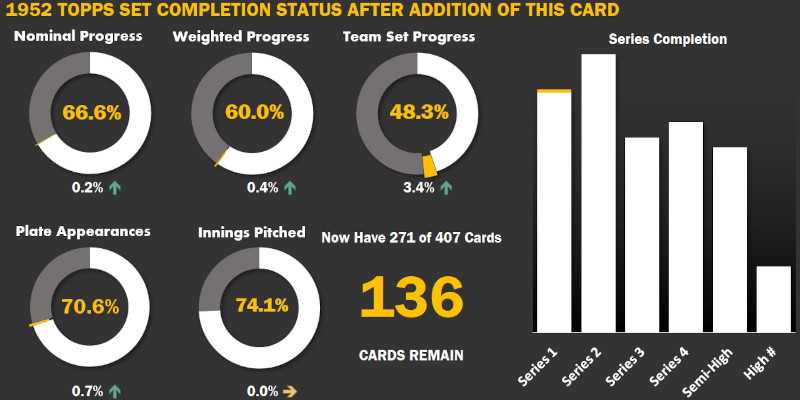
I want to turn our attention to the correctly-spelled, long-sleeved Kluszewski card that actually resides in my collection. It’s part of my ’52 Topps set building project and due to his popularity I settled for one on COMC a full grade lower than the average card in my stash. The corners are looking rough and there is a small bit of paper loss on his left sleeve, kind of like someone was trying to cut away the fabric before he even thought to do away with it entirely. The only thing giving away Klu’s size is the somewhat wider angle shot used to fit him into the image.
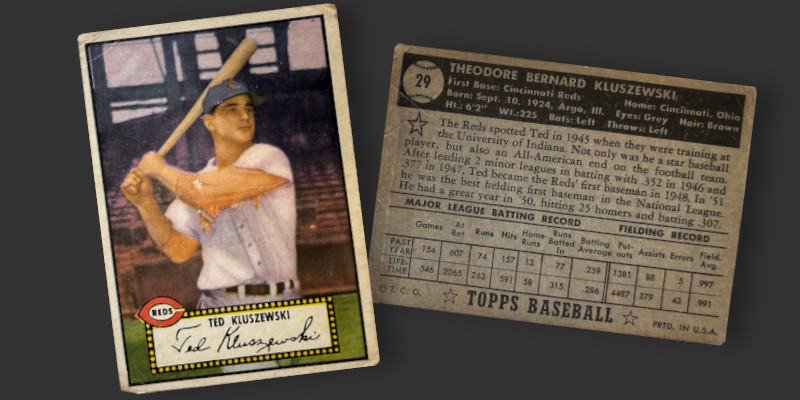
Having been issued in the first series, the card’s photo must therefore pre-date his 1952 emergence from a batting slump and the beginning of his transformation into the arguably the most dangerous hitter in the league. Key to this transformation is his wife, Eleanor, a former star softball pitcher whom he had married right around the time he signed with Cincinnati. She focused on his professional development, and in some accounts is credited with encouraging the removal of his sleeves either as a mechanical improvement in his swing or as a form of marketing to make him more noticeable. The pruning of the sleeves began early in his career and initially took the form of having the hem end somewhere between the triceps and shoulder, a look that can be seen on his outer jersey in the 1952 card. The encouragement continued as the fabric alterations became more pronounced.
Her assistance was not limited to tailoring. Just like the wife of Tony Gwynn, Eleanor took home movies of her husband at the plate. Beginning in 1951 they began dissecting his performances frame by frame, with Eleanor identifying small differences between Klu’s mechanics and his pre-slump at-bats, highlighting that his performance suffered when he was falling away from the ball with his shoulders. He adjusted his swing, leaned into the ball, and immediately raised his average to .320
The 1952 season was the one right after his terrible 1951 slump, the one he cured by watching home movies. He and his wife, Eleanor, a former star softball pitcher who’d married him in 1946, ran their 16mm Christmas film of his pre-slump swing and noticed he was falling away from the ball with his shoulders. He fixed it, and in 1952 he hit .320. They continued to work on his swing, doubling his power output over the next 12 months.
It wasn’t the lack of sleeves that made Klu such a dangerous hitter, it was Eleanor. Her adjustments to his wardrobe are just why he is remembered.