That asterisk in the title is doing some heavy lifting.
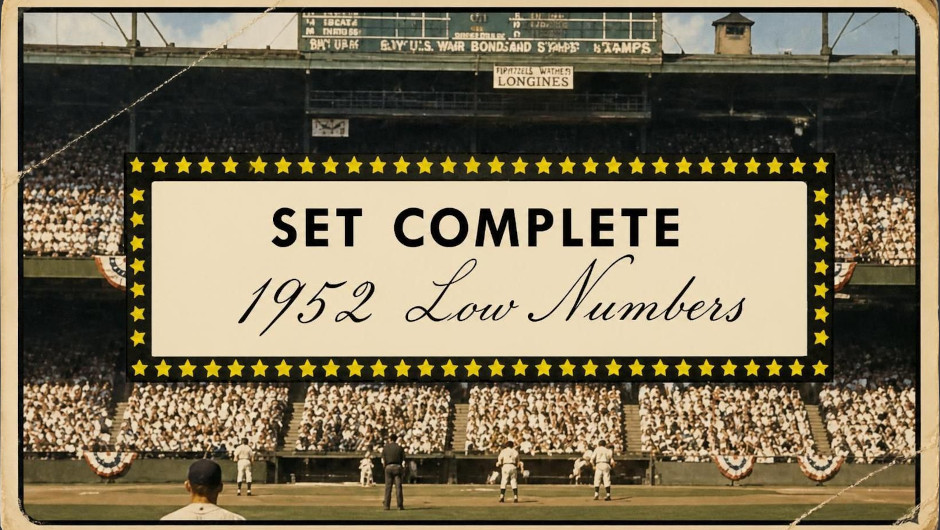
I once overheard the 1952 Topps set described as being complete at 407 cards, and done at 310. The final 97 cards are considered tough enough for them to be considered an optional side quest for those chasing the set. With this week’s sound of the postman’s truck idling briefly in front of my mailbox, I can officially say I am done with the 310-count low numbered portion of the checklist.
Here it is: The final card to be crossed off the checklist.
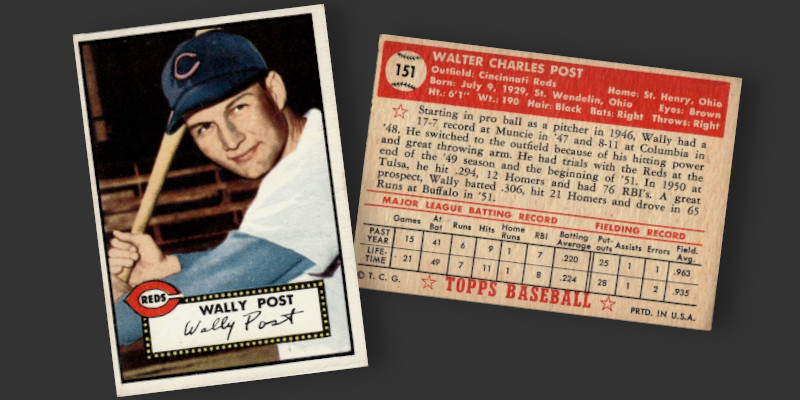
This Wally Post rookie joins the rest of the cards, mostly sourced from common bins and the castoffs of condition snobs. It should be noted that I too am a condition snob, but one who is realistic about ever completing this set on anything resembling a budget. As the last card needed for a completion milestone I stepped up a bit from the average grade inhabiting my set.
This isn’t my first encounter with ’52 Topps. The first example from the set to enter my collection arrived when I was 11 years old in the 1990s. I dug a well worn Ken Raffensberger out of a card show discount box and added it my collection for $5. That particular card left my possession when I sold off my cards to pay for tuition.The irony? I added another similar condition Raffensberger to my set build in 2022 for the princely sum of…wait for it…five dollars.
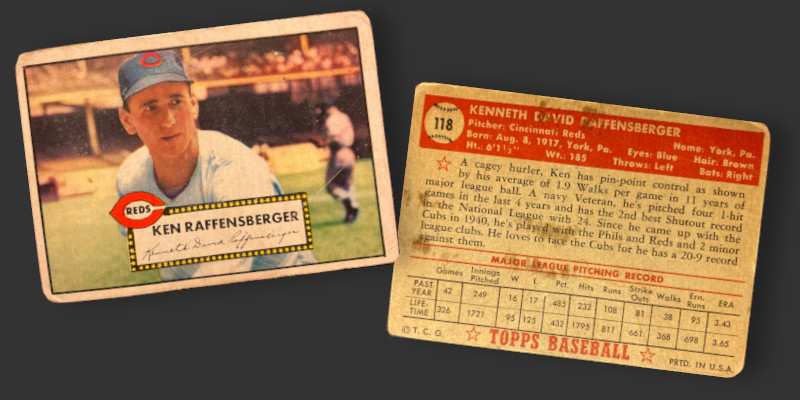
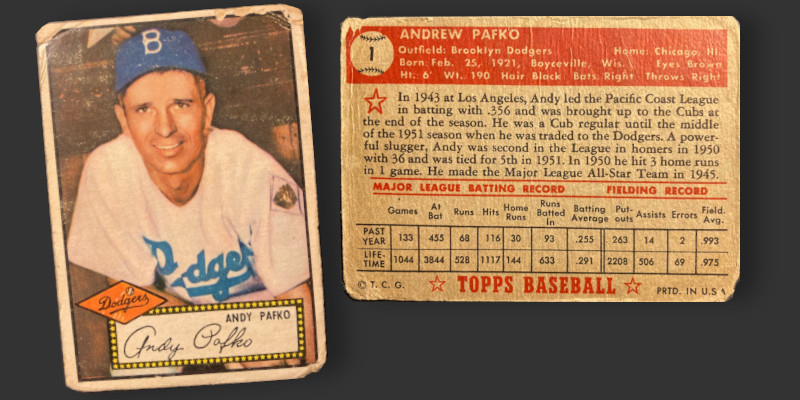
The spiritual genesis of my ’52 set resides in that horizontal card of the Reds’ veteran pitcher, but I do not consider it to be the beginning of my attempt to build the set. My teenage collection topped out at with less than a dozen names marked off the checklist. When I returned to seriously building it 1,996 days ago I did so with a statement piece. I picked up three cards in that return to the set, and the very first one was Andy Pafko. I needed to prove to myself that I was actually doing this and wouldn’t be stopped when I inevitably hit the roadblock of the big name cards. Pafko, which has long carried an extreme condition premium sometimes approaching well into the five figure territory, certainly fit the bill. When set face to face with a poor condition card, I had to find out if I would actually go through adding it to the collection. I did, and doing so mentally committed me to the chase. After quickly adding two more commons I was on my way.
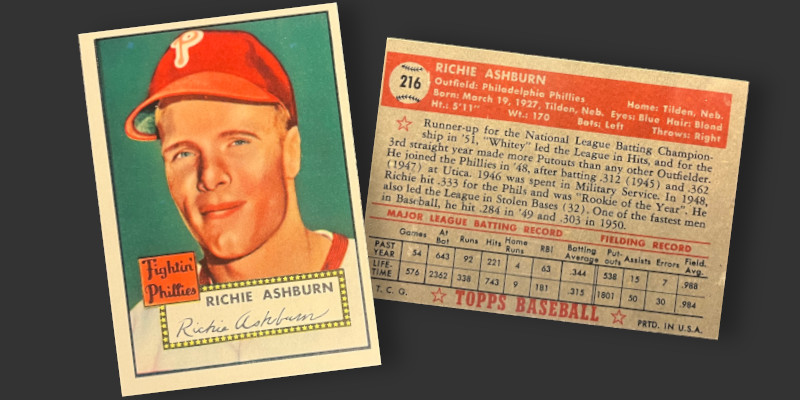
There are a good number of beaters in my run of ’52s, though there are a few outliers here and there. A dozen cards can be considered Excellent condition. My Richie Ashburn falls gets an EX condition designation with razor sharp corners offset by typical Topps centering issues. I hadn’t initially set out with plans to add such a nice card to an otherwise worn set. In fact, I tried to purchase a trimmed Ashburn card that was mistakenly mailed by the vendor to a different collector (who stole it). I encountered multiple examples of lower grade Ashburns at the Chantilly, Virginia card shows but kept turning away when dealers kept asking $100 and up for examples with corners looking like they belong on a Pokemon card. Eventually I came across this one online from a guy in Saint Louis for less than what some of the card show guys were asking. My price was something of a mix of awe for the card and spite for the condition-blind card show dealers.
We’re not here to admire art and sporting excellence. Like 90 percent of race spectators, we’re hear to see the crashes. Let’s turn to the worst condition cards in my set. 73 of these cards are at the bottom of the condition scale. Of these, four stand out as being particularly rough. The set’s Marv Rickert is missing most of its back. A kid punctured the eyes on a Johnny Lipon card. Johnny Hopp apparently took a glancing blow from a Daisy Red Rider BB gun. Each of these are likely eventual upgrades, but the most absolutely thrashed piece of cardboard features Yankees first baseman Joe Collins.
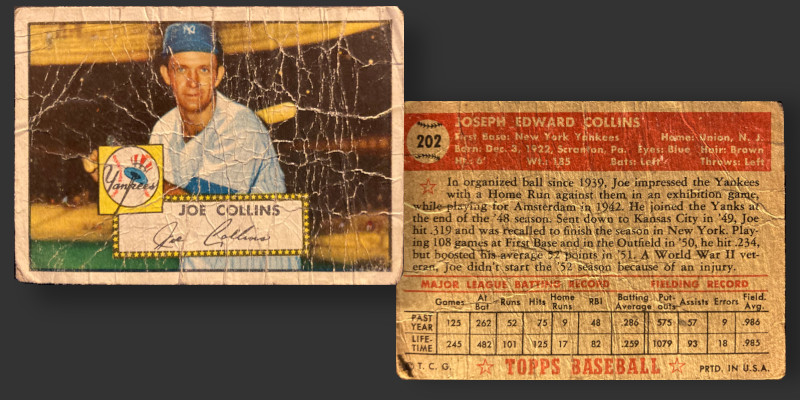
This card has heavy creasing throughout, and the pattern is suggestive of the card having been molded into a makeshift ball at least once in its life. Still, as the sellers on eBay would say, “CENTERED!” I picked this one up at my first card show in over 20 years from a dealer who had a discount bin helpfully labeled “OBC Specials” in reference to the extremely off-grade vintage cards favored by the group of collectors who frequent Old Baseball Cards. This was a fun card to buy – I enjoyed the entire process.
This brings up another aspect of building this set: Cost. I purposely stuck to the lower end of the grading scale, and the Collins card above ended up being the cheapest of the bunch at a total cost of $1. Collins takes the crown for the least financially intrusive addition, but the running for this title was surprisingly tight. Look what I got for $0.47 plus a buck for shipping:
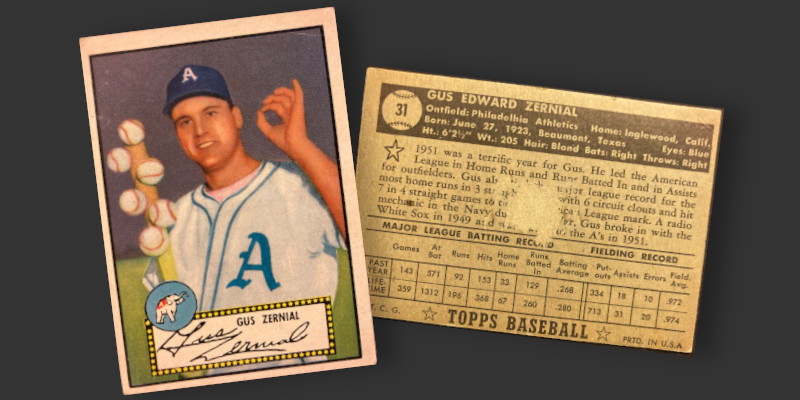
At a total cost of $1.47, the Gus Zernial card was essentially thrown in for free with the purchase of a postage stamp.
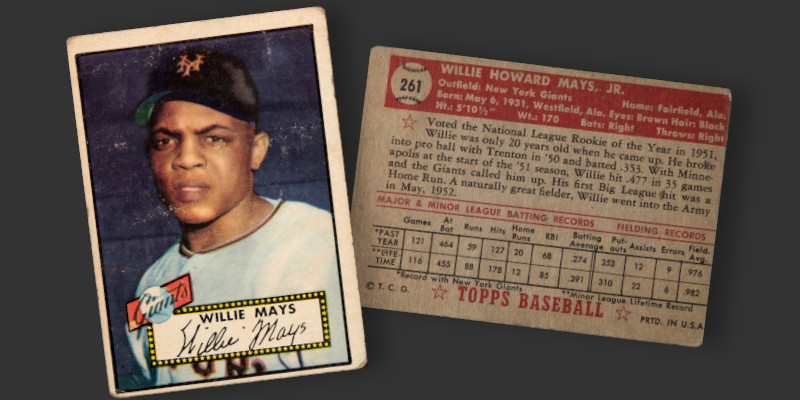
The upper end of the pricing spectrum was pretty much a given, regardless of condition. The set’s Willie Mays card has always been a monster and it took some planning to find the right one. Outside of Mays, the rest of the top five outlays (in order) consist of Ashburn, Minnie Minoso, Yogi Berra, and a high grade Bobby Shantz.
Those cards were easy enough to find, but some other names stood out as being particularly tough. Andy Seminick, Bob Ross, and Tommy Brown were all among the last names checked off the list. These semi-high numbered short-prints were indeed tougher to come across and often had significant premiums reflected on their price stickers. It took a while to find examples at the right mix of condition, availability, and price for my set. The Minoso rookie was tough as well, not in terms of availability, but in how far the price ran up following his induction into Cooperstown. I had to wait five years before the card subsided enough to finally induce pulling the trigger.
So what do the first 310 cards in my set look like? They average Good condition (2.2 on a 10 point scale) with some pretty wide dispersion among low and middle grading tiers.
| Grade | Quantity (% of set) |
|---|---|
| EX | 11 Cards (3.5%) |
| VG-EX | 41 Cards (13.2%) |
| Very Good | 40 Cards (12.9%) |
| Good-Very Good | 33 Cards (10.6%) |
| Good | 43 Cards (13.9%) |
| Fair | 69 Cards (22.3%) |
| Poor or Altered | 73 Cards (23.5%) |
The vast majority of these cards (278 names) are raw and have not been graded by third parties. The remaining 32 cards largely consist of a mix of star players, authenticated autographs, and low grade commons that were more or less ignored by other collectors given the low score on their slabs. The breakdown by grading service is as follows:

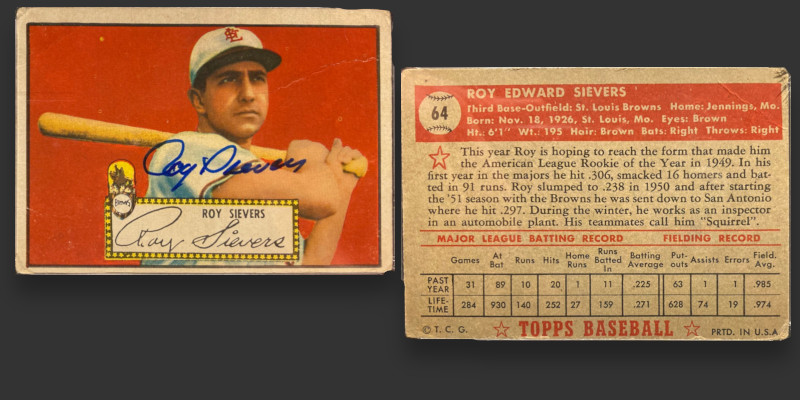
Five cards in the set are autographed, increasing to six if a very low grade duplicate Bobby Shantz card gets included in the total. Counting this, I have signatures from Shantz, Roy Sievers, Zeke Zarilla, Bob Addis, Cloyd Boyer, and Charlie Maxwell.
Unlike some collectors, I have zero problem with adding altered cards to my collection with the provisions that they be clearly identified and priced accordingly as a poor condition item. Eight such cards are in my low series set, with seven exhibiting trimming and one featuring some additional color applied to the card image. My trimmed Del Ennis provides an excellent example of the visual appeal of these kinds of cards.
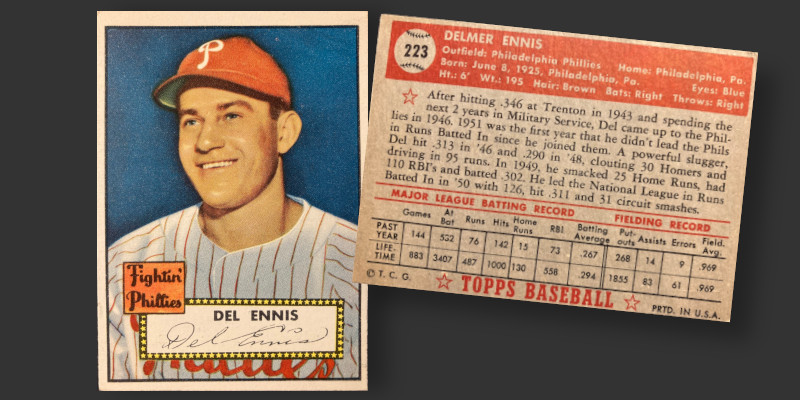
Looking back at completing the first 310 cards, what would I recommend doing differently? I would suggest obtaining cards from larger lots and selling off the resulting duplicates. The vast majority of my 52’s were obtained through the mail, and their collective shipping costs came to nearly $500. Crucially, I would have avoided specific sellers from the start of the project who consistently overgraded their cards by multiple grades. A few of these sold trimmed cards as mid-grade examples as well, though these “dishonest trims” were subsequently ejected from my set. Finally, keeping my want list up to date would have been helpful. On several occasions I passed over a need because I could not remember if I already had the card. Recently I made a purchase that ended up duplicating one of my earlier additions, along with the added injury of finding my new dupe was also trimmed on one border while being advertised as “VG” condition.
With that revelation, I need to ask if anyone reading this needs a trimmed, overgraded Roy Smally card for their collection. I have a handful of duplicates left over from this set building effort and will disburse those to other collectors in the coming months. A poor condition Allie Reynolds is among this group, as are a half dozen commons. I have 3 or 4 Monte Irvin cards, simply because it is the kind of card I can’t just leave behind when I find one floating around in a bargain bin. I am hanging onto the Irvin cards but the rest are up for grabs as I browse other collectors’ want lists.
So what’s next for this project? I am absolutely chasing the 97 cards of the high number sixth series and currently have 42 of them. The average condition of these cards is noticeably lower at Fair condition (1.6 out of 10). Some big names are in hand, but others like the Mantle card remain unresolved and will require long term planning before being added to my collection. Condition upgrades for my low number set will continue, but only for a half dozen particularly stressed cards. The rest are “good enough” to form a visually cohesive set. The first series cards are almost evenly split between black backs (39 cards) and red backs (41 cards). I didn’t seek out one version over the other and do not intend to go the master set route of building the first series twice. The same goes for the gray back cards in the third series, of which I do not own any.
I have profiled 274 cards from my 1952 set and intend to eventually write up the rest of the checklist in the order they were obtained. I am certainly not the first to do so (see this fantastic set completed just as I was starting mine) and I eagerly read about others’ progress in assembling this challenging issue. I am very happy to now have my opportunity to announce I completed a segment of the 1952 Topps set myself.