
I have never hawked a loogie into one of those plastic vials and mailed it off to find out if I am five percent Viking. I now understand the appeal after starting off this month with presenting the results of a genealogical study to the closest thing my family has to an “official” recordkeeper.
Genetic ancestry tests work by comparing shared DNA segments between two people who have never met and telling the reader how they are related. The man I traveled to West Virginia to see did take one of those tests and for what it’s worth, discovered he is 51% from the England and Norman France, 31% Scott/Irish, 13% German, and 5% Danish (again with those pesky Vikings). The software underpinning the report doesn’t really care that people lived centuries apart or never directly crossed paths, it just measures the genetic overlap and reports back.
This doesn’t mean I have been ignoring my baseball cards all this time. I did the cardboard equivalent of looking for family resemblances with a 1952 Topps card featuring a veteran outfielder and a batting champ infielder currently on loan to the Philadelphia Phillies.
The 300th card in the ’52 Topps checklist is dedicated to a portrait of Barney McCosky, an outfielder in his mid-30s finishing out his career in the wide open expanse of the Cleveland Municipal Stadium outfield. While Ray Kroc wouldn’t encounter a McDonald’s hamburger for another two years, I can’t help but notice how much McCoskey’s facial expression reminds me of Michael Keaton’s portrayal of Kroc in the film The Founder.
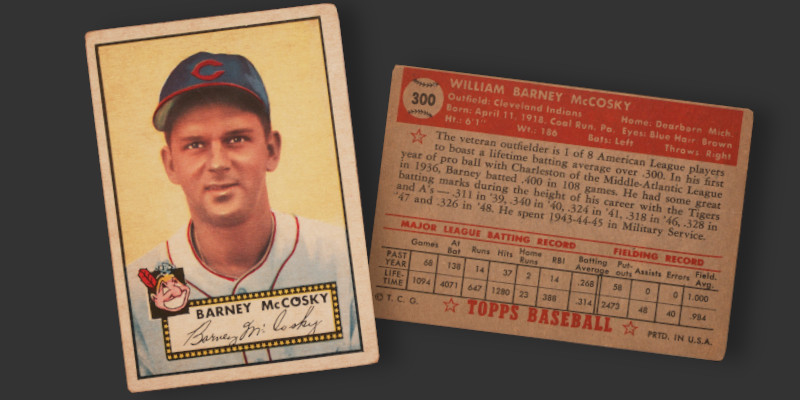
The more interesting match is the one that becomes visible in the numbers on the back of the card. The overlapping DNA of baseball talent points across 74 years of expansion teams, night games, pitch clocks, and launch angles straight to Luis Arraez.
Genealogy always starts with the paper trail. The back of my McCosky card opens with a claim rather than a standard biographical fact: The veteran outfielder is 1 of 8 American League players to boast a lifetime batting average over .300. Topps didn’t highlight his occasional home runs, the back injury that hobbled him for the final four seasons of his career, or the fact that as a rookie his offensive output trailed only his teammates Hank Greenberg and his own boyhood hero Charlie Gehringer. The writer started things off with batting average, like a family Bible listing someone’s line of descent before bothering to write their name.
At the moment McCosky was added to the checklist, his career batting average stood at .314. Sort every player in the entire checklist by that number and you will find him ranking 12th overall. He would finish his career two hobbled seasons later at .312, in line with the career mark of Edgar Martinez and within a point of claiming the career batting title for all players in the ’52 Topps checklist. Using the number actually printed on the card, McCosky clears Martinez by two points. He outright eclipses George Brett, Ichiro Suzuki, Derek Jeter, Don Mattingly, Joe Mauer, Paul Molitor, Will Clark, and Mark Grace. He beats Craig Biggio, a man with 3,000 hits, by 30 points. He finished a dozen points ahead of active career-.300 hitter Jose Altuve, one of only two current major leaguers who have managed to crack the .300-mark for more than a couple seasons of play. The other, Luis Arraez, offers about the closest thing we have to a modern day Barney McCosky.
McCosky batted over .300 in six of his first seven seasons. He finished as the runner-up in Rookie of the Year voting to a fellow outfielder named Ted Williams. Born in the heart of the era that worshipped contact hitters, over time we have lost his address and forgotten to invite him to the family reunion of contact hitters.
Let’s look closer at the batter’s box DNA overlap between McCosky and Arraez. McCoskey’s career wRC+ checks in at 112 while Arraez’s sits at 117 (without visibility into the downslope of his aging curve). McCoskey hit .312 against Arraez’s .316, closing the gap on balls in play with a BABIP of .329 over Arraez with .328. Both batters strike out at miniscule rates with McCosky whiffing in 5.5% of plate appearances while Arraez takes the walk of shame 5.8% of the time (the lowest of any qualified batter today). Neither should be confused with a slugger, just like a shared surname doesn’t make one the family’s rich uncle.
Though they share an almost genetic inability to miss a hittable pitch, the biggest contrast between them comes in the form of plate discipline. McCosky drew walks at roughly double Arraez’s career rate, pushing his on-base numbers well above those of his modern counterpart despite an almost identical batting average.
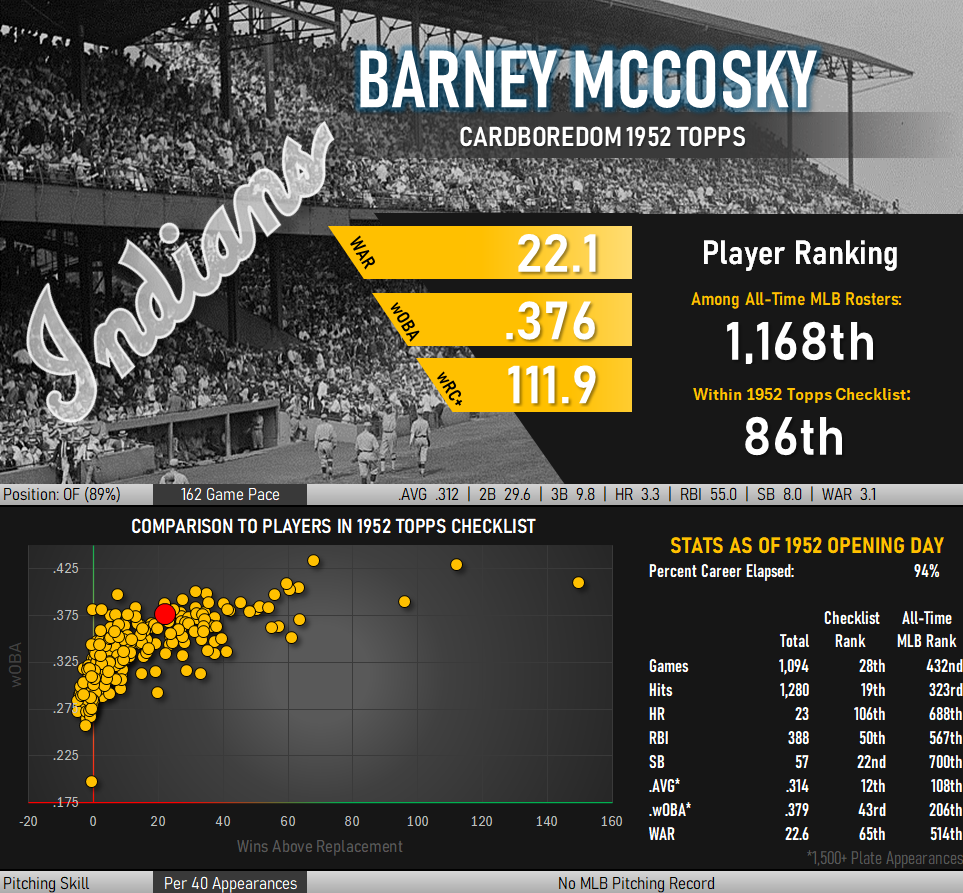
Every genealogist has to eventually note where they source their paperwork, or in this case, cardboard. My McCosky card arrived via a COMC purchase. It appears a seller had graded a run of ’52 Topps commons and then turned them loose to recoup a fraction of their expenses once the grades came back towards the modest end of the scale. This particular one looks pretty solid. It certainly shouldn’t have been a candidate for third party grading, but it’s not trashed either. It looks like the kind of thing someone played with a bit, stored in a shoebox, and presumably handed down to heirs instead of feeding it to their bicycle spokes.
This isn’t the kind of card you think of when looking through slabbed offerings, but it was exactly the fact that someone had it graded that brought the seller down to earth on price. The card number begins with a “3,” placing it high enough in the checklist to encourage sellers to price lower grade copies as if it were a high number, despite those scarcer cards not starting until card #311.
I’m not looking to hit a home run in my quest to build the set. I’m just looking to make solid contact.