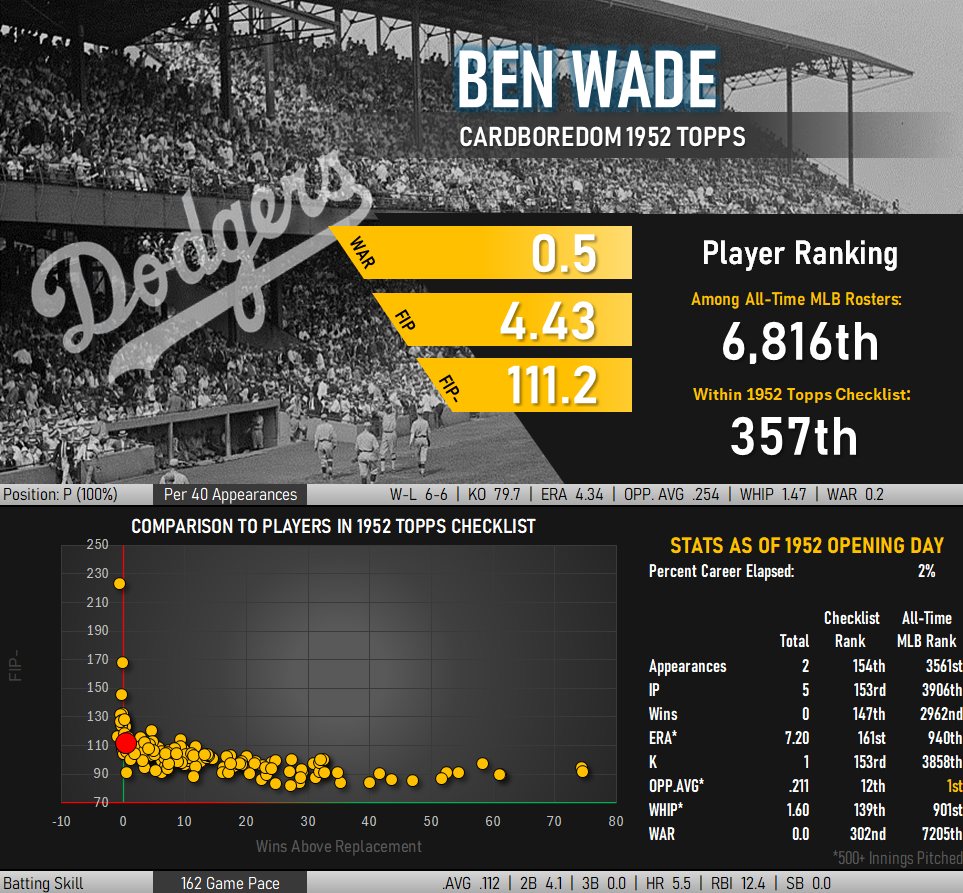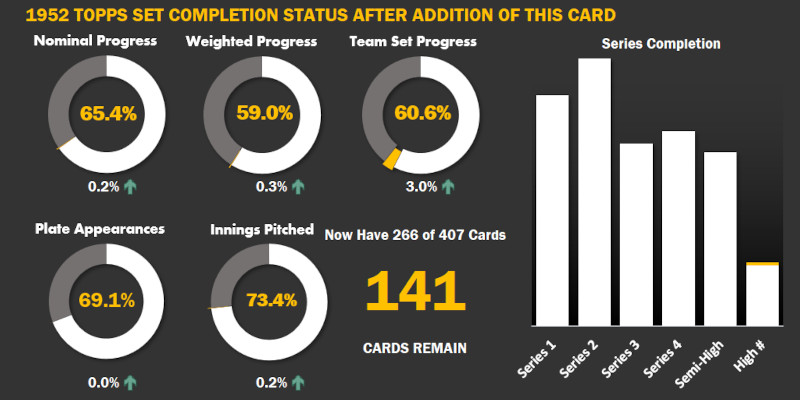
Ben Wade pitched 371 innings in the major leagues. That’s it. Three hundred seventy-one innings across parts of five seasons, with almost half crammed into 1952 alone, when he briefly convinced everyone he belonged in a big-league rotation before the universe corrected its mistake. He then faded back to the minors, resurfaced briefly with the Cardinals and Pirates, and disappeared. No dynasty. No legacy. Just a guy who could really pitch in Triple-A and occasionally couldn’t.
And yet, we have this masterpiece…
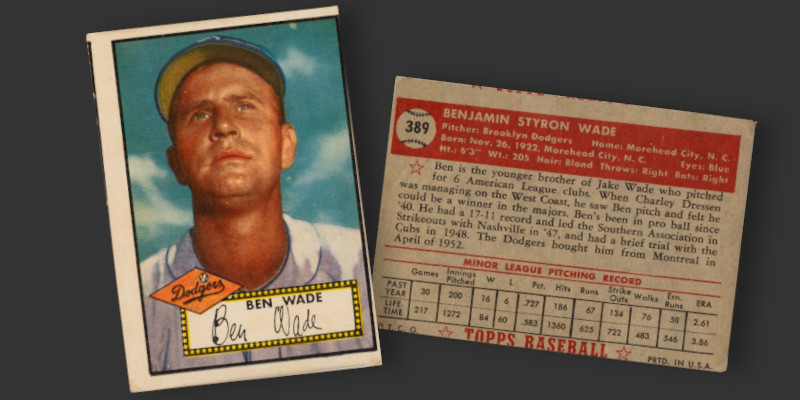
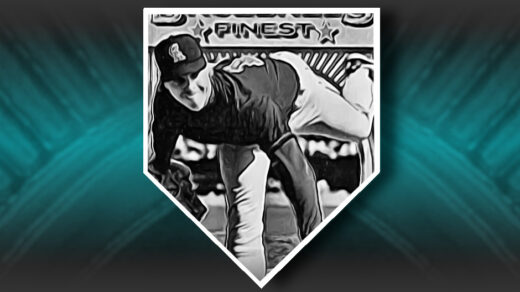
My 1952 Topps card of Wade, number 389 in the high number series, is a catastrophe for anyone with vertigo. It’s like the photographer got dizzy and snapped the image on his way to the dirt. He wasn’t the only one. Topps’ guy in charge of cutting cards from the sheet also seemed to be grossly off-balance. Gloriously and irredeemably miscut, a sliver of its border arguably belongs to Bob Chipman’s card next door. The back of the card mentions Wade had been called up from the Montreal Royals in April 1952, a detail Topps scrambled to include as the high number series came together mid-season, because Topps in 1952 was basically making baseball cards the same way a freshman writes a midterm: frantically, at the last possible moment, and with questionable attention to detail. Other than the centering disaster, it’s a clean VG-EX. A fundamentally solid card with one glaring flaw. Topps was staying on-brand for this card’s subject.
The 1952 season was Wade’s entire legal argument for existing in the major leagues. He won eleven games, threw 180 innings, posted a shutout, and on July 6th he walked to the plate against Warren Spahn and hit two home runs. Off a guy who would finish his career with 363 wins and a Cooperstown plaque. Now, Wade isn’t the only pitcher to go deep twice in a game he started. Babe Ruth did it, Shohei Ohtani did it, and 55 other guys did it, but the audacity of doing it specifically to Spahn raises the stakes considerably. Four other pitchers in the ’52 Topps checklist also managed the multi-homer game trick: Billy Hoeft, Jim Hearn, Dave Koslo, and Bob Lemon. Three of these four are also high number names, and more importantly, were legitimate pitchers with 1,500-plus major league innings. Wade had 371. He’s essentially a party crasher who somehow also had the best story of the night and then left before anyone could ask follow-up questions.
Before those 371 innings, Wade had spent years in the minors piling up 2,210 innings, a 3.81 ERA, 146 wins, and 1,327 strikeouts. Military service ate a chunk of what would have been prime pitching years, or those numbers would be bigger. His opponent batting average entering 1952 was .211, which would have been among the best in baseball history by that metric. It was also built on exactly five 1948 Cubs innings, during which he simultaneously posted a 7.20 ERA, aided by a generous helping of bases on balls. The man was a walking paradox. The Cubs, not unreasonably, sent him back to the minors rather than wait for him to resolve his own internal inconsistencies.
The Dodgers gave him three Topps cards in Dodger blue (’52, ’53, ’54) and then let him go. His later stints with the Cardinals and Pirates didn’t merit cardboard. Nobody at Topps was losing sleep over forty innings of Cardinals middle relief.
What the Dodgers eventually did was hire Wade back as a scout in 1962, and then promote him to scouting director in 1973. This is where it transitions from polite tragedy and starts being something genuinely strange and impressive. Under Wade’s watch, the Dodgers produced seven Rookie of the Year award winners inside sixteen years. Seven. Rick Sutcliffe in 1979, Steve Howe in 1980, Fernando Valenzuela in 1981, Steve Sax in 1982. Four straigh. Then in 1988 alone, Wade’s department drafted Eric Karros and a kid from Norristown, Pennsylvania named Mike Piazza in the same draft class, while signing outfielder Raul Mondesi as an amateur free agent. All three won Rookie of the Year.
The Piazza thing specifically deserves its own paragraph because it is deeply insane. Tommy Lasorda had a personal connection to the Piazza family and badly wanted to draft the kid, but Wade looked at him as a first baseman and said no. So Lasorda, possibly sitting in a golf cart with a styrofoam takeout box of pasta, asked: What if he played catcher instead? Wade, apparently deciding that this was a reasonable basis for a professional personnel decision, said sure. Mike Piazza had never caught professionally. The Dodgers simply moved his bat from the usual dumping ground for defensive liabilities to the most important defensive position on the field. He went on to hit 427 home runs, make twelve All-Star teams, and end up in Cooperstown. Ben Wade signed him for $15,000. The greatest offensive catcher of the last 50 years exists because two guys made a positional compromise in what I can only imagine was a deeply casual conversation.
And then there’s Roger Clemens, which is the part of the Wade biography that requires a moment of silence followed by some ibuprofen. In 1983, Wade had identified a right-hander out of the University of Texas as his target. The Dodgers held pick eighteen. Clemens was right there. But Steve Howe’s cocaine problems had created an urgent organizational need for bullpen help, specifically a left-hander, and Wade pivoted to Erik Sonberg from Wichita State. Boston grabbed Clemens one pick later at nineteen. Sonberg posted a 6.20 ERA in the minors and never threw a pitch in the major leagues. Clemens won seven Cy Young Awards. You know this. Wade knew it too, and presumably knew it every single day for the rest of his professional life. The decision wasn’t crazy given what he knew in June 1983. It just turned out to be one of the most expensive correct-for-the-wrong-reasons calls in draft history, the scouting equivalent of swerving to avoid a squirrel and driving into a lake.
Wade retired after 1990 with more than thirty years in the Dodgers organization and the varying titles of starting pitcher, reliever, scout, and scouting director. He left them with four Rookie of the Year winners, and three more that would receive trophies after his retirement. The man pitched 371 major league innings and then spent three decades proving that what you do on the field is not necessarily the most interesting thing about you.