Baseball cards tell the story of a season. Because they are typically sold during an active season, the sets we identify by year almost universally reflect the happenings of the prior year. Kirk Gibson’s 1988 World Series homer? That’s on his 1989 Upper Deck card. Mike Trout’s 2014 MVP? It doesn’t exist in writing on a baseball card until 2015. Today. this issue of cardboard latency has been largely solved through the emergence of Topps Now, which produces daily updates for collectors to chase.
I don’t collect Topps Now. I like Topps Then. By quantity, the gum maker’s 1952 issue makes up the largest component of my collection. I have all the low numbers from the set and have read the back of every one of them to get the highlights of the previous season. I have some of the high numbers as well, and their text includes something special. Not laid out until around August, many of the cards issued in the final series mention things that were happening in the current season.
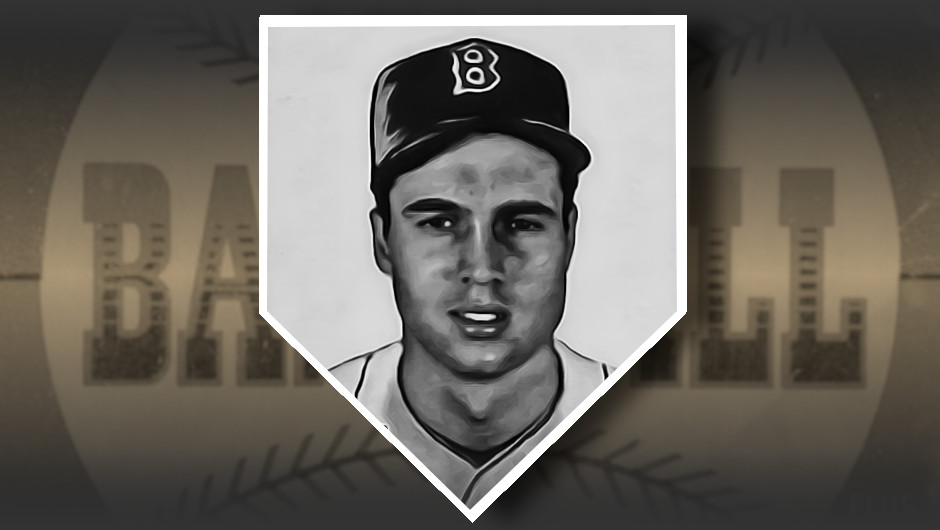
My Joe Black rookie is an example of this. Looking beyond the glue residue on the back, readers find that “The Dodgers capitalized on this ability and moved Joe into their Number 1 relief spot in ’52.”
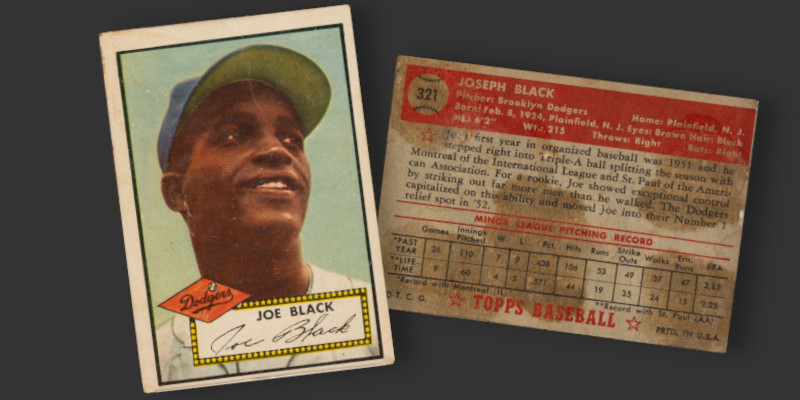
This wasn’t just a slight tweaking of his role, like a card catching up with a starter’s transfer to the bullpen. Black didn’t take the mound in any capacity for Brooklyn until May of 1952, and he only came into six contests that month. Black wouldn’t dominate the Ebbets Field bullpen until summer, leaving little turnaround time for Sy Berger to record Black’s newfound status with the team.
It wasn’t hard to miss. The Dodgers were aiming to capture the National League pennant after seeing it ripped away from their grasp on Bobby Thomson’s home run the previous year. Black was a big part of Brooklyn’s comeback, picking up 14 of his 15 wins as a reliever and posting a 2.15 ERA. He finished third in MVP voting and ran away with Rookie of the Year over Hoyt Wilhelm.
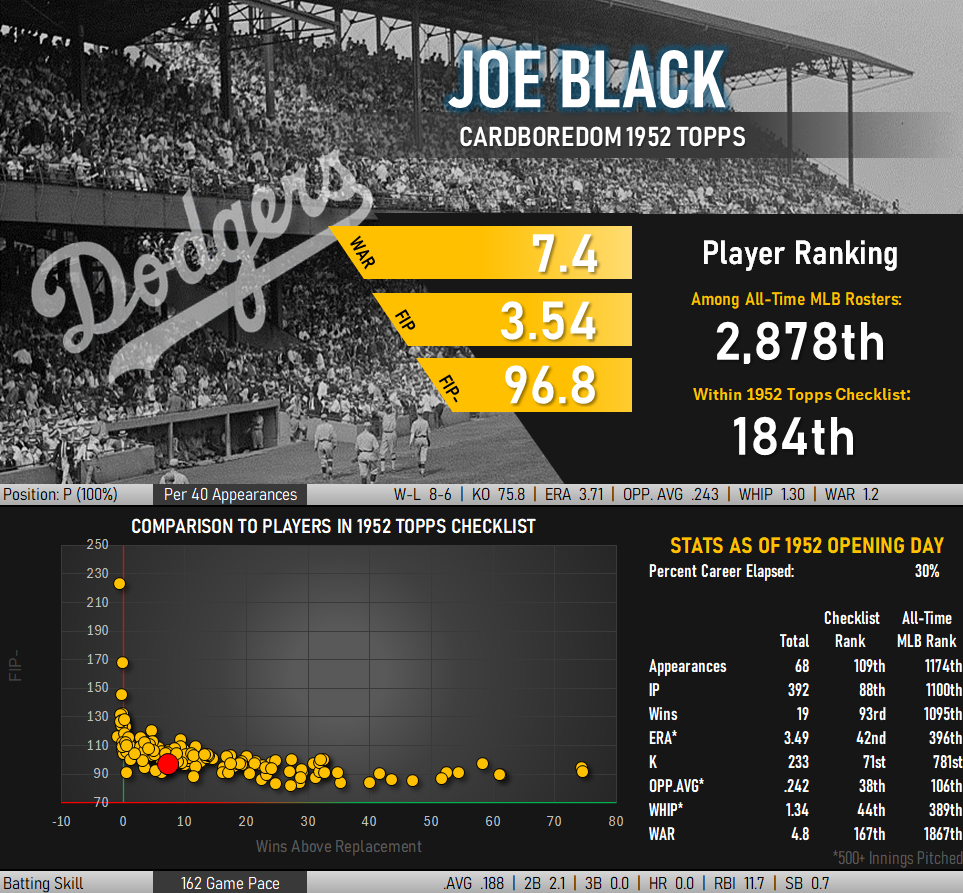
I have purposely stuck with the traditional metrics of wins and ERA, as stats like those are how we remember many of the game’s best pitchers. The Dodgers have an exceptional history of producing lights out pitching, and Black’s 1952 season belongs among the most iconic of those performances.
To highlight just how dominant his 1952 season was, let’s look at the batting average of opposing players. At .197, Black held batters below the Mendoza line. That is 8 points better than the .205 Fernando Valenzuela held opponents to in his 1981 Rookie of the Year campaign. Double that distance again and you get how batters fared against 1988 Orel Hershiser and his record setting scoreless streak. Drysdale’s best year? .204 in 1964. To find someone harder to hit among Dodgers legends you need to look at the very best seasons of Sandy Koufax (.179) and Clayton Kershaw (.183). This was an all-time great Dodger season.
Those stats and the baseball card biography make it sound like Black came out of nowhere. In one sense, he did, as the 1952 season stands out as a statistical outlier compared to the rest of his career.
However, the bio on the card back refers to Black’s 1951 minor league experience as his “first year in organized baseball.” This phrasing was Sy Berger’s default method of differentiating segregated white leagues from black leagues, which were referred to on early Topps cards as “semi-pro” leagues. Black was already 28 years old when this card was produced and had been pitching since 1943 for the Baltimore Elite Giants of the Negro National League, as well as other professional engagements as early as 1940. Roughly half his entire career took place with the Elite Giants.
The racial themes of Black’s careers offer compelling storytelling material. He was the first black man to get credited with a win in a World Series game. He reportedly did not know there was enforced segregation until his later school years. After retiring from the game, he became a high school teacher and established what essentially was an after school version of Fight Club to teach different groups to get along.
For collectors of stories, these tales are better told by Roger Kahn, whose accounts of Black are highlights in The Boys of Summer. For baseball card collectors, there are only a handful of playing days issues available to choose from. I don’t know how I could pick any other card to represent Joe Black than ’52 Topps.