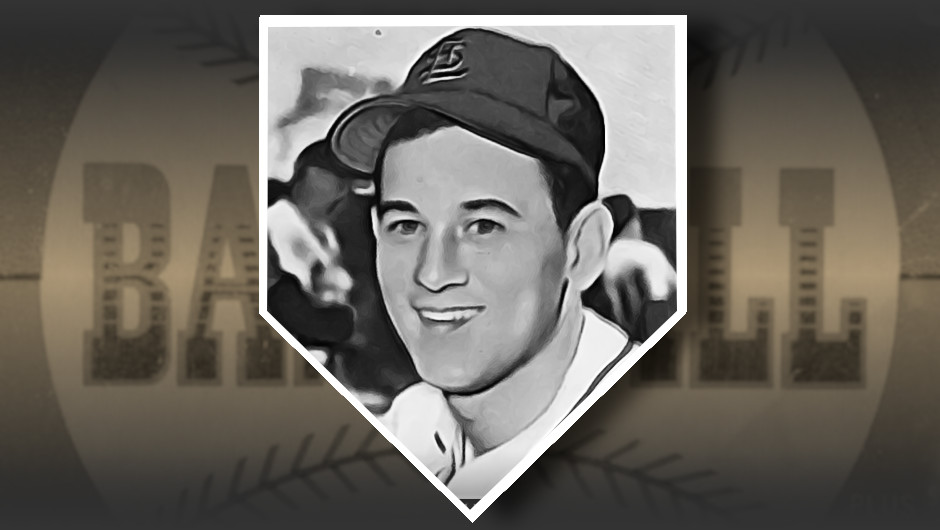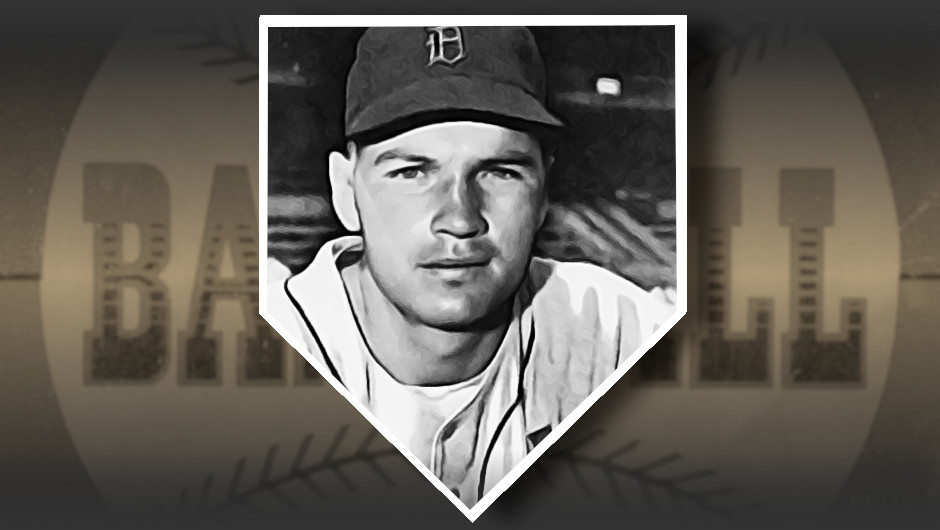
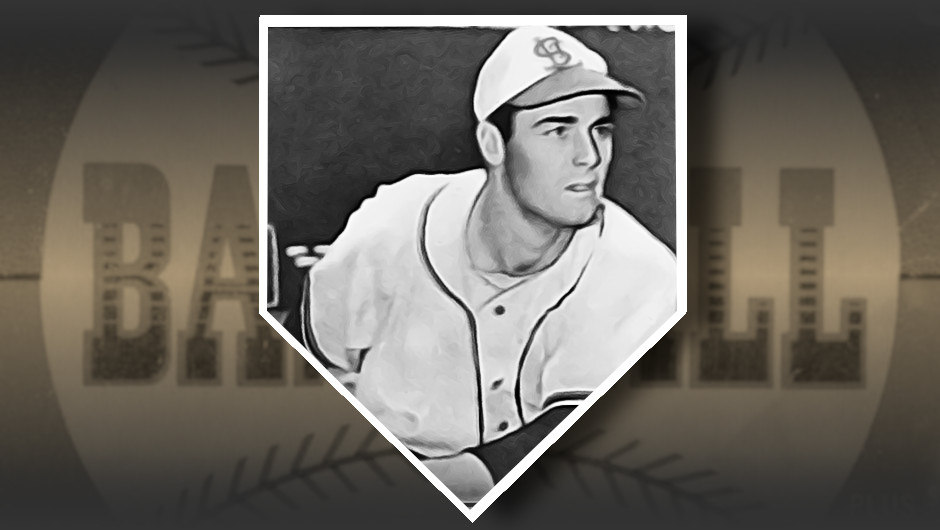
I drove seven hours into West Virginia this weekend for the express purpose of killing off a man who had famously escaped death.
That’s not quite fair to him. He’d been dead two hundred years already, technically, having drowned in a shipwreck sometime in the early 1700s or, more accurately, having not drowned and staggered out of the surf to found the branch of my family that eventually produced me. That was the whole point of him in our family lore: the man who cheated the Atlantic. I was driving up a mountain to tell his great-great-great-great-great-grandson that he’d never existed in our line at all, that the man who escaped the January Atlantic waters had, in fact, cheated somebody else’s family out of a really good story and left us awkwardly holding a name that didn’t belong to us.
My parents got into genealogy sometime in the ’90s, catching it in turn from a hardcore group of enthusiastic cousins who dove headfirst into the subject a generation earlier. Those cousins had created massive, custom made hardbound books laying out the family history: Great-Great-Grandpa CardBoredom had begat Great-Grandpa CardBoredom; and Great-Grandpa CardBoredom had begat Grandpa CardBoredom; and he in turn begat CardBoredom’s father; and the counting of Father CardBoredom’s days was 72 years. This had all taken place back when this meant driving to a county courthouse and asking a clerk to unlock a filing cabinet, not typing a name into a search bar and letting a matching algorithm hand you somebody else’s homework. My parents bought the books. I read the books, because I was a teenager who thought family history was a fun category of trivia like the kind you find on the back of a baseball card.
The focal point of our particular tree was a shipwreck, and what a wreck it was! An ancestor, we were told, had fled the Holy Roman Empire and crossed the Atlantic in the 1700s aboard a vessel whose captain abandoned it days before departure, calling it a death trap (he was right). The ship lost most of its command to fever and storm, ran short of food, and finally broke apart on a shoal within sight of land, in lethally cold water. Most of the ship’s remaining passengers didn’t make it. Mine did. It was, by any reasonable standard, a home run of a story, and I told it at every family reunion and every occasion that called for a party trick with a body count.
Earlier this year I decided to research the story properly. Get all the gory details so I could really tell the story right. Use real primary sources, not the two pages of secondhand narrative that I already knew by heart. I found exactly the kinds of resources I had hoped for.
The ship was real. The captain was real. The wreck was real, but my ancestor had experienced them all just like I had: as a secondhand account.
I had images of parish registers, tax rolls, a shipping manifest, a family Bible, and a diary from a man who names shipmates. None of it put my guy anywhere near that hull. What it did show was two men with nearly identical names, living in the same region in the same decade, whom an earlier genealogist had quietly welded into one person somewhere back in the ’80s. Correct the error and I didn’t lose a story so much as get handed a different one: My actual lineage runs somewhere else entirely, a reunion with a history I’d been, effectively, genealogically kidnapped from.
There’s a reason “begat” is such a load-bearing verb. It shows up 139 times in the King James Bible, mostly in the sort of unglamorous books you skip on your way to the parts with plagues in them, patiently doing the one job genealogy has ever had: this man, and then this man, and then this man, in order, with no editorializing. It is, of all English words, perhaps one of the least equipped to survive a typo or an eager cousin filling in a blank.
Correcting a family tree is not an act of scholarship. It’s an act of war.
A Genealogical War
We are, by the standards of modern families, enormous. That’s what happens when someone has a dozen kids who each produce another dozen, and wash/rinse/repeat the cycle for 200 years. A not insignificant chunk of us maintain profiles on crowd-sourced genealogy sites where anybody with a login can attach a source, a theory, or a wish to a shared tree. When I went looking for anyone else who’d noticed the error, I found a fight that had been simmering for decades. Two rival branches of the family had been frantically re-editing each other’s trees back and forth, one camp restoring the shipwreck ancestor as fast as the other could delete him.
This is just Brandolini’s Law holding a quill and dressed in a bonnet. The principle, coined for internet arguments but perfectly at home in a shared family tree, states that the energy required to refute bullshit is an order of magnitude greater than the energy required to produce it. It took a long-dead armchair genealogist an afternoon to weld two men into one. It has taken me half a year, way too much time deciphering old handwriting (why did the use “f” for “s”?), visits to colonial archives, and a mountain drive to even begin untangling them, and I’m still outnumbered. Any profile I correct could be recreated by three cousins with a hunch and a login before dinner. Somewhere out there (and I am absolutely not kidding about this) is a woman with a home-school co-op and a monogrammed Stanley cup who has made it her life’s mission to defend a dead man’s biography that doesn’t belong to him.
In a fight it is imperative to take up your position on the strategic high ground. This brought me to the mountain.
The Family Table
Our family’s designated keeper of this material, a man who’d spent 40 years compiling what the rest of us treated as gospel, is now 86, quick with conversational wit but no longer suited to following a heavily footnoted diagram through a landline phone. He had headed the family’s “official” genealogical society, serving multiple terms as its last president until nobody volunteered to write the newsletters and organize multistate gatherings. I packed up an overnight bag and jumped into the car to visit a house I had not set foot inside since 1992.
It sits up a pothole-scarred road on the side of Tyler Mountain, straddling the industrial city limits of Charleston and Dunbar. I hadn’t been up that road in three decades, not since I was a kid getting carsick on switchbacks on family visits, and I kept waiting for the house to have changed the way houses are supposed to change with time. It hadn’t. It was, as far as I could tell, exactly as I remembered it, which is a stranger feeling than nostalgia; it’s like walking into a photograph.
The bathroom still had its pink and gray tile, laid sometime in the 1960s and apparently declared permanent by unanimous family vote. Downstairs, the basement still had the pool table and the fireplace, and the fireplace still had that smell, the specific mineral smell of old brick that’s absorbed forty years of wood smoke and never quite let it go, a smell I would have sworn I’d forgotten until it hit me on the stairs and I was mentally opening packs of 1991 Topps as a nine year old again for about four seconds.
We didn’t sit in the living room or at the desk with his computer. We sat at his kitchen table, which felt right, as it had previously belonged to his mother and was one of the few pieces of furniture she owned when she was widowed by a mining accident in 1954. I spread my folders across the table like courtroom evidence, projected a PowerPoint presentation full of diagrams onto the wall, and walked him through it piece by piece. The two men, the conflated histories, the shoal, the wrong ship, and the ancestor who had cheated death were all methodically examined.
He listened the way people listen when you’re taking something from them gently. He asked a few good questions, like where I’d found the diary, how I obtained the parish records, and whether the other family, the one who actually descended from the shipwreck survivor, knew they had him. I had expected him to be more defensive of the story he had, like me, told for decades. By the end he wasn’t defending the old story. He was already asking where the real one led, and whether I thought it was as good a story as the one we were losing.
It was. I gave him some new stories (Pocahontas is part of the family) and he told me ones I had never heard, like the time he was injured when the sea trials of a US Navy submarine when a pressurized seal gave way.
Then he did something I hadn’t planned for. He got up, disappeared into the basement, and came back a couple of banker’s boxes. Forty years of research, he said, family photos, photocopies of documents whose originals have since been lost, cemetery guides mapping scattered graves above the floodplains of countless Kentucky hollers, hand-drawn charts connecting names I recognized to names I’d never heard, all of it accumulated by a man who’d spent four decades being, for our entire extended family, the “official” arbiter of who we actually were. His own children, he told me, without bitterness but some regret, had no interest in any of it. They hadn’t been unkind, just preoccupied with the ordinary indifference of people who’d grown up with the boxes always being there and never wondering what was in them. He didn’t want it going to a stranger, or worse, going nowhere at all. He wanted it to go to somebody who’d already proven, by driving seven to correct him in person instead of over email, that he cared enough to be trusted with being wrong occasionally.
I drove back down that potholed road with two boxes of somebody else’s life’s work riding in my back seat, and I understood, somewhere around the bottom of the hill, that I hadn’t just corrected a family tree that afternoon. I’d been handed one, the actual paper and ink of it, the accumulated evidence of a man’s entire retirement, on the strength of having shown up.
That, it turns out, is the good version of this problem. A correction was offered, weighed, and accepted, with nobody’s honor really on the line, because the man who told the story first has been dead two hundred years and can’t be embarrassed by it, and the man who kept telling it for the last forty years turned out to want the truth more than he wanted to be right.
Not every wrong ancestor gets that kindness. Some of them are still living it down, sixty years after the fact, immortalized in the lie on a piece of cardboard. This leads me to what this site at least nominally claims to be about: A baseball card.
A Photograph With Someone Else’s Uniform
I own this 1952 Topps card of Gene Bearden, misspelled “Beardon” on both sides, which feels appropriate given everything else about to happen to this man’s biography. The photo is lifted straight from an International News wire photo that was also used on Bearden’s 1949 M114 premium, a promotional issue with its own separate print run. Topps’ art department has painted over it, swapping his real uniform for a St. Louis Browns getup he had not yet worn in a game. Bearden pitched for Cleveland and Washington and the Yankees’ system and, briefly, the Browns organization on paper, but the pose on that card belongs to somebody else’s season, dressed for an occasion that didn’t happen. It’s a grafted branch, one identity painted over another so completely that the inconsistences only show if you’re looking for them.
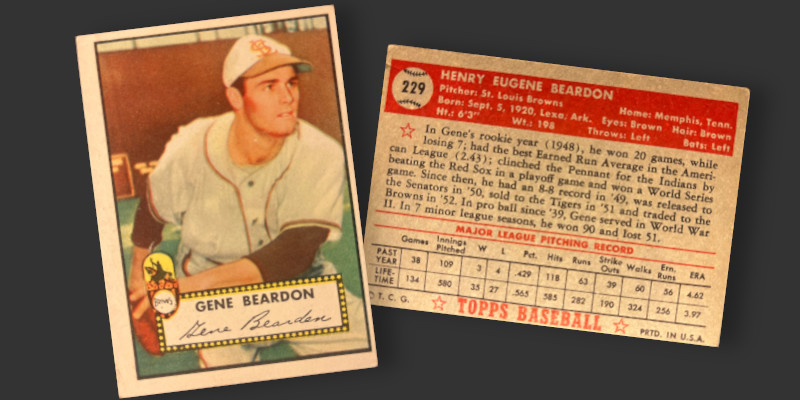
I did not, at the time I added it to my set building project, know to look for it. I was too busy reading the back of the card, where it mentions, as cards of that era liked to, that Bearden was a World War II veteran. His earlier Bowman card from 1950 goes further: it says he served aboard the USS Helena when she was torpedoed.
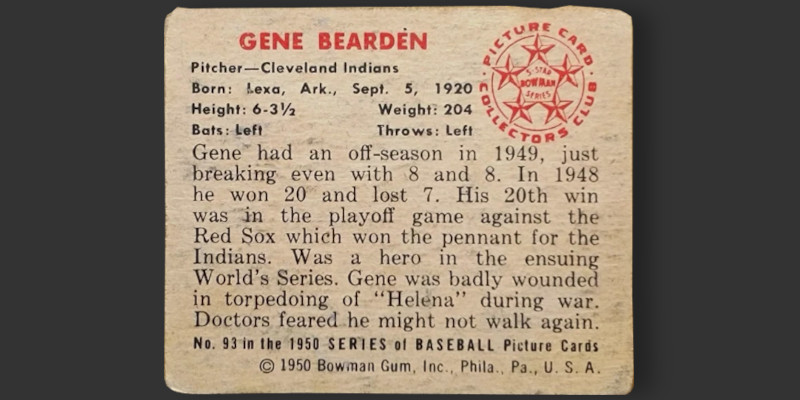
A shipwreck! A survival story. I have, you may have noticed by now, a type.
The story of the Helena needs no embellishment. Torpedoed and damaged at Pearl Harbor, repaired and modernized through 1942, she spent mid-1943 supporting the push up the Solomon chain toward New Georgia, a campaign of preparatory bombardments building toward the amphibious landings at Kula Gulf on July 5th. The next night, moving to intercept a Japanese reinforcement squadron, she was hit and went down. Most of her crew were pulled from the water within hours by a pair of destroyers. More than a hundred others weren’t so lucky, drifting for two days before making land on Japanese-held Vella Lavella, where Solomon Islanders and a coastwatcher detachment hid them from patrols for over a week until a nighttime evacuation finally got them out.
That story completely blows away the one I used to carry into any family gathering. The only trouble is that Gene Bearden didn’t carry it that story either, because he wasn’t there.
Researchers at SABR and the blog Chevrons and Diamonds went looking for him in the Helena’s crew rolls and came back with the same negative result: no Bearden. His actual service record puts him in Florida during the relevant window, aboard a sub-chaser, the USS SC-1330, on the day the Helena went to the bottom of Kula Gulf. Not a cruiser taking three torpedoes in a war zone. A patrol boat off the Gulf Coast.
So where did the Helena come from? The researchers follow the trail back to September 1945, to a Newark Star-Ledger piece by a writer named William Klein, published just as Bearden rejoined organized baseball in the Yankees’ farm system. Klein had him in the Helena’s engine room as a machinist’s mate when the torpedoes hit and, because apparently one sunk ship wasn’t dramatic enough, had him surviving a second sinking later aboard a destroyer, the Elliott. A double shipwreck survivor was born on the sports pages four years before the man himself would say anything at all on the record.
And when he finally did say something, in a 1949 autobiographical piece for The Sporting News, he said almost nothing. Asked, presumably, to confirm the tale that had by then followed him through two ballclubs and half a dozen box scores, Bearden offered this and nothing more: “I was just another gob, luckier than many, because I met up with a doctor who is, to me, the best orthopedic surgeon in the business.”
By 1948, the wire coverage had him surviving the Helena with a fractured skull, a crushed kneecap, and metal plates holding pieces of him together. By 1969, Red Smith (a Pulitzer winner, not some stringer) had him going down with a torpedoed destroyer instead of a cruiser, swapping the ship class without apparently noticing. By 1976, Milton Richman of UPI had renamed the vessel entirely, putting Bearden aboard the USS Quincy off Guadalcanal with a metal plate in his skull for good measure.
Four decades, four ships, and four sets of injuries made their appearance, and the one constant is that none of it happened. One particularly compelling theory floating around the research is that Bearden really had lived through something at sea, a collision or a close call aboard the sub-chaser he actually served on, and that Klein, working fast on a September deadline in 1945, folded that real incident into the biggest, most recent, most publicly known naval disaster of the Pacific war. A true story, grafted onto a more famous one, painted over like a photograph in someone else’s uniform.
I don’t think that’s so far from what happened to my shipwreck ancestor. Nobody sat down in the 1980s and decided to lie. Somebody just had two men with similar names, a gap in the paper trail, and a much better story sitting right there next to a much duller one. The better story won, right up until someone shows up with a manila folder or, in my case, drives away with two boxes of them, and asks it to defend itself.
Pruning Trees
Here’s where the two threads actually rejoin, and it isn’t a coincidence I went looking for: Every false lineage I’ve run down this year, both mine and Bearden’s, survived exactly as long as nobody with primary sources bothered to check it, and collapsed the moment somebody did. Genealogy databases and ballplayer biographies turn out to run on the same fuel, which is repetition mistaken for verification, and the same asymmetry that let my cousins outpace my corrections let four sportswriters outpace Bearden’s silence. Say a thing enough times, in enough newspapers or enough family trees, and it stops needing to be true. It just needs to be familiar.
The man at the kitchen table gave up our ancestor without much of a fight, in the end, once the folders were in front of him, and gave me forty years of his own work besides, on the theory that a true story is more exciting than an exciting fiction. I doubt Gene Bearden ever got a similar visit. Nobody drove into the Gulf Coast with a stack of muster rolls to ask him, gently, to let the Helena go. He just declined to elaborate, year after year, and let four different reporters paint over the same photograph in four different uniforms, until the man on the card and the man in the service record were, functionally, two different people who happened to share a name. Both are true stories about somebody, just not about the menn they got attached to. Somewhere, a hundred and thirty-nine begats into the research, one of them is still correct.
The kitchen table, for what it’s worth, survived the visit intact. So did the pink and gray tile, and the fireplace that still smells like 1974. The ancestor did not.


Parting Note: The family tree tangent is something that came up fairly recently, and I only returned from the trip with a carload of banker’s boxes this past weekend. When I first acquired my Bearden card two years ago, my notes indicate I had assumed I would be writing about a completely different, true story from his playing days. Gene’s teammate Bob Cain recalled in a 1994 interview that it was miserable playing in the humid summer heat in those old St. Louis Browns uniforms. He said Washington DC was hotter than St. Louis, and recalled a game in which Bearden was running from first to third before collapsing from dehydration into the arms of an umpire.