Today I’m looking at a couple cards that became surprisingly relevant in 2025.
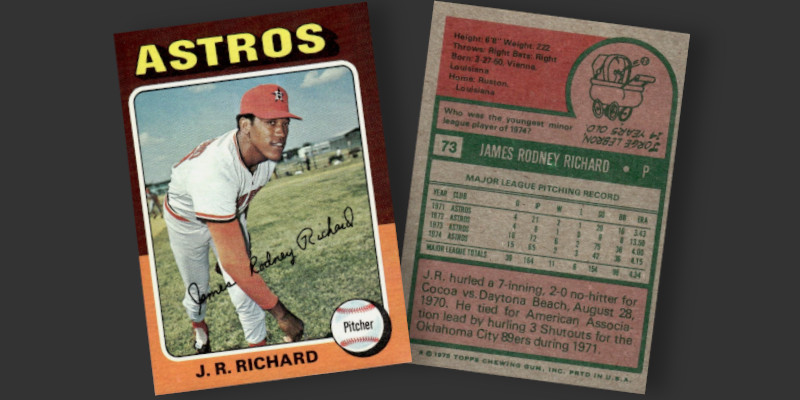
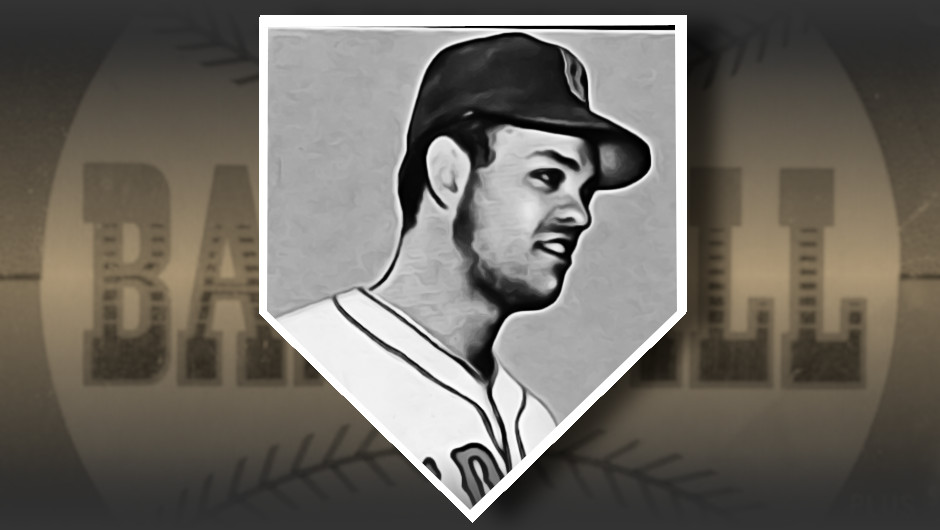
The first bit of cardboard is pulled from the checklist of 1975 Topps. Thirty years ago I was a kid trying to complete this set. While I never got more than 50% towards my goal, I do remember having this card and looking up J.R. Richard’s stats. I saw multiple bold ink entries for strikeouts and an ERA title. Subsequent research after I returned to collecting revealed that this card features a pitcher who allowed zero runs across his high school career. He signed with the Astros as a prospect able to essentially brag that he hadn’t allowed a runner to score since grade school.
Richard became a regular fixture in the Houston rotation in 1975, and by 1980 he was the undisputed staff ace. His mound presence was augmented that season when Houston’s front office added Nolan Ryan to the roster via free agency, pretty much guaranteeing an easy annual 40 wins and 600 strikeouts between the two flamethrowers. Based on their previous five years’ balance of work, Richard was actually the more effective of the two.
| 1975-1979 | W-L | SO | ERA | WHIP | WAR |
|---|---|---|---|---|---|
| J.R. Richard | 86-61 | 1,220 | 3.11 | 1.09 | 25.9 |
| Nolan Ryan | 76-73 | 1,337 | 3.34 | 1.35 | 24.5 |
After looking up Richard’s stats, I remember asking my dad why this card was a considered a common in my 1975 set building project. He simply replied, “Oh, he got hurt.” Phenomenal pitchers get hurt all the time. I moved on and didn’t think anything about it. I hadn’t been born yet when Richard’s health story splashed onto sports pages and by the time I was able to read it had faded too far into the background to come across my radar.
Richard’s story came back to the forefront when he passed away in 2021. It hadn’t been a elbow strain or a bum shoulder that derailed the 30-year-old’s career, but rather a massive stroke suffered as he was warming up for a game in Philadelphia. Partially paralyzed on his left side, he attempted to a multiyear comeback but continuing cardiovascular issues and deterioration of his prior pitch command kept him from returning to the majors.
So why my sudden interest in going back to learn about J.R. Richard? It’s personal.
If you haven’t caught on by now, I am fascinated by anything with numbers. This extends to my personal health and all the related data analysis that goes with it. For decades I’ve kept my weight, bodyfat, and macronutrients dialed in to target ranges. Aside from the benefits this brings to my physical appearance, the adherence to continual data collection makes for a fantastic early warning system given a family history of diabetes, cardiovascular, and kidney issues. A doctor once summed it all up for me with the admonition that you don’t have the luxury of letting yourself go. If you get fat, you die.
Despite outward appearances of total health I found my blood pressure becoming stubbornly high at the outset of the year. By late spring it reached levels that are alarmingly high. Off to the doctor I went, and after three months of tests and fiddling with various blood pressure pills I found myself prescribed recurring meds for the first time in my life. Given how tightly I control my exercise and diet, it is not hard to imagine where I could have been (or not been) had I never cared for that sort of thing. The good news is everything has returned to normal. I slipped my blood pressure cuff on my arm while typing this and was greeted with a reading of 118 over 74.
The J.R. Richard of ’52 Topps
You’re not reading this for a health update. You’re reading this because you like baseball cards, and if you’re like me, those of the 1952 Topps variety hold a particular allure. Luckily, we don’t have to reach to far afield from the back of a J.R. Richard card to find a connection to the high series of 1952.
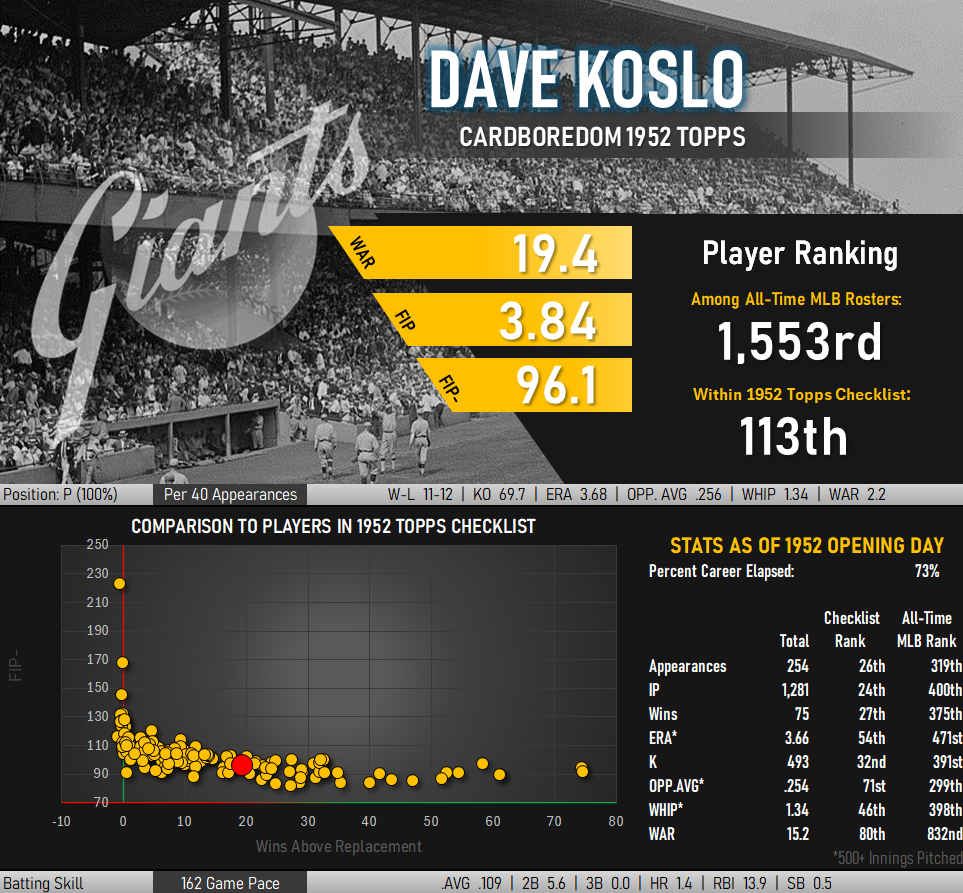
Dave Koslo was a New York Giants pitcher. Judging from his 1949 ERA title, he was more than just an effective pitcher. He averaged a shutout for every 12.6 games he started, the same ratio as Richard’s brief teammate Nolan Ryan.
Also like Richard, Koslo’s arm began giving him trouble as he turned 30 years old. Richard’s issue turned out to be cardiovascular with vision problems and arm pain the bow wave of the health scare that was approaching. Koslo had elbow pain that prompted a move to the bullpen and would drive him out of the majors by 1955. Less than two years later Koslo found himself partially paralyzed after suffering a stroke at age 36.
Postseason Surprise
Since the advent of the live ball era some combination of the Yankees, Giants, or Dodgers had been in 2 out of every 3 World Series. Almost one third of those series was played exclusively between New Yorkers. New York was a baseball town in 1952 and Topps was a New York company. That’s probably why the baseball card maker loaded up the 97-card final series of its 1952 edition with 33 players wearing the uniforms of local clubs. One player from each team (i.e. Mickey Mantle, Jackie Robinson, and Bobby Thomson) were also double printed, making the city’s cards even more prominent.
The 1951 season had concluded with another one of those all too frequent crosstown World Series. The Yankees defeated the Giants in 6 games. Dave Koslo had contributed a win and a loss to that 6 game total, putting him in prime consideration for a card issuance timed to line up with a 1952 postseason that again featured two New York teams.
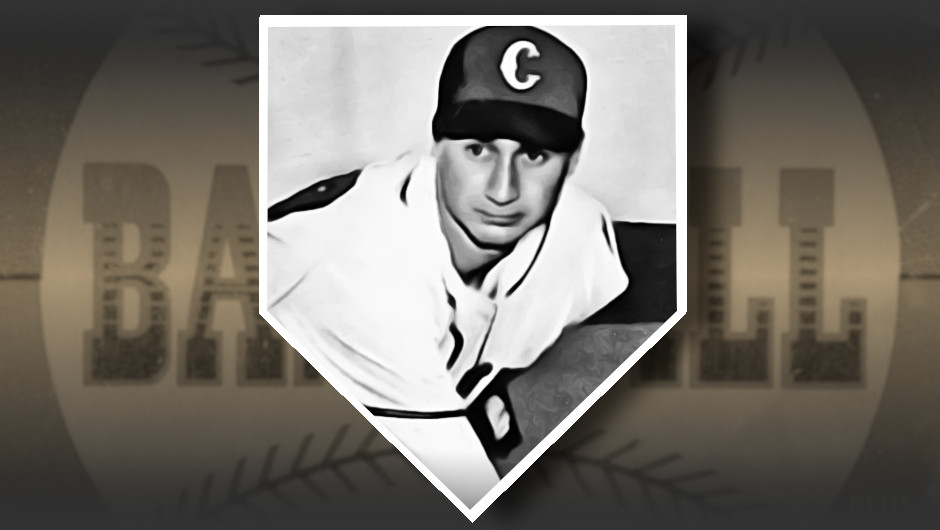
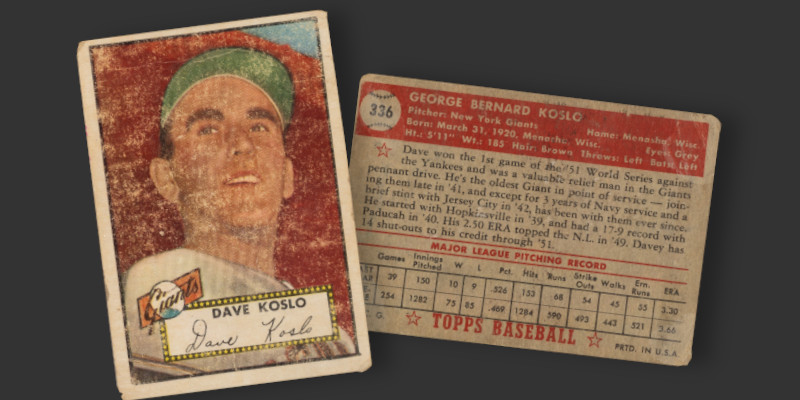
Although he was only 31 years old at the time of the card’s printing, the biographical text on the back notes that he is the Giants’ longest tenured player. That makes him, at that moment in time, the most Giants player who ever Gianted. He even looks like a giant in Topps’ “Giant-sized” card set, with the angle of the image putting his cap near a baseball stadium roofline.
I picked up my copy of this neglected ’52 high number as a castoff from one of the big auction houses last year. Aside from the usual smattering of wrinkles, centering issues, and obliteration of anything resembling a corner, the card has some heavy “snow” across much of the image. This card obviously spent some time being dragged across a sidewalk or some very rough wood floors.
Like an ever increasing number of low grade vintage commons, this one resides inside a PSA slab. So what makes this particular example so compelling? My copy is inside an ancient slab with one of grader’s oldest labels and an exceptionally low serial number. Who was grading stuff like this in the early 1990s? As should be expected, PSA opined that this piece of cardboard should carry a numerical grade of 1 out of 10. However, at the time such a grade identified the card as being in “Poor-Fair” condition rather than the more definitive “Poor.”
Although a bit difficult to see due to the rough condition of my card, that is the facade of Yankee Stadium in the background. As a National League player Koslo would only have set foot into that ballpark for one reason: To play in the World Series. This means the photo used for this card isn’t one of the out of date wire photos so often used by Topps, but rather a snapshot taken during the recent 1951 World Series!