My wife and I are celebrating Mother’s Day weekend with an argument about Kirk Gibson.
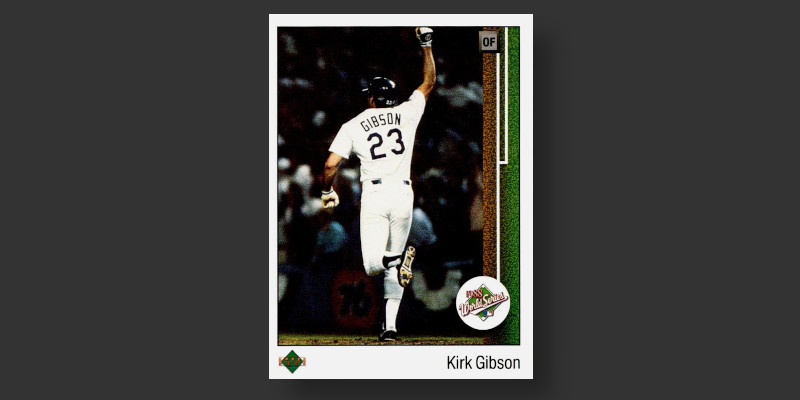
This “discussion,” as it has been styled, centers around a three game road series played by Gibson’s Arizona Diamondbacks against the Texas Rangers in June 2012. Following an 11-3 victory, the postgame Q&A turned a bit strained. With a high school graduation ceremony scheduled the same evening for Gibson’s son Cam, a reporter asked why managerial duties had not been handed off to the Arizona coaching staff so Gibson could attend.
“You’re supposed to graduate,” Gibson answered, as if the response was so self evident that a more developed rebuttal wasn’t needed. He said this with pointed emphasis and an incredulous tone that set my head nodding in agreement. Of course you’re supposed to graduate high school. And good on Gibby for having a relationship that allows the family to break free of unneeded ceremony. My wife is firmly entrenched on the opposite side of this view, seeing this as indicative of a dynamic in which Gibson’s family is resigned to accept boorish behavior rather than make things worse by pressing the issue.
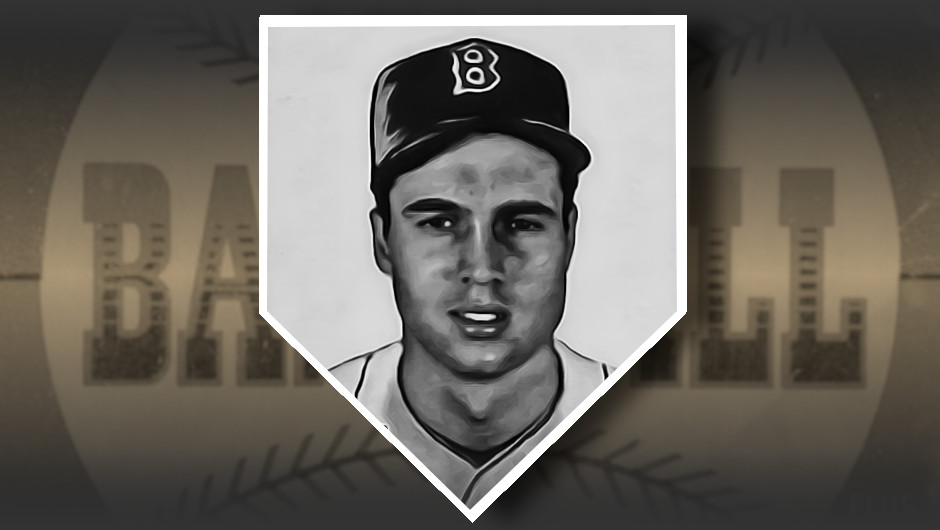
I don’t blame Gibson for any of this unpleasantness. I blame Faye Throneberry.
An aspiring outfielder for the Boston Red Sox, Throneberry is the subject of the next piece of cardboard in my box of 1952 Topps cards. One of the first things any of his biographical sketches mention is the fact that his academic career ended somewhere around the 10th grade. You can’t blame him for not getting the same memo about graduation as Gibson, with Throneberry failing multiple grades before finally moving beyond elementary school. This got me thinking a bit more about Gibson’s assertion about being “supposed to graduate” high school. I know high school wasn’t as widespread in the nineteenth century as it is today. At what point did the light switch flip on and expectations of graduation become embedded in our collective psyche?
To answer this, I turned to the Department of Education’s National Center for Education Statistics and its handy statistical digest. From there, I learned that recently 90.1% of all persons over the age of 25 had a high school diploma, or at least a GED. 9 out of 10 sounds a bit low, which tracks with the offhand nature of Gibson’s remark. Looking a bit further into this, the methodology incorporates a number of older adults from earlier generations where 9 out of 10 would have sounded incredible.
The data starts in 1910 when just 13.5% of those aged 25 and above had graduated. While a large number of adults who came of age in the nineteenth century weighed on this metric, less than one-fifth of 15-18 year olds were actively attending school during this period with many dropping out to join an industrializing workforce by the 10th grade. This starting point coincides with the beginning of the High School Movement, a period spanning three decades in which the country experienced a massive shift in favor of expanding public education and a sustained boom in school construction.
The effects were rapidly seen in the data. By 1930 the percentage of the population with a diploma expanded to 19.1%. That number increased further to 24.5% by 1940. The gravitational drag of earlier, less educated generations weighed on these statistics, which are much more impressive when targeted age cohorts are broken out. That 24.5% figure was buoyed by 73% of all 15-18 year-olds being actively enrolled in high school and represented the tipping point when the median 25-year old had a diploma. Coupled with the aging out of older generations, the graduation rate surpassed 50% of the greater adult population in the 1960s. The expectation of graduation was setting in.
Throneberry left school just prior to 1950, when roughly one third of the population carried a high school diploma. His doing so wasn’t necessarily newsworthy, as Major League rosters of the day were littered with incomplete educations. Phil Cavaretta and Mort Cooper collected NL MVP awards in the 1940s without having ever donned a cap and gown. Despite this, Throneberry’s lack of a graduation date resulted in a minor scandal.
Throneberry was an outstanding athlete as an amateur ballplayer, batting around the .500 mark in high school and American Legion competition. He signed a contract to play with the Detroit Tigers but ran afoul of another outgrowth of the High School Movement: A recently implemented prohibition within MLB against signing players prior to their high school graduation. The commissioner’s office voided the contract. Having been previously held back several grades, Throneberry argued that he would have already graduated had he continued on his original education track. The MLB rules at the time defined a player’s anticipated graduation date in terms of when they started high school, not when they first enrolled in lower levels of education. The decision stood and Throneberry found himself having to wait another two years to get a crack at playing professionally.
The Tigers moved on to other prospects, but the well funded New York Yankees and Boston Red Sox were waiting with offers in hand as Throneberry’s “graduation” date finally arrived. He signed with Boston, and did so with all the optimism of those beautiful, singing idiots of Grease‘s Rydell High. According to an interview cited in his SABR biography, he felt he could break into the lineup as an outfielder on a roster boasting Ted Williams, Dom DiMaggio, and a string of platoon players batting not far below .300.
He got his chance starting in 1952 when Ted Williams was recalled into military service for the Korean War. For Throneberry, this created an opportunity. He posted a positive WAR in his rookie campaign that year, getting legitimate playing time in a major league lineup. Then, at the end of the 1952 season, he was pulled into the Army himself. He wouldn’t return to the majors until 1955.

When you look at Faye Throneberry’s career statistics, the picture that emerges is not particularly flattering. Career WAR of negative 2.9. Career wOBA of .302. Career wRC+ of 77.3. Career batting average of .236. Only two seasons with positive WAR were that rookie campaign in 1952 and his return from the Army in 1955. He was also, by all accounts, a terrible defensive player. When you combine below-average hitting with actively harmful defense, you get a player who doesn’t stay in the starting lineup very long. By 1961, he’d signed with the expansion Los Angeles Angels, where he primarily served as a pinch hitter. His younger brother, Marv, signed with the expansion New York Mets that same period. Marv would become more famous than Faye, though largely for being comically bad. He became known as “Marvelous Marv” in that distinctly sarcastic New York way. Marv had also experienced teenage fatherhood in high school, so the Throneberry brothers were clearly living their lives at a different velocity than the folks who stuck around for graduation ceremonies and college application essays.
There was a time in American history when high school graduation was itself a very big deal. When fewer than one in five people had a diploma, completing high school meant something. It marked you as someone who’d stuck it out, who’d had the resources and determination and probably the economic room to finish. It was an achievement rather than an expectation.
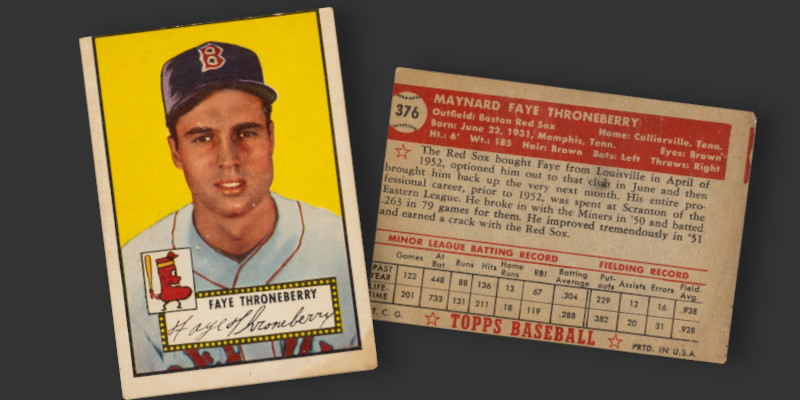
My 1952 Topps Faye Throneberry card sits in my collection as a memento of all of this. Someone at Topps apparently flunked their elementary school instruction on how to use scissors, miscutting it from top to bottom. The top border is almost missing in its entirety. The back is somehow more miscut than the front, capturing some of the red color block design elements of the next card down on the printing sheet, which was presumably card number 386 of the Cardinals’ Eddie Yuhas. The text on the back of the card mentions his callup from the minor leagues in July 1952, indicating the biographical text wasn’t prepared until most of the season had already passed. Aside from the centering issue, my card has VG condition corners and a little bit of oxidation toning on the lower right corner from sticking out of a tightly packed stack of cards for an extended period of time. It’s one of the true rookie cards in the high number series of 1952 Topps, with Throneberry having zero MLB experience prior to the beginning of the season.
The card is imperfect, just like the player it depicts. Faye never became a star. He got held back twice in elementary school, dropped out of high school in tenth grade, had his first professional contract voided by a commissioner citing bureaucratic technicalities, managed a couple of positive WAR seasons in a largely forgettable career, and ended his time in the majors as a pinch hitter for an expansion team. By conventional metrics, this is not a success story. And yet he made it to the major leagues. He played alongside Ted Williams and Dom DiMaggio. He got his own baseball card, even if the person cutting it at the printing facility may have been drunk. In a world where sixty-seven percent of his peers hadn’t graduated high school in 1950, Faye Throneberry took the path that made sense to him. He chose the diamond over the diploma, and he got to spend a few years playing a game he loved at the highest level, even if his defensive metrics suggest he probably should have spent more time on fundamentals.