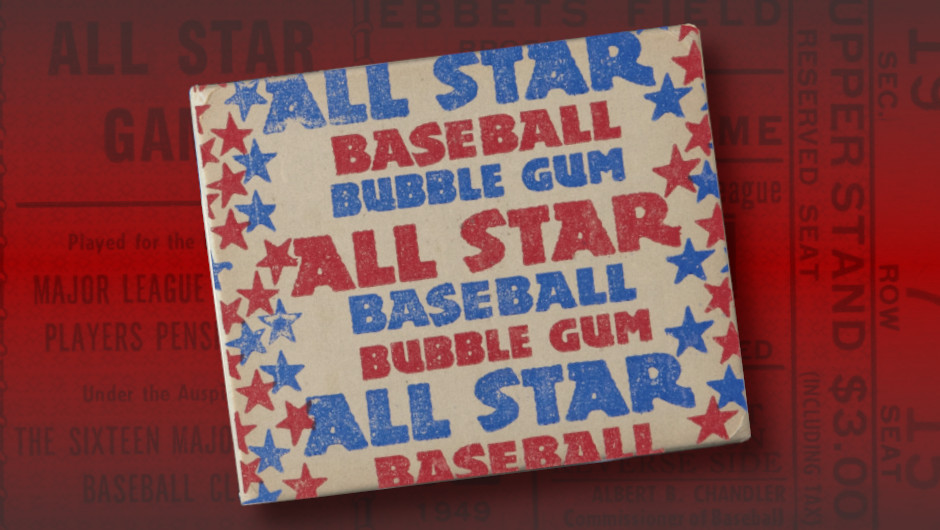
The colorful postwar Leaf Gum cards are a 1949 issue, not 1948. As with nearly every area of life, I find it helpful to step back and look at some cards from the Junk Wax Era.
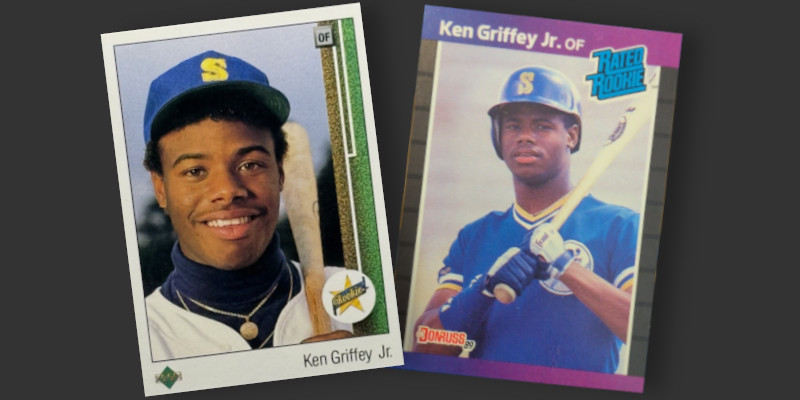
When you pull a 1989 Upper Deck, or perhaps the purple bordered Rated Rookie Ken Griffey, Jr. from your collection, nearly four decades after they popped out of a pack there is zero confusion about what you are holding. The airbrushed hat, big smile, and hologram immediately anchor the Upper Deck card to a specific point in collecting history. The same goes for the purple borders and blue “Rated Rookie” logo on the Donruss card. Everyone viewing its image of a teenage Junior trying to look comfortable at Spring Training knows this card and calls it the same thing. It’s 1989 Donruss with no further debates. Everyone immediately enters the same identifying terms into a search engine or flips to the same chronological page in their price guide. This kind of universal agreement allows collectors to communicate without friction, feeling like it has always been the natural order of things. It hasn’t.
Go back another 40 years from Griffey’s rookie cards to the genesis of the postwar card boom and you will find a set so frustratingly misidentified that it has sparked debates lasting longer than some marriages. The Leaf Candy Company’s foray into postwar baseball consists of 98 cards spread across two series. It has been variously referred to as 1948 Leaf, 1948-49 Leaf, and 1949 Leaf depending on which price guide you consulted, which grading service slabbed your cards, or apparently which side of the bed the cataloger woke up on that morning. The second series wasn’t even fully confirmed in size and scope until 20 years after the cards first appeared.
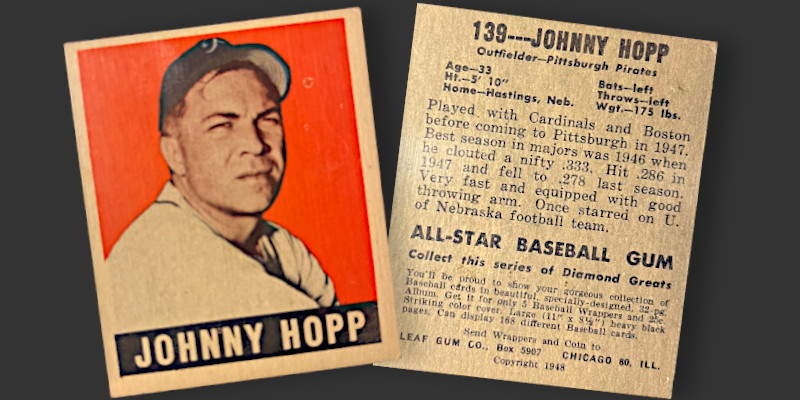
The confusion starts, as most taxonomic disasters do, with copyright dates. Flip over a Leaf card and you’ll see copyright dates of either 1948 to 1949, which is about as helpful as a map with two different “You Are Here” markers. When Jefferson Burdick was cataloging cards for his American Card Catalog, the Rosetta Stone of early collecting, he did what any reasonable person would do when confronted with a 1948 copyright: He labeled the set R-401 and called it a 1948 issue. Hobby publications of the 1960s, like good disciples, adopted Burdick’s dating with little questioning. This was gospel, handed down from the mountain, and who were they to argue with the man who had systematically organized the entire known universe of collectible cards? A few included notes in their descriptions that the cards were “issued through 1949” or that these were part of a “1948-1949” release, though their primary focus was more on finding collectors who had extras they were willing to part with.
In February 1979 Dr. James Beckett and Dennis Eckes published the Sport Americana Baseball Card Price Guide, a publication that would eventually become to the hobby what the Oxford English Dictionary is to language. They looked at those mixed copyright dates and decided to split the baby, calling the set 1948-49 Leaf. This followed the precedent of other multi-year issues like the legendary 1909-1911 T-206 tobacco cards or the 1934-36 Diamond Stars, the latter actually having cards of the same players with multiple copyright dates to choose from. The Leaf approach seemed reasonable enough, a nice compromise that acknowledged both dates without committing fully to either.
Fast forward to today and digital databases and third-party grading services, those plastic-entombing arbiters of authenticity and condition, can’t even agree on a consistent nomenclature. TCDB and COMC both identify cards from this set as being “1948-49 Leaf.” PSA, the 800-pound gorilla of the grading world, slabs these cards as “1948 Leaf” with all the confidence of a Georgian parson declaring the Earth to be 6,000 years old. SGC has long gone with “1948-49 Leaf Gum Co” on their labels, hedging their bets like a gambler who can’t decide which horse to back. CSG goes the PSA route and simply leaves it at “1948 Leaf.” Meanwhile, Beckett’s various grading services, Beckett Vintage Grading, Beckett Grading Service, and their discount option Beckett Collectors Club Grading all label these as “1949 Leaf.” It’s chaos. It’s like asking five people what to call a submarine sandwich and getting back hoagie, sub, grinder, hero, and “big honkin’ sammich” as answers.
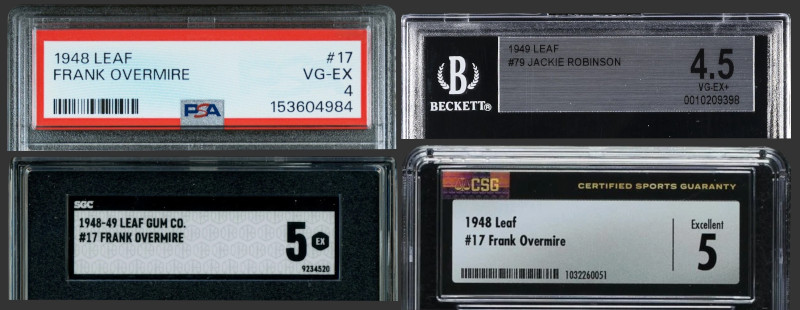
Debate about the issuance of these cards has been percolating in the hobby for decades, and this is key, there are zero contemporary accounts of someone opening these cards in 1948. None. Zero diary entries. No letters to friends. The inhabitants of 1948 are completely silent on the issue. After an ownership change, the Beckett price guides switched in the mid-’90s from calling this 1948-49 to simply 1949 Leaf, a decision that raised more than a few eyebrows among the vintage dealer community.
Of course, absence of evidence is not evidence of absence. There was more behind this editorial decision than just a growing awareness of the lack of contemporary references.
Enter Ted Zanadakis, a collector from Hillside, New Jersey, who grew up two blocks away from Phil Rizzuto and had the distinct privilege of actually opening packs of these cards when they first appeared. Not in 1948. In March 1949. At his local store. Ted remembered it clearly, buying hundreds of first series cards, completely unaware that a second series even existed. He managed to complete the full 49-card first series and then did what most kids do with hobbies: He grew up and moved on with his life, returning to collecting in 1977 only to discover, to his considerable surprise, that there were another 49 cards he had never seen.
Ted wasn’t content to just shrug and accept the hobby’s consensus dating. He went full detective mode. In 1981, he tracked down and interviewed a Leaf production employee as well as George Moll, cofounder of Bowman Gum, Leaf’s chief competitor and eventual courtroom adversary. He photographed a complete uncut sheet of the 49-card first series in 1988, a sheet that contained 33 cards with 1949 copyrights and 16 with 1948 copyrights. This is where the logic tightens: Those 1949 copyrights wouldn’t have existed in 1948, which means the sheet was only printed and distributed after January 1, 1949. The same copyright split exists on the second series sheet. Printing cards with 1949 copyrights in 1948 is legally…problematic.
Ted also noticed something else. Regardless of copyright dates, the backs of these cards list player ages, not dates of birth, and every single age is calculated based on the year being 1949. Multiple cards reference events that took place in November or December 1948, events that would have been impossible to reference if the cards had been printed earlier in 1948. Lou Boudreau’s card with a 1948 copyright is the smoking gun here. The biographical text on this first series card mentions his winning the 1948 American League MVP, an award that wasn’t announced until November 30, 1948. Given that these cards were printed on the same production sheet as other first series cards, basic logic dictates they couldn’t have existed until late December 1948 at the absolute earliest, and more realistically not until early 1949 when they could actually be distributed.
Ted wrote up his findings in the Fall 2006 edition of Old Cardboard and became something of a zealot on the topic. Anyone who asked him about the set got directed to that article, which became required reading for anyone who wanted to actually understand these cards rather than just repeat whatever received wisdom happened to come their way. In it, he lays out the four primary pillars supporting his argument that every one of the Leaf cards were issued in 1949.
But wait, there’s more. In December 2024, inspired by Brian Kappel’s book Re: Leaf, John Racanelli published an article on the SABR Baseball Card blog that brought out the big guns in its focus on the lawsuits between Bowman and Leaf. These sworn-under-oath legal documents provided exact dates. Leaf shipped its first cards to Boston on March 14, 1949. Bowman noticed immediately and fired off a cease and desist letter like an overzealous HOA board member spotting someone stepping on their lawn. A lawsuit was filed on March 21, 1949. Leaf, in their legal response, admitted that March 14, 1949 was indeed when cards first shipped to Boston. This isn’t speculation or foggy childhood memory or copyright date interpretation. This is a company, in legal proceedings where perjury is a crime, stating exactly when they distributed their product.
Racanelli makes the entirely sensible observation that if Leaf’s products had appeared on store shelves in 1948, Bowman, seeing the threat to its own sales, would have commenced legal action much earlier. Bowman wasn’t exactly known for their patience when it came to competition. Racanelli writes, “All evidence from this case, including Leaf’s own admissions, unequivocally confirms that the Leaf cards were first distributed in March 1949, to time availability with the opening of the 1949 season. Leaf had previously distributed its football cards in 1948 during the football season. This should put to rest any continuing questions whether the cards were distributed in 1948 and that the hobby should simply consider this a 1949 issue.”
This looks pretty conclusive.
So what does this mean for collectors beyond settling a decades-long argument? First, we can finally classify this set as a 1949 issue and place it in proper context with other issues of its time. Second, and this is where things get uncomfortable, several cards previously recognized as rookie cards are in fact not rookies. If Leaf is indeed a 1949 issue, and players appeared in 1948 Bowman, those Bowman cards are their rookies, not the Leaf cards.
Does this even matter? It is widely recognized within the hobby that a person referring to the 1952 Topps Mantle as his rookie card knows absolutely nothing about baseball cards, but the hobby almost universally holds it to be the ultimate representation of the player. Nobody disputes Jackie Robinson’s debut came after his Bond Bread issues of 1947, which are the closest thing he has to a true rookie card depending on your definition of how widely released a rookie card must be. Robinson, and the ’49 Leaf issues of key names like Satchel Paige, will almost certainly remain the centerpieces of those players’ cardboard legacy, even if they have to share a bit of the spotlight with their more common Bowman counterparts. It’s the story that counts.
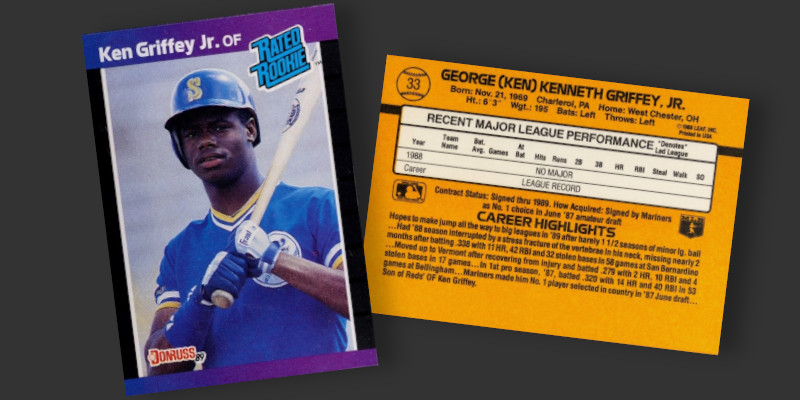
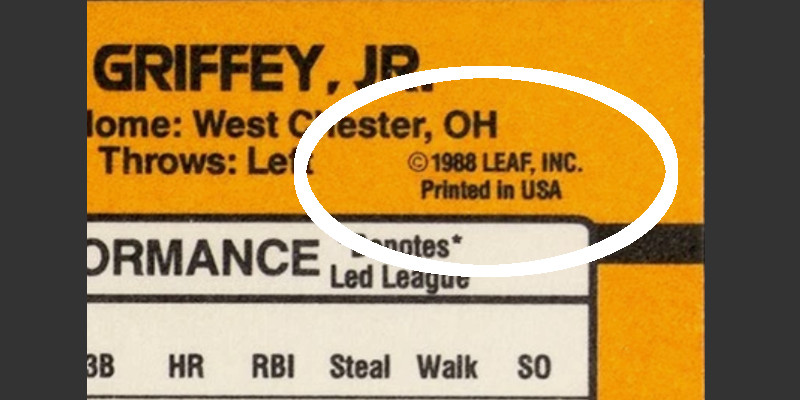
Here’s where the irony gets delicious. The 1989 Donruss Ken Griffey Jr. Rated Rookie, that card we started with, contains a 1988 copyright date and hit store shelves in late December 1988. Not a single hobby source, not one, refers to this as a 1988 issue or even a 1988-89 release. Nobody. The publishing cadence of baseball cards was well established within the hobby by then, and formal classification systems had been set up and accepted by the great majority of collectors. If someone wants to be adamant about calling the Leaf cards a 48-49 issue based on copyright dates, they must also be dogmatic enough to say Griffey’s only rookie is a 1988-89 Donruss issue and not one of his various other 1989 issues, such as Upper Deck. No sane collector will ever identify 1989 Donruss as a 1988 or 1988-89 issue, and applying that same sheer logic to the 1949 versus 1948-49 Leaf debate should land them squarely in the camp of referring to the cards as a 1949 issue.
Jim Beckett initially resisted calls to change the references to the Leaf set from 1948-49 to 1949, and he had his reasons. He’d built long-standing relationships with most of the dealer community, many of whom were either upset at the prospect of having their “rookie” cards demoted or experiencing the cognitive dissonance of having their foundational knowledge of the hobby’s history shift beneath their feet. Card collectors (myself included) are a dogmatic, outspoken bunch, and in my reading between the lines from a distance Beckett didn’t particularly want to deal with their whining/chirping. He has said almost as much in subsequent public comments, though he did so with the tact and diplomatic phrasing that has long marked his career. Over time he moved from the copyright influenced dual dating regime to an ever shrinking set of increasingly improbable scenarios that could still allow 1948 to be part of the naming convention. Beckett experienced a health scare in the mid-1990s, prompting him to reevaluate priorities and sell his eponymous price guide business. Freed from the relationships the founder had established, new leadership instituted changes, including renaming 1948-49 Leaf to 1949 in the pages of the monthly price guides and using 1949 Leaf in the identification of cards submitted to their grading services.
Old habits die hard, though. The evidence is overwhelming at this point. Ted Zanadakis’s firsthand account, corroborated by other collectors who maintained contemporary journals of their pack purchases. The uncut sheets with their legally binding 1949 copyrights. The biographical references to late 1948 events. The legal documents with specific shipping dates. And yet PSA and CSG still slab these cards as 1948 Leaf, like cartographers still drawing sea monsters on maps long after we’d sailed those waters and found nothing but fish.
However, the tide is turning. Collectors willing to put in the time and effort to understand these cards, to actually read the evidence rather than just repeat what they heard from some dealer at a card show in 1987, are coming into alignment on this being a 1949 issue. The old guard who grew up with the American Card Catalog as their Bible is passing away, and with them will go the references to 1948. It’s a generational shift, a slow-moving tectonic change that reshapes the landscape without anyone noticing until one day they wake up and realize the mountains anchoring their reference point have moved.
The 1949 Leaf set deserves to be properly dated, not because it changes the cards themselves or makes them more or less valuable or more or less beautiful, but because accuracy matters. When we talk about these cards, when we catalog them and price them and grade them and buy them and sell them, we should be speaking the same language. Any collector should be able to pull a card from a box and identify it without confusion, the way we can with that 1989 Donruss Griffey.